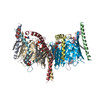
Movie
Movie Controller


+ Open data

- Basic information
| Entry | Database: PDB / ID: 9eii | ||||||||||||||||||||||||
|---|---|---|---|---|---|---|---|---|---|---|---|---|---|---|---|---|---|---|---|---|---|---|---|---|---|
| Title | Import stalled PINK1 TOM complex, symmetry expanded | ||||||||||||||||||||||||
 Components Components |
| ||||||||||||||||||||||||
 Keywords Keywords | TRANSLOCASE / PINK1 / TOM complex / VDAC | ||||||||||||||||||||||||
| Function / homology |  Function and homology information Function and homology informationmitochondrial outer membrane permeabilization / positive regulation of cristae formation / positive regulation of free ubiquitin chain polymerization / tRNA import into mitochondrion / TOM complex / mitochondrial transmembrane transport / binding of sperm to zona pellucida / regulation of protein localization to mitochondrion / Mitochondrial calcium ion transport / voltage-gated monoatomic anion channel activity ...mitochondrial outer membrane permeabilization / positive regulation of cristae formation / positive regulation of free ubiquitin chain polymerization / tRNA import into mitochondrion / TOM complex / mitochondrial transmembrane transport / binding of sperm to zona pellucida / regulation of protein localization to mitochondrion / Mitochondrial calcium ion transport / voltage-gated monoatomic anion channel activity / mitochondrion to lysosome vesicle-mediated transport / maintenance of protein location in mitochondrion / response to 3,3',5-triiodo-L-thyronine / protein kinase B binding / mitochondrial outer membrane translocase complex / cellular response to hydrogen sulfide / mitochondrion targeting sequence binding / regulation of autophagy of mitochondrion / ceramide binding / positive regulation of mitochondrial electron transport, NADH to ubiquinone / protein insertion into mitochondrial outer membrane / phospholipid scramblase activity / regulation of oxidative phosphorylation / C3HC4-type RING finger domain binding / negative regulation of hypoxia-induced intrinsic apoptotic signaling pathway / regulation of synaptic vesicle transport / negative regulation of hydrogen peroxide-induced neuron intrinsic apoptotic signaling pathway / migrasome / negative regulation of autophagosome assembly / regulation of hydrogen peroxide metabolic process / regulation of cellular response to oxidative stress / positive regulation of type 2 mitophagy / autophagy of mitochondrion / voltage-gated monoatomic ion channel activity / phosphatidylcholine binding / oxysterol binding / mitochondria-associated endoplasmic reticulum membrane contact site / negative regulation of mitophagy / Mitochondrial protein import / cellular response to toxic substance / regulation of mitochondrion organization / negative regulation of oxidative stress-induced neuron intrinsic apoptotic signaling pathway / TORC2 signaling / monoatomic anion transport / negative regulation of JNK cascade / negative regulation of reactive oxygen species metabolic process / regulation of reactive oxygen species metabolic process / phospholipid translocation / response to muscle activity / peptidase activator activity / positive regulation of mitochondrial fission / positive regulation of protein localization to mitochondrion / negative regulation of intrinsic apoptotic signaling pathway / FOXO-mediated transcription of cell death genes / astrocyte projection / negative regulation of intrinsic apoptotic signaling pathway in response to hydrogen peroxide / hemopoiesis / protein import into mitochondrial matrix / positive regulation of release of cytochrome c from mitochondria / Lewy body / cholesterol binding / positive regulation of macroautophagy / positive regulation of ATP biosynthetic process / regulation of protein ubiquitination / mitochondrial nucleoid / protein localization to mitochondrion / transmembrane protein transporter activity / regulation of protein-containing complex assembly / protein targeting / negative regulation of macroautophagy / mitophagy / response to ischemia / negative regulation of mitochondrial fission / regulation of mitochondrial membrane potential / sperm midpiece / acrosomal vesicle / positive regulation of protein ubiquitination / regulation of proteasomal protein catabolic process / respiratory electron transport chain / macroautophagy / mitochondrion organization / cell periphery / PINK1-PRKN Mediated Mitophagy / regulation of protein stability / positive regulation of translation / mitochondrial intermembrane space / kinase activity / kinase binding / mitochondrial membrane / negative regulation of neuron apoptotic process / growth cone / protease binding / cellular response to oxidative stress / response to oxidative stress / cell body / ubiquitin-dependent protein catabolic process / positive regulation of phosphatidylinositol 3-kinase/protein kinase B signal transduction / cytoskeleton / cellular response to hypoxia / regulation of apoptotic process Similarity search - Function | ||||||||||||||||||||||||
| Biological species |  Homo sapiens (human) Homo sapiens (human) | ||||||||||||||||||||||||
| Method | ELECTRON MICROSCOPY / single particle reconstruction / cryo EM / Resolution: 2.75 Å | ||||||||||||||||||||||||
 Authors Authors | Kirk, N.S. / Glukhova, A. / Callegari, S. / Komander, D. | ||||||||||||||||||||||||
| Funding support |  Australia, 2items Australia, 2items
| ||||||||||||||||||||||||
 Citation Citation | Journal: Science / Year: 2025 Title: Structure of human PINK1 at a mitochondrial TOM-VDAC array. Authors: Sylvie Callegari / Nicholas S Kirk / Zhong Yan Gan / Toby Dite / Simon A Cobbold / Andrew Leis / Laura F Dagley / Alisa Glukhova / David Komander / Abstract: Mutations in the ubiquitin kinase PINK1 cause early-onset Parkinson's disease, but how PINK1 is stabilized at depolarized mitochondrial translocase complexes has remained poorly understood. We ...Mutations in the ubiquitin kinase PINK1 cause early-onset Parkinson's disease, but how PINK1 is stabilized at depolarized mitochondrial translocase complexes has remained poorly understood. We determined a 3.1-angstrom resolution cryo-electron microscopy structure of dimeric human PINK1 stabilized at an endogenous array of mitochondrial translocase of the outer membrane (TOM) and voltage-dependent anion channel (VDAC) complexes. Symmetric arrangement of two TOM core complexes around a central VDAC2 dimer is facilitated by TOM5 and TOM20, both of which also bind PINK1 kinase C-lobes. PINK1 enters mitochondria through the proximal TOM40 barrel of the TOM core complex, guided by TOM7 and TOM22. Our structure explains how human PINK1 is stabilized at the TOM complex and regulated by oxidation, uncovers a previously unknown TOM-VDAC assembly, and reveals how a physiological substrate traverses TOM40 during translocation. | ||||||||||||||||||||||||
| History |
|
- Structure visualization
| Structure viewer | Molecule: MolmilJmol/JSmol |
|---|
- Downloads & links
-Download
| PDBx/mmCIF format | 9eii.cif.gz | 374.4 KB | Display | PDBx/mmCIF format |
|---|---|---|---|---|
| PDB format | pdb9eii.ent.gz | 297.3 KB | Display | PDB format |
| PDBx/mmJSON format | 9eii.json.gz | Tree view | PDBx/mmJSON format | |
| Others |  Other downloads Other downloads |
-Validation report
| Arichive directory | https://data.pdbj.org/pub/pdb/validation_reports/ei/9eiiftp://data.pdbj.org/pub/pdb/validation_reports/ei/9eii | HTTPS FTP |
|---|
-Related structure data
| Related structure data |  48084MC 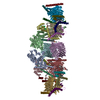 9eihC 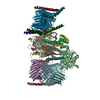 9eijC M: map data used to model this data C: citing same article ( |
|---|---|
| Similar structure data |
-Links
 PDBj
PDBj
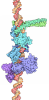

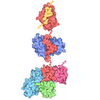
- Assembly
| Deposited unit | 
|
|---|---|
| 1 |
|
-Components
-Protein , 2 types, 2 molecules BF
| #1: Protein | Mass: 65561.562 Da / Num. of mol.: 1 Source method: isolated from a genetically manipulated source Source: (gene. exp.) Homo sapiens (human) / Gene: PINK1 / Cell line (production host): Expi293 / Production host: Homo sapiens (human)References: UniProt: Q9BXM7, non-specific serine/threonine protein kinase |
|---|---|
| #3: Protein | Mass: 31600.445 Da / Num. of mol.: 1 / Source method: isolated from a natural source / Source: (natural) Homo sapiens (human) / Cell line: Expi293 / References: UniProt: P45880 |
-Mitochondrial import receptor subunit ... , 6 types, 11 molecules DIJLZNXPVRT
| #2: Protein | Mass: 16319.862 Da / Num. of mol.: 1 / Source method: isolated from a natural source / Source: (natural) Homo sapiens (human) / Cell line: Expi293 / References: UniProt: Q15388 | ||||||||
|---|---|---|---|---|---|---|---|---|---|
| #4: Protein | Mass: 37926.926 Da / Num. of mol.: 2 / Source method: isolated from a natural source / Source: (natural) Homo sapiens (human) / Cell line: Expi293 / References: UniProt: O96008#5: Protein | Mass: 6045.318 Da / Num. of mol.: 2 / Source method: isolated from a natural source / Source: (natural) Homo sapiens (human) / Cell line: Expi293 / References: UniProt: Q8N4H5#6: Protein | Mass: 6256.473 Da / Num. of mol.: 2 / Source method: isolated from a natural source / Source: (natural) Homo sapiens (human) / Cell line: Expi293 / References: UniProt: Q9P0U1#7: Protein | Mass: 8007.988 Da / Num. of mol.: 2 / Source method: isolated from a natural source / Source: (natural) Homo sapiens (human) / Cell line: Expi293 / References: UniProt: Q96B49#8: Protein | Mass: 15532.528 Da / Num. of mol.: 2 / Source method: isolated from a natural source / Source: (natural) Homo sapiens (human) / Cell line: Expi293 / References: UniProt: Q9NS69 |
-Non-polymers , 1 types, 9 molecules 
| #9: Chemical | ChemComp-PC1 / 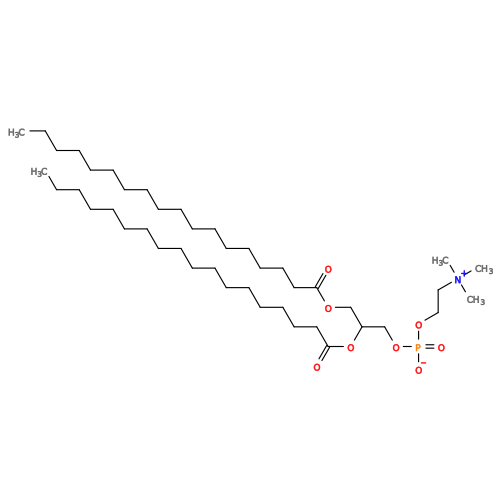 Mass: 790.145 Da / Num. of mol.: 9 / Source method: obtained synthetically / Formula: C44H88NO8P / Comment: phospholipid*YM Mass: 790.145 Da / Num. of mol.: 9 / Source method: obtained synthetically / Formula: C44H88NO8P / Comment: phospholipid*YM |
|---|
-Details
| Has ligand of interest | N |
|---|---|
| Has protein modification | Y |
-Experimental details
-Experiment
| Experiment | Method: ELECTRON MICROSCOPY |
|---|---|
| EM experiment | Aggregation state: PARTICLE / 3D reconstruction method: single particle reconstruction |
- Sample preparation
| Component | Name: Complex of VDAC, TOM core and PINK1 / Type: COMPLEX / Entity ID: #1-#8 / Source: RECOMBINANT |
|---|---|
| Molecular weight | Value: 0.75 MDa / Experimental value: NO |
| Source (natural) | Organism: Homo sapiens (human) |
| Source (recombinant) | Organism: Homo sapiens (human) / Strain: EXPI293 |
| Buffer solution | pH: 7.4 |
| Specimen | Conc.: 4.3 mg/ml / Embedding applied: NO / Shadowing applied: NO / Staining applied: NO / Vitrification applied: YES |
| Vitrification | Instrument: FEI VITROBOT MARK IV / Cryogen name: ETHANE / Humidity: 90 % / Chamber temperature: 277 K / Details: Blot force 10 for 2 s. |
- Electron microscopy imaging
| Experimental equipment |  Model: Titan Krios / Image courtesy: FEI Company |
|---|---|
| Microscopy | Model: TFS KRIOS |
| Electron gun | Electron source:  FIELD EMISSION GUN / Accelerating voltage: 300 kV / Illumination mode: FLOOD BEAM FIELD EMISSION GUN / Accelerating voltage: 300 kV / Illumination mode: FLOOD BEAM |
| Electron lens | Mode: BRIGHT FIELD / Nominal magnification: 105000 X / Nominal defocus max: 2000 nm / Nominal defocus min: 500 nm / Cs: 2.7 mm / C2 aperture diameter: 50 µm |
| Specimen holder | Cryogen: NITROGEN / Specimen holder model: FEI TITAN KRIOS AUTOGRID HOLDER |
| Image recording | Average exposure time: 3.34 sec. / Electron dose: 52.4 e/Å2 / Film or detector model: GATAN K3 BIOQUANTUM (6k x 4k) / Num. of grids imaged: 2 / Num. of real images: 16992 |
- Processing
| EM software |
| ||||||||||||||||||||||||||||||||||||||||||||||||
|---|---|---|---|---|---|---|---|---|---|---|---|---|---|---|---|---|---|---|---|---|---|---|---|---|---|---|---|---|---|---|---|---|---|---|---|---|---|---|---|---|---|---|---|---|---|---|---|---|---|
| CTF correction | Details: Patch CTF / Type: PHASE FLIPPING AND AMPLITUDE CORRECTION | ||||||||||||||||||||||||||||||||||||||||||||||||
| Particle selection | Num. of particles selected: 5700000 / Details: Picked using low resolution templates | ||||||||||||||||||||||||||||||||||||||||||||||||
| 3D reconstruction | Resolution: 2.75 Å / Resolution method: FSC 0.143 CUT-OFF / Num. of particles: 791000 / Symmetry type: POINT | ||||||||||||||||||||||||||||||||||||||||||||||||
| Atomic model building |
| ||||||||||||||||||||||||||||||||||||||||||||||||
| Atomic model building |
| ||||||||||||||||||||||||||||||||||||||||||||||||
| Refinement | Highest resolution: 2.75 Å Stereochemistry target values: REAL-SPACE (WEIGHTED MAP SUM AT ATOM CENTERS) | ||||||||||||||||||||||||||||||||||||||||||||||||
| Refine LS restraints |
|