 Movie
Movie Controller

[English] 日本語
 Yorodumi
- PDB-9e9e: Structure of AMPA receptor GluA2 and auxiliary subunit TARP gamma... -
+ Open data

- Basic information
| Entry | Database: PDB / ID: 9e9e | ||||||||||||||||||||||||
|---|---|---|---|---|---|---|---|---|---|---|---|---|---|---|---|---|---|---|---|---|---|---|---|---|---|
| Title | Structure of AMPA receptor GluA2 and auxiliary subunit TARP gamma-2 (LBD-TMD) in complex with anti-miR 17 oligonucleotide RGLS4326 | ||||||||||||||||||||||||
 Components Components | Isoform Flip of Glutamate receptor 2,Voltage-dependent calcium channel gamma-2 subunit | ||||||||||||||||||||||||
 Keywords Keywords | SIGNALING PROTEIN / AMPA receptor / TARP gamma-2 / ion channel / anti-miR 17 / oligonucleotide | ||||||||||||||||||||||||
| Function / homology |  Function and homology information Function and homology informationPresynaptic depolarization and calcium channel opening / eye blink reflex / positive regulation of protein localization to basolateral plasma membrane / positive regulation of AMPA receptor activity / cerebellar mossy fiber / LGI-ADAM interactions / Trafficking of AMPA receptors / postsynaptic neurotransmitter receptor diffusion trapping / membrane hyperpolarization / regulation of AMPA receptor activity ...Presynaptic depolarization and calcium channel opening / eye blink reflex / positive regulation of protein localization to basolateral plasma membrane / positive regulation of AMPA receptor activity / cerebellar mossy fiber / LGI-ADAM interactions / Trafficking of AMPA receptors / postsynaptic neurotransmitter receptor diffusion trapping / membrane hyperpolarization / regulation of AMPA receptor activity / channel regulator activity / protein targeting to membrane / nervous system process / voltage-gated calcium channel complex / regulation of synaptic plasticity by chemical substance / spine synapse / dendritic spine neck / dendritic spine cytoplasm / dendritic spine head / cellular response to amine stimulus / Activation of AMPA receptors / neurotransmitter receptor localization to postsynaptic specialization membrane / ligand-gated monoatomic cation channel activity / perisynaptic space / Trafficking of GluR2-containing AMPA receptors / response to lithium ion / AMPA glutamate receptor activity / AMPA glutamate receptor clustering / transmission of nerve impulse / regulation of receptor recycling / neuromuscular junction development / kainate selective glutamate receptor activity / immunoglobulin binding / AMPA glutamate receptor complex / extracellularly glutamate-gated ion channel activity / ionotropic glutamate receptor complex / cellular response to glycine / membrane depolarization / asymmetric synapse / Unblocking of NMDA receptors, glutamate binding and activation / glutamate receptor binding / positive regulation of synaptic transmission / conditioned place preference / regulation of postsynaptic membrane neurotransmitter receptor levels / regulation of synaptic transmission, glutamatergic / response to fungicide / voltage-gated calcium channel activity / cytoskeletal protein binding / extracellular ligand-gated monoatomic ion channel activity / glutamate-gated receptor activity / cellular response to brain-derived neurotrophic factor stimulus / regulation of long-term synaptic depression / positive regulation of synaptic transmission, glutamatergic / glutamate-gated calcium ion channel activity / somatodendritic compartment / presynaptic active zone membrane / ionotropic glutamate receptor binding / ionotropic glutamate receptor signaling pathway / excitatory synapse / ligand-gated monoatomic ion channel activity involved in regulation of presynaptic membrane potential / dendrite membrane / dendrite cytoplasm / positive regulation of excitatory postsynaptic potential / hippocampal mossy fiber to CA3 synapse / dendritic shaft / synaptic membrane / SNARE binding / PDZ domain binding / calcium channel regulator activity / establishment of protein localization / synaptic transmission, glutamatergic / protein tetramerization / long-term synaptic potentiation / transmitter-gated monoatomic ion channel activity involved in regulation of postsynaptic membrane potential / receptor internalization / cerebral cortex development / response to calcium ion / regulation of membrane potential / postsynaptic density membrane / modulation of chemical synaptic transmission / Schaffer collateral - CA1 synapse / terminal bouton / synaptic vesicle membrane / synaptic vesicle / amyloid-beta binding / presynapse / growth cone / signaling receptor activity / scaffold protein binding / presynaptic membrane / chemical synaptic transmission / dendritic spine / perikaryon / postsynaptic membrane / postsynaptic density / neuron projection / external side of plasma membrane / axon / neuronal cell body / dendrite Similarity search - Function | ||||||||||||||||||||||||
| Biological species |   Rattus norvegicus (Norway rat) Rattus norvegicus (Norway rat) | ||||||||||||||||||||||||
| Method | ELECTRON MICROSCOPY / single particle reconstruction / cryo EM / Resolution: 3.24 Å | ||||||||||||||||||||||||
 Authors Authors | Yen, L.Y. / Gangwar, S.P. / Yelshanskaya, M.V. / Sobolevsky, A.I. | ||||||||||||||||||||||||
| Funding support |  United States, 2items United States, 2items
| ||||||||||||||||||||||||
 Citation Citation | Journal: Nat Commun / Year: 2025 Title: The nucleobase guanine at the 3'-terminus of oligonucleotide RGLS4326 drives off-target AMPAR inhibition and CNS toxicity. Authors: Tania Valencia / Laura Y Yen / Cindy Berman / Thomas Vincent / Scott Davis / Francesca Varrone / Jianfeng Huang / Jessica Mastroianni / Morgan Carlson / Tate Owen / Amin Kamel / Denis Drygin ...Authors: Tania Valencia / Laura Y Yen / Cindy Berman / Thomas Vincent / Scott Davis / Francesca Varrone / Jianfeng Huang / Jessica Mastroianni / Morgan Carlson / Tate Owen / Amin Kamel / Denis Drygin / Garth A Kinberger / Shanti Pal Gangwar / Maria V Yelshanskaya / John Ridley / Robert Kirby / Jesus Alvarez / Ronak Lakhia / Vishal Patel / Alexander I Sobolevsky / Edmund C Lee /  Abstract: Designing safe and effective oligonucleotide (ON) therapeutics requires thorough understanding of structural-activity relationship (SAR) with the intended on-target(s) as well as the unintended off- ...Designing safe and effective oligonucleotide (ON) therapeutics requires thorough understanding of structural-activity relationship (SAR) with the intended on-target(s) as well as the unintended off-target(s). Despite encouraging pharmacodynamic activity in a Phase 1b study, development of the first-generation anti-miR-17 ON RGLS4326 for the treatment of autosomal dominant polycystic kidney disease was discontinued due to dose-limiting central nervous system (CNS)-related toxicity observed in nonclinical chronic toxicity studies. Here, we provide SAR evidence that the nucleobase guanine at the 3'-terminus of RGLS4326 drives an unexpected off-target aptamer-like direct interaction with α-amino-3-hydroxy-5-methyl-4-isoxazolepropionic acid receptor (AMPAR), thereby causing CNS toxicity. By replacing the 3'-terminal guanine with adenine, we discover the next-generation anti-miR-17 RGLS8429 that is devoid of off-target AMPAR interaction and CNS toxicity while preserving the potency against the on-target miR-17. Here, we show a way to avoid off-target CNS effects and, more importantly, data that support the clinical development of RGLS8429. | ||||||||||||||||||||||||
| History |
|
- Structure visualization
| Structure viewer | Molecule: MolmilJmol/JSmol |
|---|
- Downloads & links
-Download
| PDBx/mmCIF format | 9e9e.cif.gz | 453.6 KB | Display | PDBx/mmCIF format |
|---|---|---|---|---|
| PDB format | pdb9e9e.ent.gz | Display | PDB format | |
| PDBx/mmJSON format | 9e9e.json.gz | Tree view | PDBx/mmJSON format | |
| Others |  Other downloads Other downloads |
-Validation report
| Arichive directory | https://data.pdbj.org/pub/pdb/validation_reports/e9/9e9eftp://data.pdbj.org/pub/pdb/validation_reports/e9/9e9e | HTTPS FTP |
|---|
-Related structure data
| Related structure data |  47793MC  9e9dC M: map data used to model this data C: citing same article ( |
|---|---|
| Similar structure data |

-Links
 PDBj
PDBj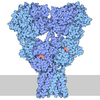
- Assembly
| Deposited unit | 
|
|---|---|
| 1 |
|
-Components
| #1: Protein | Mass: 114921.297 Da / Num. of mol.: 4 / Mutation: N48D Source method: isolated from a genetically manipulated source Source: (gene. exp.) Rattus norvegicus (Norway rat) / Gene: Gria2, GluA2, Glur2, Cacng2, Stg / Plasmid: pEG BacMam / Cell line (production host): HEK293S-GnTi / Production host:  Homo sapiens (human) / References: UniProt: P19491, UniProt: Q71RJ2 Homo sapiens (human) / References: UniProt: P19491, UniProt: Q71RJ2#2: Chemical | ChemComp-A1BX3 / Mass: 977.806 Da / Num. of mol.: 4 / Source method: obtained synthetically / Formula: C33H41N9O18P2S2 / Feature type: SUBJECT OF INVESTIGATION Has ligand of interest | Y | Has protein modification | Y | |
|---|
-Experimental details
-Experiment
| Experiment | Method: ELECTRON MICROSCOPY |
|---|---|
| EM experiment | Aggregation state: PARTICLE / 3D reconstruction method: single particle reconstruction |
- Sample preparation
| Component | Name: GluA2-y2 + oligo RGLS 4326 / Type: COMPLEX Details: LBD-TMD of AMPA receptor GluA2 in complex with auxiliary subunit TARP gamma-2 bound to anti-miR 17 oligonucleotide RGLS 4326 Entity ID: #1 / Source: RECOMBINANT | ||||||||||||||||||||
|---|---|---|---|---|---|---|---|---|---|---|---|---|---|---|---|---|---|---|---|---|---|
| Source (natural) | Organism: Rattus norvegicus (Norway rat) | ||||||||||||||||||||
| Source (recombinant) | Organism: Homo sapiens (human) / Cell: HEK293S-GnTi / Plasmid: pEG BacMam | ||||||||||||||||||||
| Buffer solution | pH: 8 | ||||||||||||||||||||
| Buffer component |
| ||||||||||||||||||||
| Specimen | Conc.: 3.24 mg/ml / Embedding applied: NO / Shadowing applied: NO / Staining applied: NO / Vitrification applied: YES Details: Protein extracted and purified in detergent micelle | ||||||||||||||||||||
| Specimen support | Grid material: GOLD / Grid mesh size: 300 divisions/in. / Grid type: UltrAuFoil | ||||||||||||||||||||
| Vitrification | Instrument: FEI VITROBOT MARK IV / Cryogen name: ETHANE / Humidity: 100 % / Chamber temperature: 277 K |
- Electron microscopy imaging
| Experimental equipment |  Model: Titan Krios / Image courtesy: FEI Company |
|---|---|
| Microscopy | Model: TFS KRIOS |
| Electron gun | Electron source:  FIELD EMISSION GUN / Accelerating voltage: 300 kV / Illumination mode: FLOOD BEAM FIELD EMISSION GUN / Accelerating voltage: 300 kV / Illumination mode: FLOOD BEAM |
| Electron lens | Mode: DARK FIELD / Nominal defocus max: 2000 nm / Nominal defocus min: 1000 nm / Cs: 2.7 mm / C2 aperture diameter: 100 µm |
| Specimen holder | Cryogen: NITROGEN / Specimen holder model: FEI TITAN KRIOS AUTOGRID HOLDER |
| Image recording | Electron dose: 45 e/Å2 / Film or detector model: GATAN K3 BIOQUANTUM (6k x 4k) |
- Processing
| EM software |
| ||||||||||||||||||||||||||||
|---|---|---|---|---|---|---|---|---|---|---|---|---|---|---|---|---|---|---|---|---|---|---|---|---|---|---|---|---|---|
| CTF correction | Type: PHASE FLIPPING AND AMPLITUDE CORRECTION | ||||||||||||||||||||||||||||
| Symmetry | Point symmetry: C2 (2 fold cyclic) | ||||||||||||||||||||||||||||
| 3D reconstruction | Resolution: 3.24 Å / Resolution method: FSC 0.143 CUT-OFF / Num. of particles: 192000 / Symmetry type: POINT | ||||||||||||||||||||||||||||
| Refinement | Stereochemistry target values: REAL-SPACE (WEIGHTED MAP SUM AT ATOM CENTERS) | ||||||||||||||||||||||||||||
| Refine LS restraints |
|
