malate dehydrogenase (decarboxylating) (NADP+) activity / malate metabolic process / chloroplast / NAD binding / metal ion binding Similarity search - Function
Agencia Nacional de Promocion Cientifica y Tecnologica (FONCYT)
PICT-2019-00079
Argentina
Citation
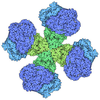
Journal: Mol Biol Evol / Year: 2026 Title: A milestone in C4 carbon concentration mechanism evolution: structural remodeling of NADP-malic enzyme in Poaceae. Authors: Jonas M Böhm / Simone Willms / Oja Ferrao / Martin Buitrago-Arango / Meike Hüdig / Gereon Poschmann / Nazanin Fazelnia / Luitgard Nagel-Steger / Sebastián Klinke / Athina Drakonaki / ...Authors: Jonas M Böhm / Simone Willms / Oja Ferrao / Martin Buitrago-Arango / Meike Hüdig / Gereon Poschmann / Nazanin Fazelnia / Luitgard Nagel-Steger / Sebastián Klinke / Athina Drakonaki / Christos Gatsogiannis / Marcos A Tronconi / Clarisa E Alvarez / Veronica G Maurino / Abstract: The evolution of C4 photosynthesis required extensive modification of ancestral enzymes enabling the development of an efficient carbon concentrating mechanism. A key example is NADP-malic enzyme ...The evolution of C4 photosynthesis required extensive modification of ancestral enzymes enabling the development of an efficient carbon concentrating mechanism. A key example is NADP-malic enzyme (NADP-ME), which, in maize and sorghum-members of the same C4 lineage-underwent gene duplication and neofunctionalization, resulting in 2 plastidic isoforms with distinct oligomeric states: a tetrameric C4-specific isoform and a dimeric housekeeping (nonC4) isoform. In this study, we resolve the structural basis of this oligomeric divergence using X-ray crystallography, cryo-electron microscopy, and molecular modeling combined with targeted biochemical analysis. Our findings demonstrate that the N-terminal region of nonC4-NADP-ME is involved in its oligomeric organization, whereas a suite of adaptive substitutions at the dimer interface drives the transition to the stable tetramer characteristic of the C4 isoform. Moreover, the C-terminal region stabilizes the oligomeric states of C4- and nonC4-NADP-ME through specific interactions with adaptive residues. We propose that tetramerization mitigates aggregation at the high expression levels demanded by the C4 cycle and likely creates a scaffold for the emergence of regulatory properties. Collectively, the data show that remodeling of terminal domains and inter-subunit interfaces rewires the quaternary architecture of the enzymes, illustrating how subtle structural changes can drive the evolution of complex innovations such as C4 photosynthesis.
 Movie
Movie Controller

 Yorodumi
 Open data
 Basic information
 Components
 Keywords
 Function and homology information
 Zea mays (maize)
 X-RAY DIFFRACTION /
  Authors
 Germany,
  Argentina, 2items
  Citation
 Structure visualization
 Downloads & links
 Other downloads


 PDBj
PDBj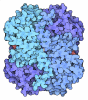
 Assembly

 Escherichia coli BL21(DE3) (bacteria) / References: UniProt: B4F8P6
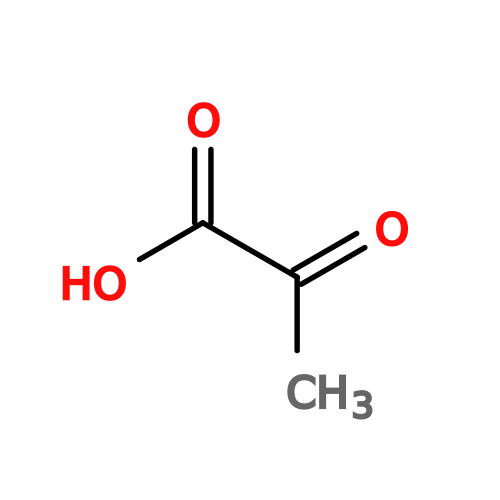 Mass: 88.062 Da / Num. of mol.: 6 / Source method: obtained synthetically / Formula: C3H4O3 / Feature type: SUBJECT OF INVESTIGATION
 Mass: 18.015 Da / Num. of mol.: 29 / Source method: isolated from a natural source / Formula: H2O
 Sample preparation
 Processing