Journal: Nature / Year: 2025 Title: Bottom-up design of Ca channels from defined selectivity filter geometry. Authors: Yulai Liu / Connor Weidle / Ljubica Mihaljević / Joseph L Watson / Zhe Li / Le Tracy Yu / Sagardip Majumder / Andrew J Borst / Kenneth D Carr / Ryan D Kibler / Tamer M Gamal El-Din / ...Authors: Yulai Liu / Connor Weidle / Ljubica Mihaljević / Joseph L Watson / Zhe Li / Le Tracy Yu / Sagardip Majumder / Andrew J Borst / Kenneth D Carr / Ryan D Kibler / Tamer M Gamal El-Din / William A Catterall / David Baker / Abstract: Native ion channels play key roles in biological systems, and engineered versions are widely used as chemogenetic tools and in sensing devices. Protein design has been harnessed to generate pore- ...Native ion channels play key roles in biological systems, and engineered versions are widely used as chemogenetic tools and in sensing devices. Protein design has been harnessed to generate pore-containing transmembrane proteins, but the design of selectivity filters with precise arrangements of amino acid side chains specific for a target ion, a crucial feature of native ion channels, has been constrained by the lack of methods for placing the metal-coordinating residues with atomic-level precision. Here we describe a bottom-up RFdiffusion-based approach to construct Ca channels from defined selectivity filter residue geometries, and use this approach to design symmetric oligomeric channels with Ca selectivity filters having different coordination numbers and different geometries at the entrance of a wider pore buttressed by multiple transmembrane helices. The designed channel proteins assemble into homogeneous pore-containing particles and, for both tetrameric and hexameric ion-coordinating configurations, patch-clamp experiments show that the designed channels have higher conductances for Ca than for Na and other divalent ions (Sr and Mg) that are eliminated after mutation of selectivity filter residues. Cryogenic electron microscopy indicates that the design method has high accuracy: the structure of the hexameric Ca channel is nearly identical to that of the design model. Our bottom-up design approach now enables the testing of hypotheses relating filter geometry to ion selectivity by direct construction, and provides a roadmap for creating selective ion channels for a wide range of applications.
History
Deposition
Oct 17, 2024
Deposition site: RCSB / Processing site: RCSB
Revision 1.0
Oct 1, 2025
Provider: repository / Type: Initial release
Revision 1.0
Oct 1, 2025
Data content type: EM metadata / Data content type: EM metadata / Provider: repository / Type: Initial release
Revision 1.0
Oct 1, 2025
Data content type: Additional map / Part number: 1 / Data content type: Additional map / Provider: repository / Type: Initial release
Revision 1.0
Oct 1, 2025
Data content type: Additional map / Part number: 2 / Data content type: Additional map / Provider: repository / Type: Initial release
Revision 1.0
Oct 1, 2025
Data content type: Additional map / Part number: 3 / Data content type: Additional map / Provider: repository / Type: Initial release
Revision 1.0
Oct 1, 2025
Data content type: Additional map / Part number: 4 / Data content type: Additional map / Provider: repository / Type: Initial release
Revision 1.0
Oct 1, 2025
Data content type: Additional map / Part number: 5 / Data content type: Additional map / Provider: repository / Type: Initial release
Revision 1.0
Oct 1, 2025
Data content type: Additional map / Part number: 6 / Data content type: Additional map / Provider: repository / Type: Initial release
Revision 1.0
Oct 1, 2025
Data content type: FSC / Data content type: FSC / Provider: repository / Type: Initial release
Revision 1.0
Oct 1, 2025
Data content type: Half map / Part number: 1 / Data content type: Half map / Provider: repository / Type: Initial release
Revision 1.0
Oct 1, 2025
Data content type: Half map / Part number: 2 / Data content type: Half map / Provider: repository / Type: Initial release
Revision 1.0
Oct 1, 2025
Data content type: Image / Data content type: Image / Provider: repository / Type: Initial release
Revision 1.0
Oct 1, 2025
Data content type: Primary map / Data content type: Primary map / Provider: repository / Type: Initial release
Data content type: EM metadata / Data content type: EM metadata / EM metadata / Group: Database references / Experimental summary / Data content type: EM metadata / EM metadata / EM metadata / Category: citation / citation_author / em_admin Data content type: EM metadata / EM metadata ...EM metadata / EM metadata / EM metadata / EM metadata / EM metadata Item: _citation.journal_volume / _citation.page_first ..._citation.journal_volume / _citation.page_first / _citation.page_last / _citation_author.identifier_ORCID / _em_admin.last_update
A: CalC6_3 with DHR extension B: CalC6_3 with DHR extension C: CalC6_3 with DHR extension D: CalC6_3 with DHR extension E: CalC6_3 with DHR extension F: CalC6_3 with DHR extension G: CalC6_3 with DHR extension
Conc.: 1 mg/ml / Embedding applied: NO / Shadowing applied: NO / Staining applied: NO / Vitrification applied: YES / Details: membrane protein in purified detergent micelle
Specimen support
Details: 5 mA current / Grid material: COPPER / Grid mesh size: 300 divisions/in. / Grid type: Quantifoil R2/2
Vitrification
Instrument: FEI VITROBOT MARK IV / Cryogen name: ETHANE / Humidity: 100 % / Chamber temperature: 295.15 K
-
Electron microscopy imaging
Experimental equipment
Model: Titan Krios / Image courtesy: FEI Company
Microscopy
Model: FEI TITAN KRIOS
Electron gun
Electron source: FIELD EMISSION GUN / Accelerating voltage: 300 kV / Illumination mode: FLOOD BEAM
Electron lens
Mode: BRIGHT FIELD / Nominal defocus max: 1800 nm / Nominal defocus min: 800 nm / Cs: 2.7 mm / C2 aperture diameter: 50 µm / Alignment procedure: COMA FREE
Specimen holder
Cryogen: NITROGEN
Image recording
Average exposure time: 4 sec. / Electron dose: 47.32 e/Å2 / Film or detector model: GATAN K3 (6k x 4k) / Num. of grids imaged: 1 / Num. of real images: 6893
EM imaging optics
Energyfilter name: GIF Bioquantum
-
Processing
EM software
ID
Name
Category
1
cryoSPARC
particleselection
2
SerialEM
imageacquisition
4
cryoSPARC
CTFcorrection
7
UCSF Chimera
modelfitting
9
cryoSPARC
initialEulerassignment
10
cryoSPARC
finalEulerassignment
11
cryoSPARC
classification
12
cryoSPARC
3Dreconstruction
13
UCSF ChimeraX
modelrefinement
14
ISOLDE
modelrefinement
15
Coot
modelrefinement
16
PHENIX
modelrefinement
17
PyMOL
modelrefinement
CTF correction
Type: PHASE FLIPPING AND AMPLITUDE CORRECTION
Particle selection
Num. of particles selected: 886110
Symmetry
Point symmetry: C7 (7 fold cyclic)
3D reconstruction
Resolution: 4.62 Å / Resolution method: FSC 0.143 CUT-OFF / Num. of particles: 45077 / Algorithm: FOURIER SPACE / Symmetry type: POINT
Atomic model building
Protocol: FLEXIBLE FIT / Space: REAL Details: For the heptamer, CalC6_3 with DHR extension hexamer design model was used as a starting model. A single chain for the heptamer was isolated in PyMOL, and 7 copies of this chain were fitted ...Details: For the heptamer, CalC6_3 with DHR extension hexamer design model was used as a starting model. A single chain for the heptamer was isolated in PyMOL, and 7 copies of this chain were fitted to the map in UCSF Chimera to reform the channel. The heptamer was refined using several rounds of relaxation and minimization, performed on the complete structures, which were manually inspected for errors each time using ISOLDE in UCSF ChimeraX, Coot, and PHENIX real-space refinement. The final model quality was analyzed using MolProbity.
Atomic model building
Details: Design protein, see paper / Source name: Other / Type: in silico model
Refine LS restraints
Refine-ID
Type
Dev ideal
Number
ELECTRONMICROSCOPY
f_bond_d
0.001
6118
ELECTRONMICROSCOPY
f_angle_d
0.355
8442
ELECTRONMICROSCOPY
f_dihedral_angle_d
2.888
1099
ELECTRONMICROSCOPY
f_chiral_restr
0.028
1092
ELECTRONMICROSCOPY
f_plane_restr
0.002
1162
+
About Yorodumi
-
News
-
Feb 9, 2022. New format data for meta-information of EMDB entries
New format data for meta-information of EMDB entries
Version 3 of the EMDB header file is now the official format.
The previous official version 1.9 will be removed from the archive.
In the structure databanks used in Yorodumi, some data are registered as the other names, "COVID-19 virus" and "2019-nCoV". Here are the details of the virus and the list of structure data.
Jan 31, 2019. EMDB accession codes are about to change! (news from PDBe EMDB page)
EMDB accession codes are about to change! (news from PDBe EMDB page)
The allocation of 4 digits for EMDB accession codes will soon come to an end. Whilst these codes will remain in use, new EMDB accession codes will include an additional digit and will expand incrementally as the available range of codes is exhausted. The current 4-digit format prefixed with “EMD-” (i.e. EMD-XXXX) will advance to a 5-digit format (i.e. EMD-XXXXX), and so on. It is currently estimated that the 4-digit codes will be depleted around Spring 2019, at which point the 5-digit format will come into force.
The EM Navigator/Yorodumi systems omit the EMD- prefix.
Related info.:Q: What is EMD? / ID/Accession-code notation in Yorodumi/EM Navigator
Yorodumi is a browser for structure data from EMDB, PDB, SASBDB, etc.
This page is also the successor to EM Navigator detail page, and also detail information page/front-end page for Omokage search.
The word "yorodu" (or yorozu) is an old Japanese word meaning "ten thousand". "mi" (miru) is to see.
Related info.:EMDB / PDB / SASBDB / Comparison of 3 databanks / Yorodumi Search / Aug 31, 2016. New EM Navigator & Yorodumi / Yorodumi Papers / Jmol/JSmol / Function and homology information / Changes in new EM Navigator and Yorodumi
 Movie
Movie Controller

 Yorodumi
 Open data
 Basic information
 Components
 Keywords
 Authors
 United States, 1items
  Citation
 Structure visualization
 Molmil
 Downloads & links
 Other downloads


 PDBj
PDBj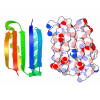
 Assembly

 Escherichia coli BL21(DE3) (bacteria)
 Sample preparation
 Electron microscopy imaging
 FIELD EMISSION GUN / Accelerating voltage: 300 kV / Illumination mode: FLOOD BEAM
 Processing