 Movie
Movie Controller


+ Open data

- Basic information
| Entry | Database: PDB / ID: 9dpi | |||||||||||||||||||||
|---|---|---|---|---|---|---|---|---|---|---|---|---|---|---|---|---|---|---|---|---|---|---|
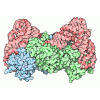
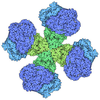
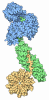
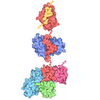
| Title | Cryo-EM structure of SerRS dimer in complex with two SIRT2 | |||||||||||||||||||||
 Components Components |
| |||||||||||||||||||||
 Keywords Keywords | RNA BINDING PROTEIN / enzymes / protein complexes | |||||||||||||||||||||
| Function / homology |  Function and homology information Function and homology informationselenocysteine-tRNA ligase activity / tRNA C3-cytosine methylation / negative regulation of vascular endothelial growth factor production / selenocysteine incorporation / selenium compound metabolic process / serine-tRNA ligase / serine-tRNA ligase activity / seryl-tRNA aminoacylation / cellular response to caloric restriction / histone methacryllysine demethacrylase activity ...selenocysteine-tRNA ligase activity / tRNA C3-cytosine methylation / negative regulation of vascular endothelial growth factor production / selenocysteine incorporation / selenium compound metabolic process / serine-tRNA ligase / serine-tRNA ligase activity / seryl-tRNA aminoacylation / cellular response to caloric restriction / histone methacryllysine demethacrylase activity / histone benzoyllysine debenzoylase activity / positive regulation of oocyte maturation / negative regulation of striated muscle tissue development / negative regulation of oligodendrocyte progenitor proliferation / negative regulation of satellite cell differentiation / histone H4K16 deacetylase activity, NAD-dependent / positive regulation of attachment of spindle microtubules to kinetochore / tRNA methyltransferase complex / NAD-dependent protein demyristoylase activity / NAD-dependent protein depalmitoylase activity / peptidyl-lysine deacetylation / positive regulation of meiotic nuclear division / paranodal junction / lateral loop / Cytosolic tRNA aminoacylation / mitotic nuclear membrane reassembly / regulation of exit from mitosis / tubulin deacetylase activity / regulation of phosphorylation / paranode region of axon / myelination in peripheral nervous system / tubulin deacetylation / negative regulation of peptidyl-threonine phosphorylation / tRNA modification / regulation of myelination / positive regulation of fatty acid biosynthetic process / Schmidt-Lanterman incisure / protein acetyllysine N-acetyltransferase / NAD-dependent protein lysine deacetylase activity / histone deacetylase activity, NAD-dependent / rDNA heterochromatin formation / juxtaparanode region of axon / Initiation of Nuclear Envelope (NE) Reformation / protein deacetylation / chromatin silencing complex / histone deacetylase activity / meiotic spindle / negative regulation of reactive oxygen species metabolic process / protein lysine deacetylase activity / positive regulation of cell division / positive regulation of DNA binding / negative regulation of fat cell differentiation / response to redox state / histone acetyltransferase binding / lipid catabolic process / NAD+ poly-ADP-ribosyltransferase activity / NAD+ binding / subtelomeric heterochromatin formation / glial cell projection / positive regulation of execution phase of apoptosis / Selenocysteine synthesis / negative regulation of angiogenesis / heterochromatin / centriole / cellular response to epinephrine stimulus / Transferases; Acyltransferases; Transferring groups other than aminoacyl groups / substantia nigra development / negative regulation of autophagy / ubiquitin binding / negative regulation of protein catabolic process / myelin sheath / epigenetic regulation of gene expression / mitotic spindle / spindle / histone deacetylase binding / positive regulation of proteasomal ubiquitin-dependent protein catabolic process / growth cone / cellular response to oxidative stress / midbody / heterochromatin formation / cellular response to hypoxia / microtubule / DNA-binding transcription factor binding / tRNA binding / proteasome-mediated ubiquitin-dependent protein catabolic process / molecular adaptor activity / regulation of cell cycle / perikaryon / cytoplasmic translation / chromosome, telomeric region / RNA polymerase II cis-regulatory region sequence-specific DNA binding / chromosome / translation / negative regulation of DNA-templated transcription / centrosome / chromatin binding / nucleolus / perinuclear region of cytoplasm / negative regulation of transcription by RNA polymerase II / enzyme binding Similarity search - Function | |||||||||||||||||||||
| Biological species |  Homo sapiens (human) Homo sapiens (human) | |||||||||||||||||||||
| Method | ELECTRON MICROSCOPY / single particle reconstruction / cryo EM / Resolution: 3.9 Å | |||||||||||||||||||||
 Authors Authors | Yang, J. / Zhang, Q. / Zhang, H. / Lander, G. / Yang, X. | |||||||||||||||||||||
| Funding support |  United States, 1items United States, 1items
| |||||||||||||||||||||
 Citation Citation | Journal: Nat Commun / Year: 2026 Title: A metabolite-bridged complex between SerRS and SIRT2 couples NAD⁺ metabolism to translation control. Authors: Qian Zhang / Huimin Zhang / Marscha Hirschi / Sheng Li / Gabriel C Lander / Jie Yang / Xiang-Lei Yang /  Abstract: Cellular homeostasis requires tight coordination between metabolic and translational networks. Here we identify a direct molecular link between these processes through a cryo-EM structure of human ...Cellular homeostasis requires tight coordination between metabolic and translational networks. Here we identify a direct molecular link between these processes through a cryo-EM structure of human cytosolic seryl-tRNA synthetase (SerRS) in complex with the NAD⁺-dependent deacetylase SIRT2. This interaction is promoted by the NAD⁺ metabolite ADP-ribose (ADPR), which acts as a molecular bridge between the two enzymes. Within the SIRT2 active site, ADPR engages SerRS residue K414 located in a flexible catalytic-domain loop. Acetylation of K414 is dispensable for binding. Functionally, complex formation inhibits SIRT2 deacetylase activity by blocking substrate access, while SIRT2 association suppresses SerRS aminoacylation activity by preventing tRNA binding. Thus, SerRS and SIRT2 mutually regulate each other, with ADPR enhancing while tRNA attenuating their interaction. Oxidative stress promotes this interaction via a PARP1-dependent pathway, revealing an ADPR-responsive regulatory module that couples metabolic state to translational output. This regulatory module is likely conserved across vertebrates. | |||||||||||||||||||||
| History |
|
- Structure visualization
| Structure viewer | Molecule: MolmilJmol/JSmol |
|---|
- Downloads & links
-Download
| PDBx/mmCIF format | 9dpi.cif.gz | 196 KB | Display | PDBx/mmCIF format |
|---|---|---|---|---|
| PDB format | pdb9dpi.ent.gz | 145.1 KB | Display | PDB format |
| PDBx/mmJSON format | 9dpi.json.gz | Tree view | PDBx/mmJSON format | |
| Others |  Other downloads Other downloads |
-Validation report
| Arichive directory | https://data.pdbj.org/pub/pdb/validation_reports/dp/9dpiftp://data.pdbj.org/pub/pdb/validation_reports/dp/9dpi | HTTPS FTP |
|---|
-Related structure data
| Related structure data |  47105MC  9dpdC M: map data used to model this data C: citing same article ( |
|---|---|
| Similar structure data |

-Links
 PDBj
PDBj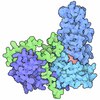
- Assembly
| Deposited unit | 
|
|---|---|
| 1 |
|
-Components
| #1: Protein | Mass: 58863.211 Da / Num. of mol.: 2 Source method: isolated from a genetically manipulated source Source: (gene. exp.) Homo sapiens (human) / Gene: SARS1, SARS, SERS / Production host:   Escherichia coli (E. coli) / References: UniProt: P49591, serine-tRNA ligase Escherichia coli (E. coli) / References: UniProt: P49591, serine-tRNA ligase#2: Protein | Mass: 43233.105 Da / Num. of mol.: 2 Source method: isolated from a genetically manipulated source Source: (gene. exp.) Homo sapiens (human) / Gene: SIRT2, SIR2L, SIR2L2 / Production host: Escherichia coli (E. coli)References: UniProt: Q8IXJ6, protein acetyllysine N-acetyltransferase, Transferases; Acyltransferases; Transferring groups other than aminoacyl groups #3: Chemical | 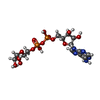 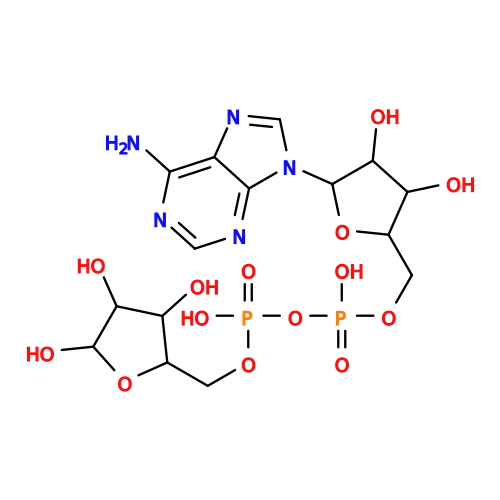 Mass: 559.316 Da / Num. of mol.: 2 / Source method: obtained synthetically / Formula: C15H23N5O14P2 / Feature type: SUBJECT OF INVESTIGATION Mass: 559.316 Da / Num. of mol.: 2 / Source method: obtained synthetically / Formula: C15H23N5O14P2 / Feature type: SUBJECT OF INVESTIGATIONHas ligand of interest | Y | Has protein modification | Y | |
|---|
-Experimental details
-Experiment
| Experiment | Method: ELECTRON MICROSCOPY |
|---|---|
| EM experiment | Aggregation state: PARTICLE / 3D reconstruction method: single particle reconstruction |
- Sample preparation
| Component | Name: Ternary complex of SerRS dimer with SIRT2 / Type: COMPLEX / Entity ID: #1-#2 / Source: RECOMBINANT |
|---|---|
| Source (natural) | Organism: Homo sapiens (human) |
| Source (recombinant) | Organism: Escherichia coli (E. coli) |
| Buffer solution | pH: 7.5 / Details: in 25mM HEPES-Na pH7.5, 150mM NaCl |
| Specimen | Embedding applied: NO / Shadowing applied: NO / Staining applied: NO / Vitrification applied: YES |
| Vitrification | Cryogen name: ETHANE / Humidity: 100 % / Chamber temperature: 277 K |
- Electron microscopy imaging
| Experimental equipment | 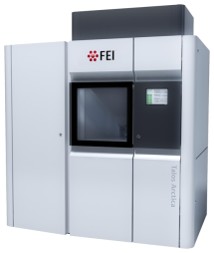 Model: Talos Arctica / Image courtesy: FEI Company |
|---|---|
| Microscopy | Model: FEI TALOS ARCTICA |
| Electron gun | Electron source:  FIELD EMISSION GUN / Accelerating voltage: 200 kV / Illumination mode: FLOOD BEAM FIELD EMISSION GUN / Accelerating voltage: 200 kV / Illumination mode: FLOOD BEAM |
| Electron lens | Mode: BRIGHT FIELD / Nominal magnification: 36000 X / Nominal defocus max: 1300 nm / Nominal defocus min: 700 nm / Cs: 2.7 mm |
| Image recording | Electron dose: 50 e/Å2 / Detector mode: COUNTING / Film or detector model: GATAN K2 SUMMIT (4k x 4k) |
- Processing
| EM software |
| ||||||||||||||||||||||||
|---|---|---|---|---|---|---|---|---|---|---|---|---|---|---|---|---|---|---|---|---|---|---|---|---|---|
| CTF correction | Type: PHASE FLIPPING ONLY | ||||||||||||||||||||||||
| 3D reconstruction | Resolution: 3.9 Å / Resolution method: FSC 0.143 CUT-OFF / Num. of particles: 523089 / Symmetry type: POINT | ||||||||||||||||||||||||
| Atomic model building | Protocol: AB INITIO MODEL / Space: REAL | ||||||||||||||||||||||||
| Refinement | Highest resolution: 3.9 Å Stereochemistry target values: REAL-SPACE (WEIGHTED MAP SUM AT ATOM CENTERS) | ||||||||||||||||||||||||
| Refine LS restraints |
|
