 Movie
Movie Controller


+ Open data

- Basic information
| Entry | Database: PDB / ID: 9dhw | ||||||||||||||||||||||||
|---|---|---|---|---|---|---|---|---|---|---|---|---|---|---|---|---|---|---|---|---|---|---|---|---|---|
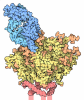
| Title | Q23.MD39 in Complex with Fabs from antibodies CH01 iGL and 35O22 | ||||||||||||||||||||||||
 Components Components |
| ||||||||||||||||||||||||
 Keywords Keywords | VIRAL PROTEIN/IMMUNE SYSTEM / Antibody / Complex / VIRAL PROTEIN / VIRAL PROTEIN-IMMUNE SYSTEM complex | ||||||||||||||||||||||||
| Function / homology |  Function and homology information Function and homology informationpositive regulation of plasma membrane raft polarization / positive regulation of receptor clustering / symbiont-mediated perturbation of host defense response / host cell endosome membrane / clathrin-dependent endocytosis of virus by host cell / viral protein processing / fusion of virus membrane with host plasma membrane / fusion of virus membrane with host endosome membrane / viral envelope / virion attachment to host cell ...positive regulation of plasma membrane raft polarization / positive regulation of receptor clustering / symbiont-mediated perturbation of host defense response / host cell endosome membrane / clathrin-dependent endocytosis of virus by host cell / viral protein processing / fusion of virus membrane with host plasma membrane / fusion of virus membrane with host endosome membrane / viral envelope / virion attachment to host cell / host cell plasma membrane / virion membrane / structural molecule activity / membrane Similarity search - Function | ||||||||||||||||||||||||
| Biological species |   Human immunodeficiency virus 1 Human immunodeficiency virus 1 Homo sapiens (human) Homo sapiens (human) | ||||||||||||||||||||||||
| Method | ELECTRON MICROSCOPY / single particle reconstruction / cryo EM / Resolution: 3.35 Å | ||||||||||||||||||||||||
 Authors Authors | Lin, Z.J. / Cui, J. / Du, J. / Habib, R. / Kulp, D. / Pallesen, J. | ||||||||||||||||||||||||
| Funding support |  United States, 1items United States, 1items
| ||||||||||||||||||||||||
 Citation Citation | Journal: Proc Natl Acad Sci U S A / Year: 2026 Title: Deep mining of the human antibody repertoire identifies frequent and genetically diverse CDRH3 topologies targetable by vaccination. Authors: Rumi Habib / Shahlo O Solieva / Zi Jie Lin / Sukanya Ghosh / Kelly Bayruns / Maya Singh / Colby J Agostino / Nicholas J Tursi / Kirsten J Sowers / Jinwei Huang / Ryan S Roark / Mansi Purwar ...Authors: Rumi Habib / Shahlo O Solieva / Zi Jie Lin / Sukanya Ghosh / Kelly Bayruns / Maya Singh / Colby J Agostino / Nicholas J Tursi / Kirsten J Sowers / Jinwei Huang / Ryan S Roark / Mansi Purwar / Younghoon Park / Kasirajan Ayyanathan / Hui Li / John W Carey / Amber Kim / Joyce Park / Madison E McCanna / Ashwin N Skelly / Neethu Chokkalingam / Sinja Kriete / Nicholas Shupin / Alana Huynh / Susanne Walker / Roopak Sadeesh / Niklas Laenger / Jianqiu Du / Jiayan Cui / Ami Patel / Amelia Escolano / Peter D Kwong / Lawrence Shapiro / Gregory R Bowman / Beatrice H Hahn / George M Shaw / David B Weiner / Jesper Pallesen / Daniel W Kulp / Abstract: Germline targeting vaccination strategies against highly variable pathogens such as HIV aim to elicit broadly neutralizing antibodies (bnAbs) with particular immunogenetic or structural features. The ...Germline targeting vaccination strategies against highly variable pathogens such as HIV aim to elicit broadly neutralizing antibodies (bnAbs) with particular immunogenetic or structural features. The V2 apex of the HIV Env protein is a promising target for a class of bnAbs that contain conserved structural motifs in the heavy chain complementarity determining region 3 (CDRH3). Here, we show that these structural motifs are targetable by vaccination by characterizing V2 apex "axe-like" CDRH3s in the human repertoire and developing immunogens capable of engaging them. We determined the frequency and diversity of axe-like CDRH3s in healthy human donors using a series of structural informatics approaches, finding these precursors in nearly 90% of donors. Axe-targeting immunogens based on the HIV Env Q23.17 bound axe-like precursors in cryo-electron microscopy structures, induced V2 apex-specific antibody responses in humanized mice, and induced axe-like heterologous neutralizing antibodies in rhesus macaques infected with a germline-targeted simian-HIV. These results illustrate a structure-guided immunoinformatic vaccine design paradigm that can be employed to elicit immunogenetically diverse yet structurally conserved classes of antibodies. #1: Journal: bioRxiv / Year: 2025 Title: Deep Mining of the Human Antibody Repertoire Identifies Frequent and Genetically Diverse CDRH3 Topologies Targetable by Vaccination. Authors: Rumi Habib / Shahlo O Solieva / Zi Jie Lin / Sukanya Ghosh / Kelly Bayruns / Maya Singh / Colby J Agostino / Nicholas J Tursi / Kirsten J Sowers / Jinwei Huang / Ryan S Roark / Mansi Purwar ...Authors: Rumi Habib / Shahlo O Solieva / Zi Jie Lin / Sukanya Ghosh / Kelly Bayruns / Maya Singh / Colby J Agostino / Nicholas J Tursi / Kirsten J Sowers / Jinwei Huang / Ryan S Roark / Mansi Purwar / Younghoon Park / Kasirajan Ayyanathan / Hui Li / John W Carey / Amber Kim / Joyce Park / Madison E McCanna / Ashwin N Skelly / Neethu Chokkalingam / Sinja Kriete / Nicholas Shupin / Alana Huynh / Susanne Walker / Roopak Sadeesh / Niklas Laenger / Jianqiu Du / Jiayan Cui / Ami Patel / Amelia Escolano / Peter D Kwong / Lawrence Shapiro / Gregory R Bowman / Beatrice H Hahn / George M Shaw / David B Weiner / Jesper Pallesen / Daniel W Kulp Abstract: Germline targeting vaccination strategies against highly variable pathogens such as HIV aim to elicit broadly neutralizing antibodies (bnAbs) with particular immunogenetic or structural features. The ...Germline targeting vaccination strategies against highly variable pathogens such as HIV aim to elicit broadly neutralizing antibodies (bnAbs) with particular immunogenetic or structural features. The V2 apex of the HIV Env protein is a promising target for a class of bnAbs that contain conserved structural motifs in the heavy chain complementarity determining region 3 (CDRH3). Here, we show that these structural motifs are targetable by vaccination by characterizing V2 apex 'axe-like' CDRH3s in the human repertoire and developing new immunogens capable of engaging them. We determined the frequency and diversity of axe-like CDHR3s in healthy human donors using a series of structural informatics approaches, finding these precursors in nearly 90% of donors. Axe-targeting immunogens based on the HIV Env Q23.17 bound axe-like precursors in cryo-EM structures, induced V2 apex-specific antibody responses in humanized mice, and induced axe-like heterologous neutralizing antibodies in rhesus macaques infected with a germline-targeted simian-human immunodeficiency virus. These results illustrate a new structure-guided immunoinformatic vaccine design paradigm that can be employed to elicit immunogenetically diverse yet structurally conserved classes of antibodies. SIGNIFICANCE STATEMENT: Many broadly neutralizing antibodies (bnAbs) utilize modes of epitope recognition dominated by the antibody complementarity determining region 3 (CDRH3). The CDRH3 is the most ...SIGNIFICANCE STATEMENT: Many broadly neutralizing antibodies (bnAbs) utilize modes of epitope recognition dominated by the antibody complementarity determining region 3 (CDRH3). The CDRH3 is the most diverse part of the antibody, posing a challenge for germline targeting vaccine designs that aim to elicit antibodies with particular immunogenetic features. Vaccine design strategies that accommodate CDRH3 variability are therefore needed. Many HIV Env V2 apex bnAbs share "axe-like" CDRH3 microfolds that arise from diverse immunogenetic origins. Here we determined the frequency in humans of B cells with such CDRH3 topologies and designed immunogens to engage their precursors. This work opens a path toward vaccines that engage specific structural classes of B cells, thereby advancing the rational design of immunogens for HIV and other pathogens. | ||||||||||||||||||||||||
| History |
|
- Structure visualization
| Structure viewer | Molecule: MolmilJmol/JSmol |
|---|
- Downloads & links
-Download
| PDBx/mmCIF format | 9dhw.cif.gz | 522.9 KB | Display | PDBx/mmCIF format |
|---|---|---|---|---|
| PDB format | pdb9dhw.ent.gz | Display | PDB format | |
| PDBx/mmJSON format | 9dhw.json.gz | Tree view | PDBx/mmJSON format | |
| Others |  Other downloads Other downloads |
-Validation report
| Arichive directory | https://data.pdbj.org/pub/pdb/validation_reports/dh/9dhwftp://data.pdbj.org/pub/pdb/validation_reports/dh/9dhw | HTTPS FTP |
|---|
-Related structure data
| Related structure data |  46884MC  9dimC  9z9lC M: map data used to model this data C: citing same article ( |
|---|---|
| Similar structure data |


-Links
 PDBj
PDBj
- Assembly
| Deposited unit | 
|
|---|---|
| 1 |
|
-Components
-Protein , 2 types, 6 molecules ACGBDI
| #1: Protein | Mass: 52753.762 Da / Num. of mol.: 3 Source method: isolated from a genetically manipulated source Source: (gene. exp.) Human immunodeficiency virus 1 / Gene: env / Cell line (production host): HEK293F / Production host: Homo sapiens (human) / References: UniProt: O55774#2: Protein | Mass: 17329.604 Da / Num. of mol.: 3 Source method: isolated from a genetically manipulated source Source: (gene. exp.) Human immunodeficiency virus 1 / Gene: env / Cell line (production host): HEK293F / Production host: Homo sapiens (human) / References: UniProt: O55774 |
|---|
-Antibody , 4 types, 6 molecules EHFLMN
| #3: Antibody | Mass: 26170.533 Da / Num. of mol.: 2 Source method: isolated from a genetically manipulated source Source: (gene. exp.) Homo sapiens (human) / Cell line (production host): HEK293F / Production host: Homo sapiens (human)#4: Antibody | Mass: 23318.824 Da / Num. of mol.: 2 Source method: isolated from a genetically manipulated source Source: (gene. exp.) Homo sapiens (human) / Cell line (production host): HEK293F / Production host: Homo sapiens (human)#5: Antibody | | Mass: 11663.895 Da / Num. of mol.: 1 Source method: isolated from a genetically manipulated source Source: (gene. exp.) Homo sapiens (human) / Cell line (production host): HEK293F / Production host: Homo sapiens (human)#6: Antibody | | Mass: 14540.956 Da / Num. of mol.: 1 Source method: isolated from a genetically manipulated source Source: (gene. exp.) Homo sapiens (human) / Cell line (production host): HEK293F / Production host: Homo sapiens (human) |
|---|
-Sugars , 10 types, 50 molecules 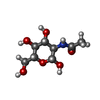
| #7: Polysaccharide | alpha-D-mannopyranose-(1-3)-alpha-D-mannopyranose-(1-6)-[alpha-D-mannopyranose-(1-3)]beta-D- ...alpha-D-mannopyranose-(1-3)-alpha-D-mannopyranose-(1-6)-[alpha-D-mannopyranose-(1-3)]beta-D-mannopyranose-(1-4)-2-acetamido-2-deoxy-beta-D-glucopyranose-(1-4)-2-acetamido-2-deoxy-beta-D-glucopyranose Source method: isolated from a genetically manipulated source | ||||||||||||||||
|---|---|---|---|---|---|---|---|---|---|---|---|---|---|---|---|---|---|
| #8: Polysaccharide | 2-acetamido-2-deoxy-beta-D-glucopyranose-(1-4)-2-acetamido-2-deoxy-beta-D-glucopyranose Source method: isolated from a genetically manipulated source #9: Polysaccharide | alpha-D-mannopyranose-(1-2)-alpha-D-mannopyranose-(1-2)-alpha-D-mannopyranose-(1-3)-[alpha-D- ...alpha-D-mannopyranose-(1-2)-alpha-D-mannopyranose-(1-2)-alpha-D-mannopyranose-(1-3)-[alpha-D-mannopyranose-(1-6)]beta-D-mannopyranose-(1-4)-2-acetamido-2-deoxy-beta-D-glucopyranose-(1-4)-2-acetamido-2-deoxy-beta-D-glucopyranose | Source method: isolated from a genetically manipulated source #10: Polysaccharide | beta-D-mannopyranose-(1-4)-2-acetamido-2-deoxy-beta-D-glucopyranose-(1-4)-2-acetamido-2-deoxy-beta- ...beta-D-mannopyranose-(1-4)-2-acetamido-2-deoxy-beta-D-glucopyranose-(1-4)-2-acetamido-2-deoxy-beta-D-glucopyranose Source method: isolated from a genetically manipulated source #11: Polysaccharide | alpha-L-fucopyranose-(1-6)-2-acetamido-2-deoxy-beta-D-glucopyranose | Source method: isolated from a genetically manipulated source #12: Polysaccharide | alpha-D-mannopyranose-(1-3)-[alpha-D-mannopyranose-(1-6)]beta-D-mannopyranose-(1-4)-2-acetamido-2- ...alpha-D-mannopyranose-(1-3)-[alpha-D-mannopyranose-(1-6)]beta-D-mannopyranose-(1-4)-2-acetamido-2-deoxy-beta-D-glucopyranose-(1-4)-2-acetamido-2-deoxy-beta-D-glucopyranose | Source method: isolated from a genetically manipulated source #13: Polysaccharide | Source method: isolated from a genetically manipulated source #14: Polysaccharide | alpha-D-mannopyranose-(1-2)-alpha-D-mannopyranose-(1-3)-[alpha-D-mannopyranose-(1-3)-[alpha-D- ...alpha-D-mannopyranose-(1-2)-alpha-D-mannopyranose-(1-3)-[alpha-D-mannopyranose-(1-3)-[alpha-D-mannopyranose-(1-6)]alpha-D-mannopyranose-(1-6)]beta-D-mannopyranose-(1-4)-2-acetamido-2-deoxy-beta-D-glucopyranose-(1-4)-2-acetamido-2-deoxy-beta-D-glucopyranose | Source method: isolated from a genetically manipulated source #15: Polysaccharide | beta-D-mannopyranose-(1-4)-2-acetamido-2-deoxy-beta-D-glucopyranose-(1-4)-[alpha-L-fucopyranose-(1- ...beta-D-mannopyranose-(1-4)-2-acetamido-2-deoxy-beta-D-glucopyranose-(1-4)-[alpha-L-fucopyranose-(1-6)]2-acetamido-2-deoxy-beta-D-glucopyranose | Source method: isolated from a genetically manipulated source #16: Sugar | ChemComp-NAG / 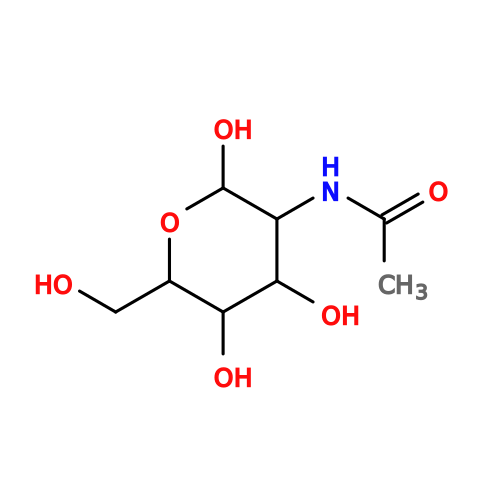 Type: D-saccharide, beta linking / Mass: 221.208 Da / Num. of mol.: 22 Type: D-saccharide, beta linking / Mass: 221.208 Da / Num. of mol.: 22Source method: isolated from a genetically manipulated source Formula: C8H15NO6 / Feature type: SUBJECT OF INVESTIGATION |
-Details
| Has ligand of interest | Y |
|---|---|
| Has protein modification | Y |
-Experimental details
-Experiment
| Experiment | Method: ELECTRON MICROSCOPY |
|---|---|
| EM experiment | Aggregation state: PARTICLE / 3D reconstruction method: single particle reconstruction |
- Sample preparation
| Component |
| ||||||||||||||||||||||||||||||
|---|---|---|---|---|---|---|---|---|---|---|---|---|---|---|---|---|---|---|---|---|---|---|---|---|---|---|---|---|---|---|---|
| Molecular weight | Experimental value: NO | ||||||||||||||||||||||||||||||
| Source (natural) |
| ||||||||||||||||||||||||||||||
| Source (recombinant) |
| ||||||||||||||||||||||||||||||
| Buffer solution | pH: 7.6 / Details: 1X PBS | ||||||||||||||||||||||||||||||
| Specimen | Embedding applied: NO / Shadowing applied: NO / Staining applied: NO / Vitrification applied: YES | ||||||||||||||||||||||||||||||
| Specimen support | Grid material: GOLD / Grid mesh size: 300 divisions/in. / Grid type: UltrAuFoil R1.2/1.3 | ||||||||||||||||||||||||||||||
| Vitrification | Instrument: FEI VITROBOT MARK IV / Cryogen name: ETHANE / Humidity: 100 % / Chamber temperature: 298 K |
- Electron microscopy imaging
| Experimental equipment |  Model: Titan Krios / Image courtesy: FEI Company |
|---|---|
| Microscopy | Model: TFS KRIOS |
| Electron gun | Electron source:  FIELD EMISSION GUN / Accelerating voltage: 300 kV / Illumination mode: FLOOD BEAM FIELD EMISSION GUN / Accelerating voltage: 300 kV / Illumination mode: FLOOD BEAM |
| Electron lens | Mode: BRIGHT FIELD / Nominal defocus max: 2500 nm / Nominal defocus min: 500 nm |
| Image recording | Electron dose: 40 e/Å2 / Film or detector model: GATAN K3 BIOQUANTUM (6k x 4k) |
- Processing
| EM software | Name: cryoSPARC / Category: 3D reconstruction |
|---|---|
| CTF correction | Type: NONE |
| Symmetry | Point symmetry: C1 (asymmetric) |
| 3D reconstruction | Resolution: 3.35 Å / Resolution method: FSC 0.143 CUT-OFF / Num. of particles: 71949 / Symmetry type: POINT |
