National Institutes of Health/National Institute of General Medical Sciences (NIH/NIGMS)
1DP2GM146250
米国
引用
ジャーナル: Nature / 年: 2025 タイトル: A DNA-gated molecular guard controls bacterial Hailong anti-phage defence. 著者: Joel M J Tan / Sarah Melamed / Joshua C Cofsky / Deepsing Syangtan / Samuel J Hobbs / Josefina Del Mármol / Marco Jost / Andrew C Kruse / Rotem Sorek / Philip J Kranzusch / 要旨: Animal and bacterial cells use nucleotidyltransferase (NTase) enzymes to respond to viral infection and control major forms of immune signalling including cGAS-STING innate immunity and CBASS anti- ...Animal and bacterial cells use nucleotidyltransferase (NTase) enzymes to respond to viral infection and control major forms of immune signalling including cGAS-STING innate immunity and CBASS anti-phage defence. Here we discover a family of bacterial defence systems, which we name Hailong, that use NTase enzymes to constitutively synthesize DNA signals and guard against phage infection. Hailong protein B (HalB) is an NTase that converts deoxy-ATP into single-stranded DNA oligomers. A series of X-ray crystal structures define a stepwise mechanism of HalB DNA synthesis initiated by a C-terminal tyrosine residue that enables de novo enzymatic priming. We show that HalB DNA signals bind to and repress activation of a partnering Hailong protein A (HalA) effector complex. A 2.0-Å cryo-electron microscopy structure of the HalA-DNA complex reveals a membrane protein with a conserved ion channel domain and a unique crown domain that binds the DNA signal and gates activation. Analysing Hailong defence in vivo, we demonstrate that viral DNA exonucleases required for phage replication trigger release of the primed HalA complex and induce protective host cell growth arrest. Our results explain how inhibitory nucleotide immune signals can serve as molecular guards against phage infection and expand the mechanisms NTase enzymes use to control antiviral immunity.
 ムービー
ムービー コントローラー


 データを開く
 基本情報
基本情報 要素
要素 キーワード
キーワード 機能・相同性情報
 Rhodobacteraceae bacterium QY30 (バクテリア)
 X線回折 /
  データ登録者
 米国, 1件
  引用
引用
 構造の表示
構造の表示 ダウンロードとリンク
 その他のダウンロード


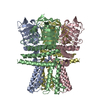
 PDBj
PDBj 集合体
集合体
 Escherichia coli BL21(DE3) (大腸菌)
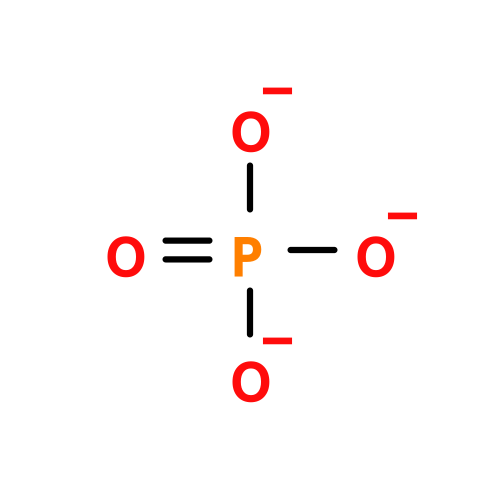 分子量: 94.971 Da / 分子数: 4 / 由来タイプ: 合成 / 式: PO4
 分子量: 18.015 Da / 分子数: 600 / 由来タイプ: 天然 / 式: H2O
 試料調製
試料調製 / ビームライン: I03 / 波長: 0.9792 Å
 解析
解析