 Movie
Movie Controller


+ Open data

- Basic information
| Entry | Database: PDB / ID: 9bux | ||||||
|---|---|---|---|---|---|---|---|
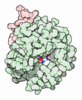
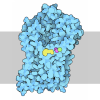
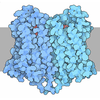
| Title | Structure of GGCX-BGP-menaquinone-4 epoxide complex | ||||||
 Components Components |
| ||||||
 Keywords Keywords | MEMBRANE PROTEIN / LYASE/SUBSTRATE / vitamin K cycle / LYASE-SUBSTRATE complex | ||||||
| Function / homology |  Function and homology information Function and homology informationresponse to hydroxyisoflavone / hydroxyapatite binding / structural constituent of bone / type B pancreatic cell proliferation / cellular response to zinc ion starvation / peptidyl-glutamate 4-carboxylase / gamma-glutamyl carboxylase activity / negative regulation of testosterone biosynthetic process / peptidyl-glutamic acid carboxylation / negative regulation of bone development ...response to hydroxyisoflavone / hydroxyapatite binding / structural constituent of bone / type B pancreatic cell proliferation / cellular response to zinc ion starvation / peptidyl-glutamate 4-carboxylase / gamma-glutamyl carboxylase activity / negative regulation of testosterone biosynthetic process / peptidyl-glutamic acid carboxylation / negative regulation of bone development / response to macrophage colony-stimulating factor / regulation of testosterone biosynthetic process / vitamin binding / vitamin K metabolic process / Defective gamma-carboxylation of F9 / positive regulation of neurotransmitter secretion / response to vitamin K / regulation of osteoclast differentiation / cellular response to vitamin D / non-collagenous component of basement membrane / regulation of bone mineralization / response to vitamin D / negative regulation of neurotransmitter secretion / regulation of bone resorption / bone mineralization / response to zinc ion / RUNX2 regulates osteoblast differentiation / response to gravity / response to testosterone / skeletal system development / Transport of gamma-carboxylated protein precursors from the endoplasmic reticulum to the Golgi apparatus / response to mechanical stimulus / Gamma-carboxylation of protein precursors / Removal of aminoterminal propeptides from gamma-carboxylated proteins / stem cell differentiation / regulation of cellular response to insulin stimulus / response to glucocorticoid / response to activity / protein modification process / brain development / protein maturation / hormone activity / bone development / response to estrogen / Golgi lumen / cellular response to growth factor stimulus / blood coagulation / cognition / osteoblast differentiation / cellular response to insulin stimulus / glucose homeostasis / cell adhesion / vesicle / response to ethanol / perikaryon / learning or memory / response to xenobiotic stimulus / endoplasmic reticulum lumen / calcium ion binding / dendrite / endoplasmic reticulum membrane / structural molecule activity / extracellular region / membrane / cytoplasm Similarity search - Function | ||||||
| Biological species |  Homo sapiens (human) Homo sapiens (human) | ||||||
| Method | ELECTRON MICROSCOPY / single particle reconstruction / cryo EM / Resolution: 3.06 Å | ||||||
 Authors Authors | Wang, R. / Qi, X. | ||||||
| Funding support |  United States, 1items United States, 1items
| ||||||
 Citation Citation | Journal: Nature / Year: 2025 Title: Structure and mechanism of vitamin-K-dependent γ-glutamyl carboxylase. Authors: Rong Wang / Baozhi Chen / Nadia Elghobashi-Meinhardt / Jian-Ke Tie / Alyssa Ayala / Ning Zhou / Xiaofeng Qi /  Abstract: γ-Glutamyl carboxylase (GGCX) is the sole identified enzyme that uses vitamin K (VK) as a cofactor in humans. This protein catalyses the oxidation of VK hydroquinone to convert specific glutamate ...γ-Glutamyl carboxylase (GGCX) is the sole identified enzyme that uses vitamin K (VK) as a cofactor in humans. This protein catalyses the oxidation of VK hydroquinone to convert specific glutamate residues to γ-carboxyglutamate residues in VK-dependent proteins (VDPs), which are involved in various essential biological processes and diseases. However, the working mechanism of GGCX remains unclear. Here we report three cryogenic electron microscopy structures of human GGCX: in the apo state, bound to osteocalcin (a VDP) and bound to VK. The propeptide of the VDP binds to the lumenal domain of GGCX, which stabilizes transmembrane helices 6 and 7 of GGCX to create the VK-binding pocket. After binding of VK, residue Lys218 in GGCX mediates the oxidation of VK hydroxyquinone, which leads to the deprotonation of glutamate residues and the construction of γ-carboxyglutamate residues. Our structural observations and results from binding and cell biological assays and molecular dynamics simulations show that a cholesterol molecule interacts with the transmembrane helices of GGCX to regulate its protein levels in cells. Together, these results establish a link between cholesterol metabolism and VK-dependent pathways. | ||||||
| History |
|
- Structure visualization
| Structure viewer | Molecule: MolmilJmol/JSmol |
|---|
- Downloads & links
-Download
| PDBx/mmCIF format | 9bux.cif.gz | 147.9 KB | Display | PDBx/mmCIF format |
|---|---|---|---|---|
| PDB format | pdb9bux.ent.gz | Display | PDB format | |
| PDBx/mmJSON format | 9bux.json.gz | Tree view | PDBx/mmJSON format | |
| Others |  Other downloads Other downloads |
-Validation report
| Arichive directory | https://data.pdbj.org/pub/pdb/validation_reports/bu/9buxftp://data.pdbj.org/pub/pdb/validation_reports/bu/9bux | HTTPS FTP |
|---|
-Related structure data
| Related structure data | 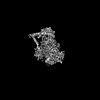 44924MC  9bumC  9burC  44923 C: citing same article ( M: map data used to model this data |
|---|---|
| Similar structure data |
-Links
 PDBj
PDBj


- Assembly
| Deposited unit | 
|
|---|---|
| 1 |
|
-Components
-Protein , 2 types, 2 molecules AB
| #1: Protein | Mass: 88652.609 Da / Num. of mol.: 1 Source method: isolated from a genetically manipulated source Source: (gene. exp.) Homo sapiens (human) / Gene: GGCX, GC / Production host: Homo sapiens (human)References: UniProt: P38435, peptidyl-glutamate 4-carboxylase |
|---|---|
| #2: Protein | Mass: 11804.439 Da / Num. of mol.: 1 Source method: isolated from a genetically manipulated source Source: (gene. exp.) Homo sapiens (human) / Gene: BGLAP / Production host: Homo sapiens (human) / References: UniProt: P02818 |
-Sugars , 2 types, 3 molecules 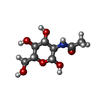
| #3: Polysaccharide | 2-acetamido-2-deoxy-beta-D-glucopyranose-(1-4)-2-acetamido-2-deoxy-beta-D-glucopyranose Source method: isolated from a genetically manipulated source |
|---|---|
| #4: Sugar | 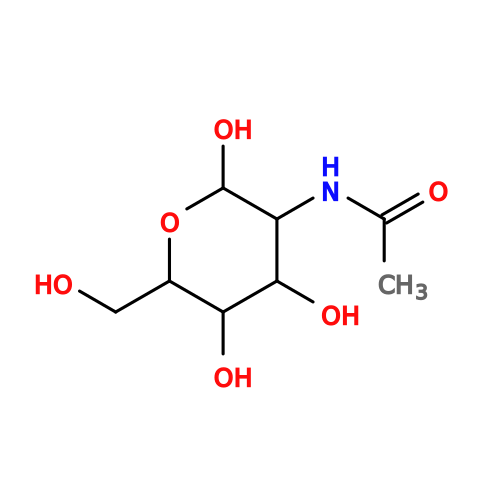 Type: D-saccharide, beta linking / Mass: 221.208 Da / Num. of mol.: 2 Type: D-saccharide, beta linking / Mass: 221.208 Da / Num. of mol.: 2Source method: isolated from a genetically manipulated source Formula: C8H15NO6 |
-Non-polymers , 3 types, 3 molecules 
| #5: Chemical | ChemComp-CLR / 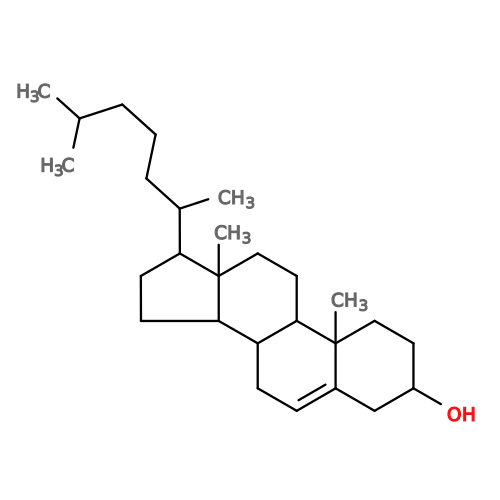 Mass: 386.654 Da / Num. of mol.: 1 / Source method: obtained synthetically / Formula: C27H46O Mass: 386.654 Da / Num. of mol.: 1 / Source method: obtained synthetically / Formula: C27H46O |
|---|---|
| #6: Chemical | ChemComp-POV / (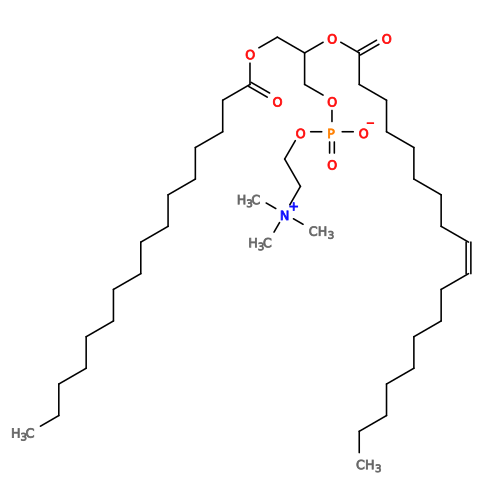 Mass: 760.076 Da / Num. of mol.: 1 / Source method: obtained synthetically / Formula: C42H82NO8P / Comment: phospholipid*YM Mass: 760.076 Da / Num. of mol.: 1 / Source method: obtained synthetically / Formula: C42H82NO8P / Comment: phospholipid*YM |
| #7: Chemical | ChemComp-A1AT1 / ( Mass: 460.648 Da / Num. of mol.: 1 / Source method: obtained synthetically / Formula: C31H40O3 |
-Details
| Has ligand of interest | N |
|---|---|
| Has protein modification | Y |
-Experimental details
-Experiment
| Experiment | Method: ELECTRON MICROSCOPY |
|---|---|
| EM experiment | Aggregation state: PARTICLE / 3D reconstruction method: single particle reconstruction |
- Sample preparation
| Component | Name: GGCX-BGP-menaquinone-4 epoxide complex / Type: COMPLEX / Entity ID: #1-#2 / Source: RECOMBINANT |
|---|---|
| Source (natural) | Organism: Homo sapiens (human) |
| Source (recombinant) | Organism: Homo sapiens (human) |
| Buffer solution | pH: 7.5 |
| Specimen | Embedding applied: NO / Shadowing applied: NO / Staining applied: NO / Vitrification applied: YES |
| Vitrification | Cryogen name: ETHANE |
- Electron microscopy imaging
| Experimental equipment |  Model: Titan Krios / Image courtesy: FEI Company |
|---|---|
| Microscopy | Model: FEI TITAN KRIOS |
| Electron gun | Electron source:  FIELD EMISSION GUN / Accelerating voltage: 300 kV / Illumination mode: FLOOD BEAM FIELD EMISSION GUN / Accelerating voltage: 300 kV / Illumination mode: FLOOD BEAM |
| Electron lens | Mode: BRIGHT FIELD / Nominal defocus max: 2000 nm / Nominal defocus min: 1000 nm |
| Image recording | Electron dose: 60 e/Å2 / Film or detector model: GATAN K3 (6k x 4k) |
- Processing
| CTF correction | Type: NONE |
|---|---|
| 3D reconstruction | Resolution: 3.06 Å / Resolution method: FSC 0.143 CUT-OFF / Num. of particles: 195408 / Symmetry type: POINT |
