 Movie
Movie Controller

[English] 日本語
 Yorodumi
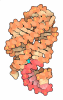
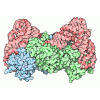
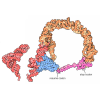
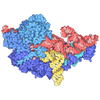
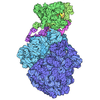
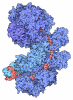
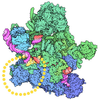
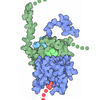
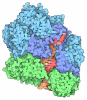
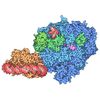
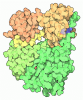
- PDB-9bkd: The structure of human Pdcd4 bound to the 40S small ribosomal subunit -
+ Open data

- Basic information
| Entry | Database: PDB / ID: 9bkd | |||||||||||||||||||||||||||||||||
|---|---|---|---|---|---|---|---|---|---|---|---|---|---|---|---|---|---|---|---|---|---|---|---|---|---|---|---|---|---|---|---|---|---|---|
| Title | The structure of human Pdcd4 bound to the 40S small ribosomal subunit | |||||||||||||||||||||||||||||||||
 Components Components |
| |||||||||||||||||||||||||||||||||
 Keywords Keywords | ANTITUMOR PROTEIN / Inhibitor | |||||||||||||||||||||||||||||||||
| Function / homology |  Function and homology information Function and homology informationepithelial to mesenchymal transition involved in cardiac fibroblast development / negative regulation of myofibroblast differentiation / negative regulation of vascular associated smooth muscle cell differentiation / negative regulation of JUN kinase activity / negative regulation of endoplasmic reticulum unfolded protein response / oxidized pyrimidine DNA binding / response to TNF agonist / positive regulation of base-excision repair / positive regulation of intrinsic apoptotic signaling pathway in response to DNA damage / positive regulation of respiratory burst involved in inflammatory response ...epithelial to mesenchymal transition involved in cardiac fibroblast development / negative regulation of myofibroblast differentiation / negative regulation of vascular associated smooth muscle cell differentiation / negative regulation of JUN kinase activity / negative regulation of endoplasmic reticulum unfolded protein response / oxidized pyrimidine DNA binding / response to TNF agonist / positive regulation of base-excision repair / positive regulation of intrinsic apoptotic signaling pathway in response to DNA damage / positive regulation of respiratory burst involved in inflammatory response / regulation of adenylate cyclase-activating G protein-coupled receptor signaling pathway / positive regulation of gastrulation / protein tyrosine kinase inhibitor activity / IRE1-RACK1-PP2A complex / TNFR1-mediated ceramide production / positive regulation of Golgi to plasma membrane protein transport / positive regulation of vascular associated smooth muscle cell apoptotic process / nucleolus organization / positive regulation of ubiquitin-protein transferase activity / positive regulation of DNA-templated transcription initiation / negative regulation of RNA splicing / negative regulation of DNA repair / supercoiled DNA binding / erythrocyte homeostasis / regulation of establishment of cell polarity / oxidized purine DNA binding / NF-kappaB complex / rRNA modification in the nucleus and cytosol / negative regulation of intrinsic apoptotic signaling pathway in response to hydrogen peroxide / negative regulation of phagocytosis / ubiquitin-like protein conjugating enzyme binding / cytoplasmic translational initiation / cytoplasmic side of rough endoplasmic reticulum membrane / Formation of the ternary complex, and subsequently, the 43S complex / ion channel inhibitor activity / laminin receptor activity / negative regulation of myoblast fusion / protein kinase A binding / Ribosomal scanning and start codon recognition / Translation initiation complex formation / negative regulation of vascular associated smooth muscle cell proliferation / negative regulation of Wnt signaling pathway / BMP signaling pathway / TOR signaling / BH3 domain binding / fibroblast growth factor binding / Protein hydroxylation / negative regulation of translational frameshifting / mTORC1-mediated signalling / monocyte chemotaxis / PELO:HBS1L and ABCE1 dissociate a ribosome on a non-stop mRNA / positive regulation of endothelial cell apoptotic process / SARS-CoV-1 modulates host translation machinery / regulation of cell division / positive regulation of GTPase activity / Peptide chain elongation / negative regulation of protein binding / Selenocysteine synthesis / Formation of a pool of free 40S subunits / positive regulation of intrinsic apoptotic signaling pathway by p53 class mediator / negative regulation of respiratory burst involved in inflammatory response / protein serine/threonine kinase inhibitor activity / Eukaryotic Translation Termination / Dengue Virus Attachment and Entry / SRP-dependent cotranslational protein targeting to membrane / Response of EIF2AK4 (GCN2) to amino acid deficiency / Viral mRNA Translation / ubiquitin ligase inhibitor activity / endonucleolytic cleavage to generate mature 3'-end of SSU-rRNA from (SSU-rRNA, 5.8S rRNA, LSU-rRNA) / Nonsense Mediated Decay (NMD) independent of the Exon Junction Complex (EJC) / positive regulation of signal transduction by p53 class mediator / GTP hydrolysis and joining of the 60S ribosomal subunit / L13a-mediated translational silencing of Ceruloplasmin expression / regulation of translational fidelity / spindle assembly / Major pathway of rRNA processing in the nucleolus and cytosol / positive regulation of microtubule polymerization / phagocytic cup / Nonsense Mediated Decay (NMD) enhanced by the Exon Junction Complex (EJC) / negative regulation of ubiquitin-dependent protein catabolic process / Protein methylation / positive regulation of cell cycle / endonucleolytic cleavage in ITS1 to separate SSU-rRNA from 5.8S rRNA and LSU-rRNA from tricistronic rRNA transcript (SSU-rRNA, 5.8S rRNA, LSU-rRNA) / translation regulator activity / Nuclear events stimulated by ALK signaling in cancer / DNA-(apurinic or apyrimidinic site) endonuclease activity / ribosomal small subunit export from nucleus / negative regulation of protein ubiquitination / Amplification of signal from unattached kinetochores via a MAD2 inhibitory signal / rough endoplasmic reticulum / negative regulation of cytokine production involved in inflammatory response / laminin binding / SH2 domain binding / positive regulation of apoptotic signaling pathway / signaling adaptor activity / Gene and protein expression by JAK-STAT signaling after Interleukin-12 stimulation / Maturation of protein E / MDM2/MDM4 family protein binding / Maturation of protein E / Mitotic Prometaphase Similarity search - Function | |||||||||||||||||||||||||||||||||
| Biological species |  Homo sapiens (human) Homo sapiens (human) | |||||||||||||||||||||||||||||||||
| Method | ELECTRON MICROSCOPY / single particle reconstruction / cryo EM / Resolution: 2.6 Å | |||||||||||||||||||||||||||||||||
 Authors Authors | Brito Querido, J. / Sokabe, M. / Diaz-Lopez, I. / Gordiyenko, Y. / Zuber, P. / Albacete-Albacete, L. / Ramakrishnan, V. / S.Fraser, C. | |||||||||||||||||||||||||||||||||
| Funding support |  United Kingdom, United Kingdom,  Switzerland, 3items Switzerland, 3items
| |||||||||||||||||||||||||||||||||
 Citation Citation | Journal: Nat Commun / Year: 2024 Title: Human tumor suppressor protein Pdcd4 binds at the mRNA entry channel in the 40S small ribosomal subunit. Authors: Jailson Brito Querido / Masaaki Sokabe / Irene Díaz-López / Yuliya Gordiyenko / Philipp Zuber / Yifei Du / Lucas Albacete-Albacete / V Ramakrishnan / Christopher S Fraser /  Abstract: Translation is regulated mainly in the initiation step, and its dysregulation is implicated in many human diseases. Several proteins have been found to regulate translational initiation, including ...Translation is regulated mainly in the initiation step, and its dysregulation is implicated in many human diseases. Several proteins have been found to regulate translational initiation, including Pdcd4 (programmed cell death gene 4). Pdcd4 is a tumor suppressor protein that prevents cell growth, invasion, and metastasis. It is downregulated in most tumor cells, while global translation in the cell is upregulated. To understand the mechanisms underlying translational control by Pdcd4, we used single-particle cryo-electron microscopy to determine the structure of human Pdcd4 bound to 40S small ribosomal subunit, including Pdcd4-40S and Pdcd4-40S-eIF4A-eIF3-eIF1 complexes. The structures reveal the binding site of Pdcd4 at the mRNA entry site in the 40S, where the C-terminal domain (CTD) interacts with eIF4A at the mRNA entry site, while the N-terminal domain (NTD) is inserted into the mRNA channel and decoding site. The structures, together with quantitative binding and in vitro translation assays, shed light on the critical role of the NTD for the recruitment of Pdcd4 to the ribosomal complex and suggest a model whereby Pdcd4 blocks the eIF4F-independent role of eIF4A during recruitment and scanning of the 5' UTR of mRNA. | |||||||||||||||||||||||||||||||||
| History |
|
- Structure visualization
| Structure viewer | Molecule: MolmilJmol/JSmol |
|---|
- Downloads & links
-Download
| PDBx/mmCIF format | 9bkd.cif.gz | 1.9 MB | Display | PDBx/mmCIF format |
|---|---|---|---|---|
| PDB format | pdb9bkd.ent.gz | 1.4 MB | Display | PDB format |
| PDBx/mmJSON format | 9bkd.json.gz | Tree view | PDBx/mmJSON format | |
| Others |  Other downloads Other downloads |
-Validation report
| Arichive directory | https://data.pdbj.org/pub/pdb/validation_reports/bk/9bkdftp://data.pdbj.org/pub/pdb/validation_reports/bk/9bkd | HTTPS FTP |
|---|
-Related structure data
| Related structure data |  44641MC  9blnC M: map data used to model this data C: citing same article ( |
|---|---|
| Similar structure data |
-Links
 PDBj
PDBj


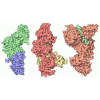
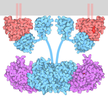
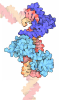
- Assembly
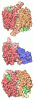
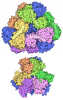
| Deposited unit | 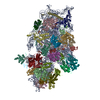
|
|---|---|
| 1 |
|
-Components
-Small ribosomal subunit protein ... , 14 types, 14 molecules SGNBCDEFRTZaef
| #1: Protein | Mass: 28751.906 Da / Num. of mol.: 1 / Source method: isolated from a natural source / Source: (natural) Homo sapiens (human) / References: UniProt: P62753 |
|---|---|
| #2: Protein | Mass: 22168.914 Da / Num. of mol.: 1 / Source method: isolated from a natural source / Source: (natural) Homo sapiens (human) / References: UniProt: P62081 |
| #7: Protein | Mass: 32883.938 Da / Num. of mol.: 1 / Source method: isolated from a natural source / Source: (natural) Homo sapiens (human) / References: UniProt: P08865 |
| #13: Protein | Mass: 18468.826 Da / Num. of mol.: 1 / Source method: isolated from a natural source / Source: (natural) Homo sapiens (human) / References: UniProt: P62280 |
| #14: Protein | Mass: 29654.869 Da / Num. of mol.: 1 / Source method: isolated from a natural source / Source: (natural) Homo sapiens (human) / References: UniProt: P62701 |
| #15: Protein | Mass: 22641.564 Da / Num. of mol.: 1 / Source method: isolated from a natural source / Source: (natural) Homo sapiens (human) / References: UniProt: P46781 |
| #16: Protein | Mass: 15844.666 Da / Num. of mol.: 1 / Source method: isolated from a natural source / Source: (natural) Homo sapiens (human) / References: UniProt: P62266 |
| #17: Protein | Mass: 6668.938 Da / Num. of mol.: 1 / Source method: isolated from a natural source / Source: (natural) Homo sapiens (human) / References: UniProt: P62861 |
| #19: Protein | Mass: 24263.387 Da / Num. of mol.: 1 / Source method: isolated from a natural source / Source: (natural) Homo sapiens (human) / References: UniProt: P62241 |
| #20: Protein | Mass: 15463.333 Da / Num. of mol.: 1 / Source method: isolated from a natural source / Source: (natural) Homo sapiens (human) / References: UniProt: P62847 |
| #23: Protein | Mass: 26729.369 Da / Num. of mol.: 1 / Source method: isolated from a natural source / Source: (natural) Homo sapiens (human)References: UniProt: P23396, DNA-(apurinic or apyrimidinic site) lyase |
| #24: Protein | Mass: 18933.846 Da / Num. of mol.: 1 / Source method: isolated from a natural source / Source: (natural) Homo sapiens (human) / References: UniProt: P46783 |
| #28: Protein | Mass: 13776.224 Da / Num. of mol.: 1 / Source method: isolated from a natural source / Source: (natural) Homo sapiens (human) / References: UniProt: P62851 |
| #29: Protein | Mass: 17759.777 Da / Num. of mol.: 1 / Source method: isolated from a natural source / Source: (natural) Homo sapiens (human) / References: UniProt: P62269 |
-40S ribosomal protein ... , 17 types, 17 molecules HKLOQPIJVYbdimnMh
| #3: Protein | Mass: 9480.186 Da / Num. of mol.: 1 / Source method: isolated from a natural source / Source: (natural) Homo sapiens (human) / References: UniProt: P42677 |
|---|---|
| #4: Protein | Mass: 9124.389 Da / Num. of mol.: 1 / Source method: isolated from a natural source / Source: (natural) Homo sapiens (human) / References: UniProt: P63220 |
| #5: Protein | Mass: 31376.516 Da / Num. of mol.: 1 / Source method: isolated from a natural source / Source: (natural) Homo sapiens (human) / References: UniProt: P15880 |
| #6: Protein | Mass: 30002.061 Da / Num. of mol.: 1 / Source method: isolated from a natural source / Source: (natural) Homo sapiens (human) / References: UniProt: P61247 |
| #8: Protein | Mass: 13047.532 Da / Num. of mol.: 1 / Source method: isolated from a natural source / Source: (natural) Homo sapiens (human) / References: UniProt: P62854 |
| #9: Protein | Mass: 16302.772 Da / Num. of mol.: 1 / Source method: isolated from a natural source / Source: (natural) Homo sapiens (human) / References: UniProt: P62263 |
| #10: Protein | Mass: 17259.389 Da / Num. of mol.: 1 / Source method: isolated from a natural source / Source: (natural) Homo sapiens (human) / References: UniProt: P62277 |
| #18: Protein | Mass: 14865.555 Da / Num. of mol.: 1 / Source method: isolated from a natural source / Source: (natural) Homo sapiens (human) / References: UniProt: P62244 |
| #21: Protein | Mass: 22913.453 Da / Num. of mol.: 1 / Source method: isolated from a natural source / Source: (natural) Homo sapiens (human) / References: UniProt: P46782 |
| #22: Protein | Mass: 16477.377 Da / Num. of mol.: 1 / Source method: isolated from a natural source / Source: (natural) Homo sapiens (human) / References: UniProt: P62249 |
| #25: Protein | Mass: 17076.207 Da / Num. of mol.: 1 / Source method: isolated from a natural source / Source: (natural) Homo sapiens (human) / References: UniProt: P62841 |
| #27: Protein | Mass: 16091.562 Da / Num. of mol.: 1 / Source method: isolated from a natural source / Source: (natural) Homo sapiens (human) / References: UniProt: P39019 |
| #30: Protein | Mass: 6690.821 Da / Num. of mol.: 1 / Source method: isolated from a natural source / Source: (natural) Homo sapiens (human) / References: UniProt: P62273 |
| #32: Protein | Mass: 14538.987 Da / Num. of mol.: 1 / Source method: isolated from a natural source / Source: (natural) Homo sapiens (human) / References: UniProt: P25398 |
| #33: Protein | Mass: 7855.052 Da / Num. of mol.: 1 / Source method: isolated from a natural source / Source: (natural) Homo sapiens (human) / References: UniProt: P62857 |
| #34: Protein | Mass: 15578.156 Da / Num. of mol.: 1 / Source method: isolated from a natural source / Source: (natural) Homo sapiens (human) / References: UniProt: P08708 |
| #35: Protein | Mass: 13398.763 Da / Num. of mol.: 1 / Source method: isolated from a natural source / Source: (natural) Homo sapiens (human) / References: UniProt: P60866 |
-Protein , 3 types, 3 molecules ckU
| #26: Protein | Mass: 35115.652 Da / Num. of mol.: 1 / Source method: isolated from a natural source / Source: (natural) Homo sapiens (human) / References: UniProt: P63244 |
|---|---|
| #31: Protein | Mass: 18004.041 Da / Num. of mol.: 1 / Source method: isolated from a natural source / Source: (natural) Homo sapiens (human) / References: UniProt: P62979 |
| #36: Protein | Mass: 51802.168 Da / Num. of mol.: 1 Source method: isolated from a genetically manipulated source Source: (gene. exp.) Homo sapiens (human) / Gene: PDCD4, H731 / Production host:   Escherichia coli BL21(DE3) (bacteria) / References: UniProt: Q53EL6 Escherichia coli BL21(DE3) (bacteria) / References: UniProt: Q53EL6 |
-Protein/peptide / RNA chain , 2 types, 2 molecules 9A
| #11: Protein/peptide | Mass: 3473.451 Da / Num. of mol.: 1 / Source method: isolated from a natural source / Source: (natural) Homo sapiens (human) / References: UniProt: P62945 |
|---|---|
| #12: RNA chain | Mass: 555109.000 Da / Num. of mol.: 1 / Source method: isolated from a natural source / Source: (natural) Homo sapiens (human) |
-Non-polymers , 4 types, 111 molecules 


| #37: Chemical |  Mass: 65.409 Da / Num. of mol.: 3 / Source method: obtained synthetically / Formula: Zn / Feature type: SUBJECT OF INVESTIGATION Mass: 65.409 Da / Num. of mol.: 3 / Source method: obtained synthetically / Formula: Zn / Feature type: SUBJECT OF INVESTIGATION#38: Chemical | ChemComp-K /  Mass: 39.098 Da / Num. of mol.: 19 Mass: 39.098 Da / Num. of mol.: 19Source method: isolated from a genetically manipulated source Formula: K / Feature type: SUBJECT OF INVESTIGATION #39: Chemical | ChemComp-MG /  Mass: 24.305 Da / Num. of mol.: 88 / Source method: obtained synthetically / Formula: Mg / Feature type: SUBJECT OF INVESTIGATION Mass: 24.305 Da / Num. of mol.: 88 / Source method: obtained synthetically / Formula: Mg / Feature type: SUBJECT OF INVESTIGATION#40: Chemical | ChemComp-SPD / | 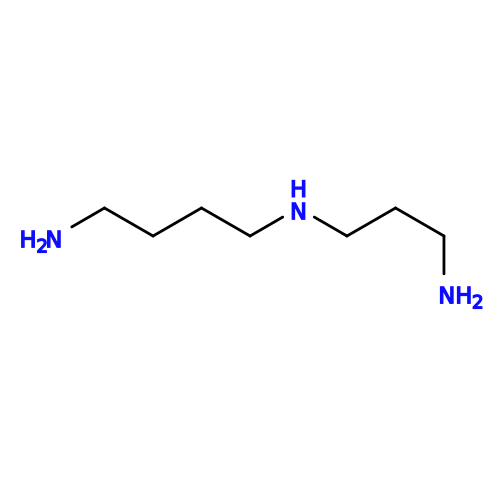 Mass: 145.246 Da / Num. of mol.: 1 / Source method: obtained synthetically / Formula: C7H19N3 / Feature type: SUBJECT OF INVESTIGATION Mass: 145.246 Da / Num. of mol.: 1 / Source method: obtained synthetically / Formula: C7H19N3 / Feature type: SUBJECT OF INVESTIGATION |
|---|
-Details
| Has ligand of interest | Y |
|---|---|
| Has protein modification | N |
-Experimental details
-Experiment
| Experiment | Method: ELECTRON MICROSCOPY |
|---|---|
| EM experiment | Aggregation state: PARTICLE / 3D reconstruction method: single particle reconstruction |
- Sample preparation
| Component | Name: 40S ribosome bound to Pdcd4 / Type: COMPLEX / Entity ID: #1-#11, #13-#36 / Source: NATURAL |
|---|---|
| Molecular weight | Value: 1.2 MDa / Experimental value: NO |
| Source (natural) | Organism: Homo sapiens (human) |
| Buffer solution | pH: 7.5 |
| Specimen | Embedding applied: NO / Shadowing applied: NO / Staining applied: NO / Vitrification applied: YES |
| Specimen support | Grid material: GOLD / Grid mesh size: 300 divisions/in. |
| Vitrification | Cryogen name: ETHANE |
- Electron microscopy imaging
| Experimental equipment |  Model: Titan Krios / Image courtesy: FEI Company |
|---|---|
| Microscopy | Model: FEI TITAN KRIOS |
| Electron gun | Electron source:  FIELD EMISSION GUN / Accelerating voltage: 300 kV / Illumination mode: OTHER FIELD EMISSION GUN / Accelerating voltage: 300 kV / Illumination mode: OTHER |
| Electron lens | Mode: OTHER / Nominal defocus max: 3000 nm / Nominal defocus min: 1200 nm / C2 aperture diameter: 100 µm |
| Image recording | Electron dose: 25 e/Å2 / Film or detector model: GATAN K3 (6k x 4k) |
- Processing
| EM software | Name: PHENIX / Version: dev_4620: / Category: model refinement | ||||||||||||||||||||||||
|---|---|---|---|---|---|---|---|---|---|---|---|---|---|---|---|---|---|---|---|---|---|---|---|---|---|
| CTF correction | Type: PHASE FLIPPING AND AMPLITUDE CORRECTION | ||||||||||||||||||||||||
| 3D reconstruction | Resolution: 2.6 Å / Resolution method: FSC 0.143 CUT-OFF / Num. of particles: 85656 / Symmetry type: POINT | ||||||||||||||||||||||||
| Refine LS restraints |
|
