National Natural Science Foundation of China (NSFC)
China
Citation
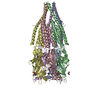
Journal: Proc Natl Acad Sci U S A / Year: 2024 Title: Cryo-EM structure of the zinc-activated channel (ZAC) in the Cys-loop receptor superfamily. Authors: Fei Jin / Yi-Yu Lin / Ru-Chun Wang / Tang-Xuan Xie / Yimeng Zhao / Cheng Shen / Danqi Sheng / Muneyoshi Ichikawa / Ye Yu / Jin Wang / Motoyuki Hattori / Abstract: Cys-loop receptors are a large superfamily of pentameric ligand-gated ion channels with various physiological roles, especially in neurotransmission in the central nervous system. Among them, zinc- ...Cys-loop receptors are a large superfamily of pentameric ligand-gated ion channels with various physiological roles, especially in neurotransmission in the central nervous system. Among them, zinc-activated channel (ZAC) is a Zn-activated ion channel that is widely expressed in the human body and is conserved among eukaryotes. Due to its gating by extracellular Zn, ZAC has been considered a Zn sensor, but it has undergone minimal structural and functional characterization since its molecular cloning. Among the families in the Cys-loop receptor superfamily, only the structure of ZAC has yet to be determined. Here, we determined the cryo-EM structure of ZAC in the apo state and performed structure-based mutation analyses. We identified a few residues in the extracellular domain whose mutations had a mild impact on Zn sensitivity. The constriction site in the ion-conducting pore differs from the one in other Cys-loop receptor structures, and further mutational analysis identified a key residue that is important for ion selectivity. In summary, our work provides a structural framework for understanding the ion-conducting mechanism of ZAC.
History
Deposition
Jun 7, 2024
Deposition site: PDBJ / Processing site: PDBJ
Revision 1.0
Nov 27, 2024
Provider: repository / Type: Initial release
Revision 1.0
Nov 27, 2024
Data content type: EM metadata / Data content type: EM metadata / Provider: repository / Type: Initial release
Revision 1.0
Nov 27, 2024
Data content type: FSC / Data content type: FSC / Provider: repository / Type: Initial release
Revision 1.0
Nov 27, 2024
Data content type: Half map / Part number: 1 / Data content type: Half map / Provider: repository / Type: Initial release
Revision 1.0
Nov 27, 2024
Data content type: Half map / Part number: 2 / Data content type: Half map / Provider: repository / Type: Initial release
Revision 1.0
Nov 27, 2024
Data content type: Image / Data content type: Image / Provider: repository / Type: Initial release
Revision 1.0
Nov 27, 2024
Data content type: Primary map / Data content type: Primary map / Provider: repository / Type: Initial release
Data content type: EM metadata / Data content type: EM metadata / EM metadata / Group: Data processing / Experimental summary / Data content type: EM metadata / EM metadata / Category: em_admin / em_software / Data content type: EM metadata / EM metadata / Item: _em_admin.last_update / _em_software.name
Mass: 47255.855 Da / Num. of mol.: 5 Source method: isolated from a genetically manipulated source Source: (gene. exp.) Oryzias latipes (Japanese medaka) / Cell line (production host): HEK293 / Production host: Homo sapiens (human)
In the structure databanks used in Yorodumi, some data are registered as the other names, "COVID-19 virus" and "2019-nCoV". Here are the details of the virus and the list of structure data.
Jan 31, 2019. EMDB accession codes are about to change! (news from PDBe EMDB page)
EMDB accession codes are about to change! (news from PDBe EMDB page)
The allocation of 4 digits for EMDB accession codes will soon come to an end. Whilst these codes will remain in use, new EMDB accession codes will include an additional digit and will expand incrementally as the available range of codes is exhausted. The current 4-digit format prefixed with “EMD-” (i.e. EMD-XXXX) will advance to a 5-digit format (i.e. EMD-XXXXX), and so on. It is currently estimated that the 4-digit codes will be depleted around Spring 2019, at which point the 5-digit format will come into force.
The EM Navigator/Yorodumi systems omit the EMD- prefix.
Related info.:Q: What is EMD? / ID/Accession-code notation in Yorodumi/EM Navigator
Yorodumi is a browser for structure data from EMDB, PDB, SASBDB, etc.
This page is also the successor to EM Navigator detail page, and also detail information page/front-end page for Omokage search.
The word "yorodu" (or yorozu) is an old Japanese word meaning "ten thousand". "mi" (miru) is to see.
Related info.:EMDB / PDB / SASBDB / Comparison of 3 databanks / Yorodumi Search / Aug 31, 2016. New EM Navigator & Yorodumi / Yorodumi Papers / Jmol/JSmol / Function and homology information / Changes in new EM Navigator and Yorodumi
 Movie
Movie Controller


 Open data
 Basic information
 Components
 Keywords
 Oryzias latipes (Japanese medaka)
 Authors
 China, 1items
  Citation
 Structure visualization
 Molmil
 Downloads & links
 Other downloads
 PDBj
PDBj Assembly
 Homo sapiens (human)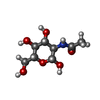
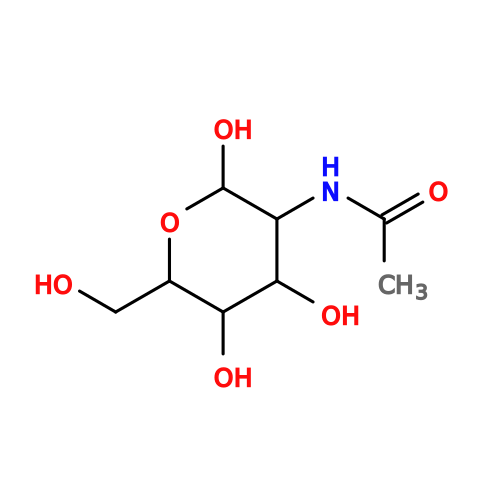 Type: D-saccharide, beta linking / Mass: 221.208 Da / Num. of mol.: 5 / Source method: obtained synthetically / Formula: C8H15NO6
 Sample preparation
 Electron microscopy imaging
 FIELD EMISSION GUN / Accelerating voltage: 300 kV / Illumination mode: FLOOD BEAM
 Processing