 Movie
Movie Controller


+ Open data

- Basic information
| Entry | Database: PDB / ID: 8thf | ||||||
|---|---|---|---|---|---|---|---|
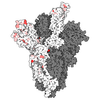
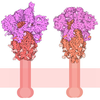
| Title | SARS-CoV-2 BA.1 S-6P-no-RBD | ||||||
 Components Components | Spike protein S1,Spike glycoprotein | ||||||
 Keywords Keywords | VIRAL PROTEIN / SARS-CoV-2 / omicron spike / vaccine | ||||||
| Function / homology |  Function and homology information Function and homology informationsymbiont-mediated disruption of host tissue / Maturation of spike protein / host cell surface / Translation of Structural Proteins / Virion Assembly and Release / Lectin pathway of complement activation / host extracellular region / symbiont-mediated-mediated suppression of host tetherin activity / structural constituent of virion / Induction of Cell-Cell Fusion ...symbiont-mediated disruption of host tissue / Maturation of spike protein / host cell surface / Translation of Structural Proteins / Virion Assembly and Release / Lectin pathway of complement activation / host extracellular region / symbiont-mediated-mediated suppression of host tetherin activity / structural constituent of virion / Induction of Cell-Cell Fusion / positive regulation of viral entry into host cell / Initial triggering of complement / membrane fusion / host cell endoplasmic reticulum-Golgi intermediate compartment membrane / Attachment and Entry / entry receptor-mediated virion attachment to host cell / receptor-mediated virion attachment to host cell / host cell surface receptor binding / symbiont-mediated suppression of host innate immune response / endocytosis involved in viral entry into host cell / receptor ligand activity / fusion of virus membrane with host plasma membrane / fusion of virus membrane with host endosome membrane / viral envelope / symbiont entry into host cell / virion attachment to host cell / host cell plasma membrane / SARS-CoV-2 activates/modulates innate and adaptive immune responses / virion membrane / membrane / identical protein binding / plasma membrane Similarity search - Function | ||||||
| Biological species |  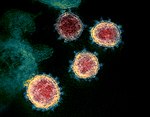 Severe acute respiratory syndrome coronavirus 2 Severe acute respiratory syndrome coronavirus 2 | ||||||
| Method | ELECTRON MICROSCOPY / single particle reconstruction / cryo EM / Resolution: 2.83 Å | ||||||
 Authors Authors | Bu, F. / Li, F. / Liu, B. | ||||||
| Funding support |  United States, 1items United States, 1items
| ||||||
 Citation Citation | Journal: NPJ Vaccines / Year: 2024 Title: Universal subunit vaccine protects against multiple SARS-CoV-2 variants and SARS-CoV. Authors: Gang Wang / Abhishek K Verma / Juan Shi / Xiaoqing Guan / David K Meyerholz / Fan Bu / Wei Wen / Bin Liu / Fang Li / Stanley Perlman / Lanying Du / Abstract: Although Omicron RBD of SARS-CoV-2 accumulates many mutations, the backbone region (truncated RBD) of spike protein is highly conserved. Here, we designed several subunit vaccines by keeping the ...Although Omicron RBD of SARS-CoV-2 accumulates many mutations, the backbone region (truncated RBD) of spike protein is highly conserved. Here, we designed several subunit vaccines by keeping the conserved spike backbone region of SARS-CoV-2 Omicron BA.1 subvariant (S-6P-no-RBD), or inserting the RBD of Delta variant (S-6P-Delta-RBD), Omicron (BA.5) variant (S-6P-BA5-RBD), or ancestral SARS-CoV-2 (S-6P-WT-RBD) to the above backbone construct, and evaluated their ability to induce immune responses and cross-protective efficacy against various SARS-CoV-2 variants and SARS-CoV. Among the four subunit vaccines, S-6P-Delta-RBD protein elicited broad and potent neutralizing antibodies against all SARS-CoV-2 variants tested, including Alpha, Beta, Gamma, and Delta variants, the BA.1, BA.2, BA.2.75, BA.4.6, and BA.5 Omicron subvariants, and the ancestral strain of SARS-CoV-2. This vaccine prevented infection and replication of SARS-CoV-2 Omicron, and completely protected immunized mice against lethal challenge with the SARS-CoV-2 Delta variant and SARS-CoV. Sera from S-6P-Delta-RBD-immunized mice protected naive mice against challenge with the Delta variant, with significantly reduced viral titers and without pathological effects. Protection correlated positively with the serum neutralizing antibody titer. Overall, the designed vaccine has potential for development as a universal COVID-19 vaccine and/or a pan-sarbecovirus subunit vaccine that will prevent current and future outbreaks caused by SARS-CoV-2 variants and SARS-related CoVs. | ||||||
| History |
|
- Structure visualization
| Structure viewer | Molecule: MolmilJmol/JSmol |
|---|
- Downloads & links
-Download
| PDBx/mmCIF format | 8thf.cif.gz | 493.4 KB | Display | PDBx/mmCIF format |
|---|---|---|---|---|
| PDB format | pdb8thf.ent.gz | 395.7 KB | Display | PDB format |
| PDBx/mmJSON format | 8thf.json.gz | Tree view | PDBx/mmJSON format | |
| Others |  Other downloads Other downloads |
-Validation report
| Arichive directory | https://data.pdbj.org/pub/pdb/validation_reports/th/8thfftp://data.pdbj.org/pub/pdb/validation_reports/th/8thf | HTTPS FTP |
|---|
-Related structure data
| Related structure data |  41260MC M: map data used to model this data C: citing same article ( |
|---|---|
| Similar structure data |
-Links
 PDBj
PDBj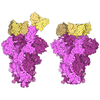
- Assembly
| Deposited unit | 
|
|---|---|
| 1 |
|
-Components
| #1: Protein | Mass: 114876.422 Da / Num. of mol.: 3 / Fragment: RBD truncated,RBD truncated Source method: isolated from a genetically manipulated source Source: (gene. exp.) Severe acute respiratory syndrome coronavirus 2Gene: S, 2 / Production host:  Homo sapiens (human) / References: UniProt: P0DTC2 Homo sapiens (human) / References: UniProt: P0DTC2#2: Polysaccharide | 2-acetamido-2-deoxy-beta-D-glucopyranose-(1-4)-2-acetamido-2-deoxy-beta-D-glucopyranose Source method: isolated from a genetically manipulated source #3: Sugar | ChemComp-NAG /  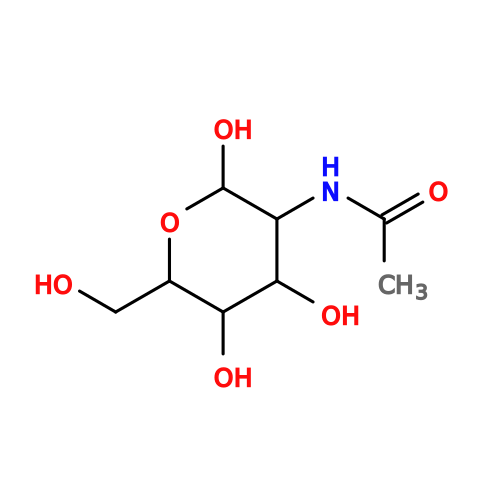 Type: D-saccharide, beta linking / Mass: 221.208 Da / Num. of mol.: 15 / Source method: obtained synthetically / Formula: C8H15NO6 / Feature type: SUBJECT OF INVESTIGATION Type: D-saccharide, beta linking / Mass: 221.208 Da / Num. of mol.: 15 / Source method: obtained synthetically / Formula: C8H15NO6 / Feature type: SUBJECT OF INVESTIGATIONHas ligand of interest | Y | Has protein modification | Y | |
|---|
-Experimental details
-Experiment
| Experiment | Method: ELECTRON MICROSCOPY |
|---|---|
| EM experiment | Aggregation state: PARTICLE / 3D reconstruction method: single particle reconstruction |
- Sample preparation
| Component | Name: SARS-CoV-2 omicron BA.1 spike no-RBD / Type: COMPLEX / Entity ID: #1 / Source: RECOMBINANT |
|---|---|
| Molecular weight | Experimental value: NO |
| Source (natural) | Organism: Severe acute respiratory syndrome coronavirus 2 |
| Source (recombinant) | Organism: Homo sapiens (human) |
| Buffer solution | pH: 7.4 |
| Specimen | Embedding applied: NO / Shadowing applied: NO / Staining applied: NO / Vitrification applied: YES |
| Specimen support | Grid material: COPPER / Grid mesh size: 300 divisions/in. / Grid type: Quantifoil R1.2/1.3 |
| Vitrification | Instrument: FEI VITROBOT MARK IV / Cryogen name: ETHANE / Humidity: 100 % / Chamber temperature: 295 K |
- Electron microscopy imaging
| Experimental equipment |  Model: Titan Krios / Image courtesy: FEI Company |
|---|---|
| Microscopy | Model: FEI TITAN KRIOS |
| Electron gun | Electron source:  FIELD EMISSION GUN / Accelerating voltage: 300 kV / Illumination mode: FLOOD BEAM FIELD EMISSION GUN / Accelerating voltage: 300 kV / Illumination mode: FLOOD BEAM |
| Electron lens | Mode: BRIGHT FIELD / Nominal magnification: 130000 X / Nominal defocus max: 2500 nm / Nominal defocus min: 750 nm / Cs: 2.7 mm / C2 aperture diameter: 50 µm |
| Specimen holder | Cryogen: NITROGEN / Specimen holder model: FEI TITAN KRIOS AUTOGRID HOLDER / Temperature (max): 70 K / Temperature (min): 70 K |
| Image recording | Electron dose: 42 e/Å2 / Detector mode: COUNTING / Film or detector model: GATAN K3 BIOQUANTUM (6k x 4k) |
| EM imaging optics | Energyfilter name: GIF Bioquantum / Energyfilter slit width: 20 eV |
- Processing
| EM software | Name: PHENIX / Version: 1.18.2_3874: / Category: model refinement | ||||||||||||||||||||||||
|---|---|---|---|---|---|---|---|---|---|---|---|---|---|---|---|---|---|---|---|---|---|---|---|---|---|
| CTF correction | Type: PHASE FLIPPING AND AMPLITUDE CORRECTION | ||||||||||||||||||||||||
| Symmetry | Point symmetry: C3 (3 fold cyclic) | ||||||||||||||||||||||||
| 3D reconstruction | Resolution: 2.83 Å / Resolution method: FSC 0.143 CUT-OFF / Num. of particles: 171788 / Symmetry type: POINT | ||||||||||||||||||||||||
| Atomic model building | PDB-ID: 7TGW Accession code: 7TGW / Source name: PDB / Type: experimental model | ||||||||||||||||||||||||
| Refine LS restraints |
|

