 Movie
Movie Controller

[English] 日本語
 Yorodumi
- PDB-8oxm: ATM(Q2971A) activated by oxidative stress in complex with Mg AMP-... -
+ Open data

- Basic information
| Entry | Database: PDB / ID: 8oxm | ||||||||||||
|---|---|---|---|---|---|---|---|---|---|---|---|---|---|
| Title | ATM(Q2971A) activated by oxidative stress in complex with Mg AMP-PNP and p53 peptide | ||||||||||||
 Components Components |
| ||||||||||||
 Keywords Keywords | SIGNALING PROTEIN / Ataxia-Telangiectasia Mutated / ATM / kinase / oxidative stress | ||||||||||||
| Function / homology |  Function and homology information Function and homology informationcellular response to nitrosative stress / negative regulation of telomere capping / peptidyl-serine autophosphorylation / establishment of RNA localization to telomere / positive regulation of telomerase catalytic core complex assembly / Sensing of DNA Double Strand Breaks / establishment of protein-containing complex localization to telomere / positive regulation of telomere maintenance via telomere lengthening / negative regulation of B cell proliferation / regulation of telomere maintenance via telomerase ...cellular response to nitrosative stress / negative regulation of telomere capping / peptidyl-serine autophosphorylation / establishment of RNA localization to telomere / positive regulation of telomerase catalytic core complex assembly / Sensing of DNA Double Strand Breaks / establishment of protein-containing complex localization to telomere / positive regulation of telomere maintenance via telomere lengthening / negative regulation of B cell proliferation / regulation of telomere maintenance via telomerase / extrinsic component of synaptic vesicle membrane / DNA-dependent protein kinase activity / histone mRNA catabolic process / pre-B cell allelic exclusion / histone H2AXS139 kinase activity / DNA double-strand break processing / cellular response to X-ray / regulation of autophagosome assembly / pexophagy / positive regulation of autophagosome assembly / negative regulation of helicase activity / Impaired BRCA2 binding to PALB2 / Loss of function of TP53 in cancer due to loss of tetramerization ability / Regulation of TP53 Expression / signal transduction by p53 class mediator / negative regulation of G1 to G0 transition / Transcriptional activation of cell cycle inhibitor p21 / negative regulation of pentose-phosphate shunt / DNA repair complex / Activation of NOXA and translocation to mitochondria / ATP-dependent DNA/DNA annealing activity / regulation of cell cycle G2/M phase transition / oligodendrocyte apoptotic process / positive regulation of thymocyte apoptotic process / oxidative stress-induced premature senescence / bone marrow development / circadian behavior / cellular response to actinomycin D / positive regulation of programmed necrotic cell death / RUNX3 regulates CDKN1A transcription / reciprocal meiotic recombination / TP53 Regulates Transcription of Death Receptors and Ligands / Activation of PUMA and translocation to mitochondria / TP53 regulates transcription of additional cell cycle genes whose exact role in the p53 pathway remain uncertain / mRNA transcription / Urea cycle / Regulation of TP53 Activity through Association with Co-factors / ER overload response / hematopoietic stem cell differentiation / cellular response to stress / Formation of Senescence-Associated Heterochromatin Foci (SAHF) / 1-phosphatidylinositol-3-kinase activity / mitotic spindle assembly checkpoint signaling / TP53 Regulates Transcription of Caspase Activators and Caspases / response to ionizing radiation / intrinsic apoptotic signaling pathway by p53 class mediator / entrainment of circadian clock by photoperiod / response to starvation / Homologous DNA Pairing and Strand Exchange / Defective homologous recombination repair (HRR) due to BRCA1 loss of function / Defective HDR through Homologous Recombination Repair (HRR) due to PALB2 loss of BRCA1 binding function / Defective HDR through Homologous Recombination Repair (HRR) due to PALB2 loss of BRCA2/RAD51/RAD51C binding function / Resolution of D-loop Structures through Synthesis-Dependent Strand Annealing (SDSA) / HDR through Single Strand Annealing (SSA) / Zygotic genome activation (ZGA) / mitotic G2 DNA damage checkpoint signaling / Resolution of D-loop Structures through Holliday Junction Intermediates / TP53 Regulates Transcription of Genes Involved in Cytochrome C Release / PI5P Regulates TP53 Acetylation / positive regulation of release of cytochrome c from mitochondria / hematopoietic progenitor cell differentiation / Association of TriC/CCT with target proteins during biosynthesis / negative regulation of telomere maintenance via telomerase / SUMOylation of transcription factors / TP53 regulates transcription of several additional cell death genes whose specific roles in p53-dependent apoptosis remain uncertain / peroxisomal matrix / positive regulation of double-strand break repair / intrinsic apoptotic signaling pathway in response to DNA damage by p53 class mediator / Transcriptional Regulation by VENTX / Impaired BRCA2 binding to RAD51 / replicative senescence / TFIID-class transcription factor complex binding / intrinsic apoptotic signaling pathway in response to endoplasmic reticulum stress / positive regulation of DNA damage response, signal transduction by p53 class mediator / viral process / positive regulation of intrinsic apoptotic signaling pathway / Pyroptosis / determination of adult lifespan / positive regulation of RNA polymerase II transcription preinitiation complex assembly / Regulation of HSF1-mediated heat shock response / negative regulation of fibroblast proliferation / general transcription initiation factor binding / positive regulation of execution phase of apoptosis / type II interferon-mediated signaling pathway / Presynaptic phase of homologous DNA pairing and strand exchange / TP53 Regulates Transcription of Genes Involved in G1 Cell Cycle Arrest / cellular response to glucose starvation / core promoter sequence-specific DNA binding / cellular response to retinoic acid / cis-regulatory region sequence-specific DNA binding Similarity search - Function | ||||||||||||
| Biological species |  Homo sapiens (human) Homo sapiens (human) | ||||||||||||
| Method | ELECTRON MICROSCOPY / single particle reconstruction / cryo EM / Resolution: 3.3 Å | ||||||||||||
 Authors Authors | Howes, A.C. / Perisic, O. / Williams, R.L. | ||||||||||||
| Funding support |  United Kingdom, 3items United Kingdom, 3items
| ||||||||||||
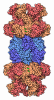
 Citation Citation | Journal: Sci Adv / Year: 2023 Title: Structural insights into the activation of ataxia-telangiectasia mutated by oxidative stress. Authors: Anna C Howes / Olga Perisic / Roger L Williams / Abstract: Ataxia-telangiectasia mutated (ATM) is a master kinase regulating DNA damage response that is activated by DNA double-strand breaks. However, ATM is also directly activated by reactive oxygen ...Ataxia-telangiectasia mutated (ATM) is a master kinase regulating DNA damage response that is activated by DNA double-strand breaks. However, ATM is also directly activated by reactive oxygen species, but how oxidative activation is achieved remains unknown. We determined the cryo-EM structure of an HO-activated ATM and showed that under oxidizing conditions, ATM formed an intramolecular disulfide bridge between two protomers that are rotated relative to each other when compared to the basal state. This rotation is accompanied by release of the substrate-blocking PRD region and twisting of the N-lobe relative to the C-lobe, which greatly optimizes catalysis. This active site remodeling enabled us to capture a substrate (p53) bound to the enzyme. This provides the first structural insights into how ATM is activated during oxidative stress. | ||||||||||||
| History |
|
- Structure visualization
| Structure viewer | Molecule: MolmilJmol/JSmol |
|---|
- Downloads & links
-Download
| PDBx/mmCIF format | 8oxm.cif.gz | 1.3 MB | Display | PDBx/mmCIF format |
|---|---|---|---|---|
| PDB format | pdb8oxm.ent.gz | 883.5 KB | Display | PDB format |
| PDBx/mmJSON format | 8oxm.json.gz | Tree view | PDBx/mmJSON format | |
| Others |  Other downloads Other downloads |
-Validation report
| Arichive directory | https://data.pdbj.org/pub/pdb/validation_reports/ox/8oxmftp://data.pdbj.org/pub/pdb/validation_reports/ox/8oxm | HTTPS FTP |
|---|
-Related structure data
| Related structure data |  17265MC  8oxoC  8oxpC  8oxqC M: map data used to model this data C: citing same article ( |
|---|---|
| Similar structure data |


-Links
 PDBj
PDBj
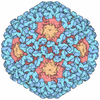
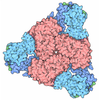
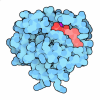
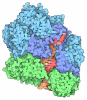
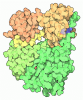
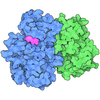

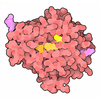
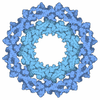
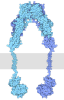
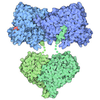
- Assembly
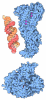
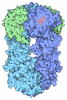
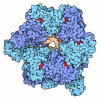
| Deposited unit | 
|
|---|---|
| 1 |
|
-Components
| #1: Protein/peptide | Mass: 1362.438 Da / Num. of mol.: 2 / Source method: obtained synthetically / Details: Custom synthesized peptide / Source: (synth.) Homo sapiens (human) / References: UniProt: P04637#2: Protein | Mass: 365005.562 Da / Num. of mol.: 2 / Mutation: Q2971A Source method: isolated from a genetically manipulated source Source: (gene. exp.) Homo sapiens (human) / Gene: ATM / Production host: Homo sapiens (human)References: UniProt: Q13315, non-specific serine/threonine protein kinase #3: Chemical | 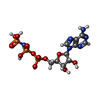 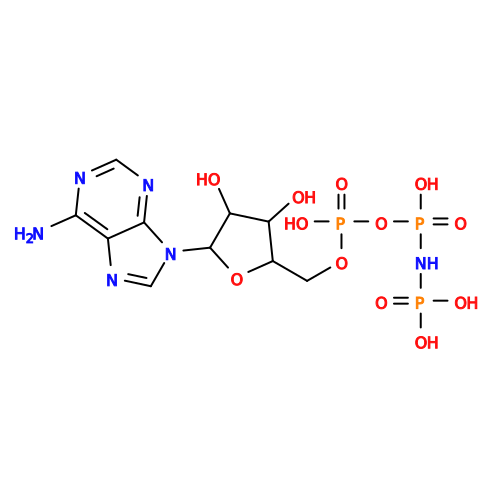 Mass: 506.196 Da / Num. of mol.: 2 / Source method: obtained synthetically / Formula: C10H17N6O12P3 / Feature type: SUBJECT OF INVESTIGATION / Comment: AMP-PNP, energy-carrying molecule analogue*YM Mass: 506.196 Da / Num. of mol.: 2 / Source method: obtained synthetically / Formula: C10H17N6O12P3 / Feature type: SUBJECT OF INVESTIGATION / Comment: AMP-PNP, energy-carrying molecule analogue*YM#4: Chemical |   Mass: 24.305 Da / Num. of mol.: 2 / Source method: obtained synthetically / Formula: Mg / Feature type: SUBJECT OF INVESTIGATION Mass: 24.305 Da / Num. of mol.: 2 / Source method: obtained synthetically / Formula: Mg / Feature type: SUBJECT OF INVESTIGATION#5: Chemical |   Mass: 65.409 Da / Num. of mol.: 2 / Source method: obtained synthetically / Formula: Zn / Feature type: SUBJECT OF INVESTIGATION Mass: 65.409 Da / Num. of mol.: 2 / Source method: obtained synthetically / Formula: Zn / Feature type: SUBJECT OF INVESTIGATIONHas ligand of interest | Y | |
|---|
-Experimental details
-Experiment
| Experiment | Method: ELECTRON MICROSCOPY |
|---|---|
| EM experiment | Aggregation state: PARTICLE / 3D reconstruction method: single particle reconstruction |
- Sample preparation
| Component | Name: ATM(Q2971A) dimer activated by H2O2 and bound to Mg AMP-PNP and p53 substrate peptide Type: COMPLEX / Entity ID: #1-#2 / Source: RECOMBINANT |
|---|---|
| Source (natural) | Organism: Homo sapiens (human) |
| Source (recombinant) | Organism: Homo sapiens (human) / Cell: Kidney (Embryonic) |
| Buffer solution | pH: 7.5 |
| Specimen | Embedding applied: NO / Shadowing applied: NO / Staining applied: NO / Vitrification applied: YES |
| Vitrification | Cryogen name: ETHANE |
- Electron microscopy imaging
| Experimental equipment |  Model: Titan Krios / Image courtesy: FEI Company |
|---|---|
| Microscopy | Model: FEI TITAN KRIOS |
| Electron gun | Electron source:  FIELD EMISSION GUN / Accelerating voltage: 300 kV / Illumination mode: FLOOD BEAM FIELD EMISSION GUN / Accelerating voltage: 300 kV / Illumination mode: FLOOD BEAM |
| Electron lens | Mode: BRIGHT FIELD / Nominal magnification: 105000 X / Nominal defocus max: 3000 nm / Nominal defocus min: 1000 nm |
| Specimen holder | Specimen holder model: FEI TITAN KRIOS AUTOGRID HOLDER |
| Image recording | Electron dose: 39.5 e/Å2 / Film or detector model: GATAN K3 (6k x 4k) |
- Processing
| Software |
| ||||||||||||||||||||||||||||
|---|---|---|---|---|---|---|---|---|---|---|---|---|---|---|---|---|---|---|---|---|---|---|---|---|---|---|---|---|---|
| EM software |
| ||||||||||||||||||||||||||||
| CTF correction | Type: PHASE FLIPPING AND AMPLITUDE CORRECTION | ||||||||||||||||||||||||||||
| Symmetry | Point symmetry: C2 (2 fold cyclic) | ||||||||||||||||||||||||||||
| 3D reconstruction | Resolution: 3.3 Å / Resolution method: FSC 0.143 CUT-OFF / Num. of particles: 30707 / Symmetry type: POINT | ||||||||||||||||||||||||||||
| Atomic model building | PDB-ID: 7SIC Accession code: 7SIC / Source name: PDB / Type: experimental model | ||||||||||||||||||||||||||||
| Refinement | Cross valid method: NONE Stereochemistry target values: GeoStd + Monomer Library + CDL v1.2 | ||||||||||||||||||||||||||||
| Displacement parameters | Biso mean: 244.25 Å2 | ||||||||||||||||||||||||||||
| Refine LS restraints |
|

