 Movie
Movie Controller

[English] 日本語
 Yorodumi
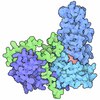
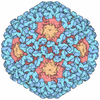
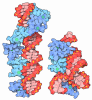
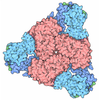
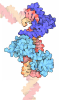
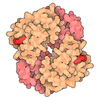
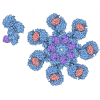
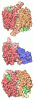
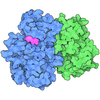
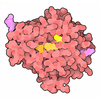
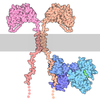
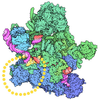
- PDB-8j8n: Structure of p53 DNA-binding domain and ZNF568 KRAB domain complex -
+ Open data

- Basic information
| Entry | Database: PDB / ID: 8j8n | ||||||
|---|---|---|---|---|---|---|---|
| Title | Structure of p53 DNA-binding domain and ZNF568 KRAB domain complex | ||||||
 Components Components |
| ||||||
 Keywords Keywords | PROTEIN BINDING / p53 DBD / ZNF 568 KRAB / p53-dependent glycosis / mitochondrial respiration | ||||||
| Function / homology |  Function and homology information Function and homology informationnegative regulation of helicase activity / signal transduction by p53 class mediator / Loss of function of TP53 in cancer due to loss of tetramerization ability / Regulation of TP53 Expression / regulation of cell cycle G2/M phase transition / negative regulation of G1 to G0 transition / Transcriptional activation of cell cycle inhibitor p21 / negative regulation of pentose-phosphate shunt / Activation of NOXA and translocation to mitochondria / ATP-dependent DNA/DNA annealing activity ...negative regulation of helicase activity / signal transduction by p53 class mediator / Loss of function of TP53 in cancer due to loss of tetramerization ability / Regulation of TP53 Expression / regulation of cell cycle G2/M phase transition / negative regulation of G1 to G0 transition / Transcriptional activation of cell cycle inhibitor p21 / negative regulation of pentose-phosphate shunt / Activation of NOXA and translocation to mitochondria / ATP-dependent DNA/DNA annealing activity / oligodendrocyte apoptotic process / positive regulation of thymocyte apoptotic process / oxidative stress-induced premature senescence / bone marrow development / cellular response to actinomycin D / circadian behavior / positive regulation of programmed necrotic cell death / RUNX3 regulates CDKN1A transcription / TP53 Regulates Transcription of Death Receptors and Ligands / Activation of PUMA and translocation to mitochondria / TP53 regulates transcription of additional cell cycle genes whose exact role in the p53 pathway remain uncertain / mRNA transcription / Regulation of TP53 Activity through Association with Co-factors / Urea cycle / ER overload response / hematopoietic stem cell differentiation / Formation of Senescence-Associated Heterochromatin Foci (SAHF) / TP53 Regulates Transcription of Caspase Activators and Caspases / intrinsic apoptotic signaling pathway by p53 class mediator / entrainment of circadian clock by photoperiod / Zygotic genome activation (ZGA) / TP53 Regulates Transcription of Genes Involved in Cytochrome C Release / PI5P Regulates TP53 Acetylation / positive regulation of release of cytochrome c from mitochondria / hematopoietic progenitor cell differentiation / Association of TriC/CCT with target proteins during biosynthesis / negative regulation of telomere maintenance via telomerase / SUMOylation of transcription factors / TP53 regulates transcription of several additional cell death genes whose specific roles in p53-dependent apoptosis remain uncertain / intrinsic apoptotic signaling pathway in response to DNA damage by p53 class mediator / Transcriptional Regulation by VENTX / TFIID-class transcription factor complex binding / replicative senescence / viral process / intrinsic apoptotic signaling pathway in response to endoplasmic reticulum stress / Pyroptosis / determination of adult lifespan / positive regulation of RNA polymerase II transcription preinitiation complex assembly / general transcription initiation factor binding / negative regulation of fibroblast proliferation / positive regulation of execution phase of apoptosis / type II interferon-mediated signaling pathway / TP53 Regulates Transcription of Genes Involved in G1 Cell Cycle Arrest / cellular response to glucose starvation / core promoter sequence-specific DNA binding / cis-regulatory region sequence-specific DNA binding / Regulation of TP53 Activity through Acetylation / intrinsic apoptotic signaling pathway / mitotic G1 DNA damage checkpoint signaling / positive regulation of intrinsic apoptotic signaling pathway / response to gamma radiation / 14-3-3 protein binding / MDM2/MDM4 family protein binding / TP53 Regulates Transcription of Genes Involved in G2 Cell Cycle Arrest / protein phosphatase 2A binding / transcription initiation-coupled chromatin remodeling / Regulation of PTEN gene transcription / molecular function activator activity / tumor necrosis factor-mediated signaling pathway / cellular response to ionizing radiation / cellular response to xenobiotic stimulus / DNA damage response, signal transduction by p53 class mediator / TP53 Regulates Metabolic Genes / TP53 Regulates Transcription of DNA Repair Genes / Regulation of NF-kappa B signaling / mRNA 3'-UTR binding / protein tetramerization / promoter-specific chromatin binding / Stabilization of p53 / molecular condensate scaffold activity / cellular response to gamma radiation / negative regulation of cell growth / nucleotide-excision repair / G2/M Checkpoints / receptor tyrosine kinase binding / Autodegradation of the E3 ubiquitin ligase COP1 / cellular senescence / PML body / positive regulation of miRNA transcription / Oncogene Induced Senescence / DNA-binding transcription repressor activity, RNA polymerase II-specific / PKR-mediated signaling / Regulation of TP53 Activity through Methylation / G2/M DNA damage checkpoint / DNA Damage/Telomere Stress Induced Senescence / Pre-NOTCH Transcription and Translation / positive regulation of reactive oxygen species metabolic process / intracellular protein localization / histone deacetylase binding / autophagy Similarity search - Function | ||||||
| Biological species |  Homo sapiens (human) Homo sapiens (human) | ||||||
| Method | ELECTRON MICROSCOPY / single particle reconstruction / cryo EM / Resolution: 9.02 Å | ||||||
 Authors Authors | Han, C.W. | ||||||
| Funding support |  Korea, Republic Of, 1items Korea, Republic Of, 1items
| ||||||
 Citation Citation | Journal: Int J Biol Macromol / Year: 2024 Title: Influence of the interaction between p53 and ZNF568 on mitochondrial oxidative phosphorylation. Authors: Chang Woo Han / Mi Suk Jeong / Se Bok Jang / Abstract: The tumor suppressor p53 plays important roles in suppressing the development and progression of cancer by responding to various stress signals. In addition, p53 can regulate the metabolic pathways ...The tumor suppressor p53 plays important roles in suppressing the development and progression of cancer by responding to various stress signals. In addition, p53 can regulate the metabolic pathways of cancer cells by regulating energy metabolism and oxidative phosphorylation. Here, we present a mechanism for the interaction between p53 and ZNF568. Initially, we used X-ray crystallography to determine the irregular loop structure of the ZNF568 KRAB domain; this loop plays an important role in the interaction between p53 and ZNF568. In addition, Cryo-EM was used to examine how the p53 DBD and ZNF568 KRAB domains bind together. The function of ZNF568 on p53-mediated mitochondrial respiration was confirmed by measuring glucose consumption and lactate production. These findings show that ZNF568 can reduce p53-mediated mitochondrial respiratory activity by binding to p53 and inhibiting the transcription of SCO2. SIGNIFICANCE: ZNF568 can directly bind to the p53 DBD and transcriptionally regulate the SCO2 gene. SCO2 transcriptional regulation by interaction between ZNF568 and p53 may regulate the balance between mitochondrial respiration and glycolysis. | ||||||
| History |
|
- Structure visualization
| Structure viewer | Molecule: MolmilJmol/JSmol |
|---|
- Downloads & links
-Download
| PDBx/mmCIF format | 8j8n.cif.gz | 207.5 KB | Display | PDBx/mmCIF format |
|---|---|---|---|---|
| PDB format | pdb8j8n.ent.gz | Display | PDB format | |
| PDBx/mmJSON format | 8j8n.json.gz | Tree view | PDBx/mmJSON format | |
| Others |  Other downloads Other downloads |
-Validation report
| Arichive directory | https://data.pdbj.org/pub/pdb/validation_reports/j8/8j8nftp://data.pdbj.org/pub/pdb/validation_reports/j8/8j8n | HTTPS FTP |
|---|
-Related structure data
| Related structure data |  36075MC M: map data used to model this data C: citing same article ( |
|---|---|
| Similar structure data |
-Links
 PDBj
PDBj


- Assembly
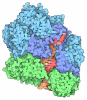
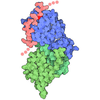
| Deposited unit | 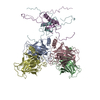
|
|---|---|
| 1 |
|
-Components
| #1: Protein | Mass: 13940.639 Da / Num. of mol.: 2 Source method: isolated from a genetically manipulated source Source: (gene. exp.) Homo sapiens (human) / Gene: ZNF568 / Production host:   Escherichia coli (E. coli) / References: UniProt: C9JLX5 Escherichia coli (E. coli) / References: UniProt: C9JLX5#2: Protein | Mass: 22658.805 Da / Num. of mol.: 4 / Fragment: DNA binding domain Source method: isolated from a genetically manipulated source Source: (gene. exp.) Homo sapiens (human) / Gene: TP53, P53 / Production host: Escherichia coli (E. coli) / References: UniProt: P04637#3: Chemical | ChemComp-ZN /  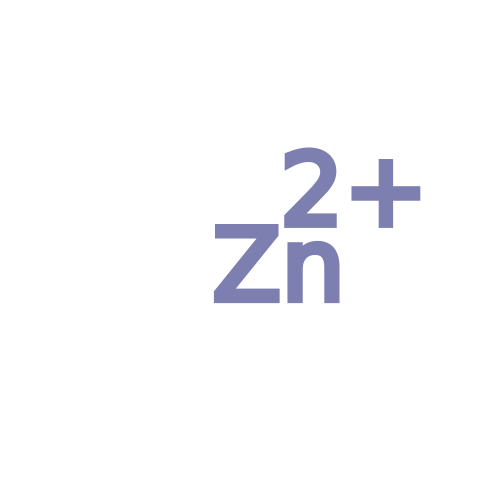 Mass: 65.409 Da / Num. of mol.: 4 / Source method: obtained synthetically / Formula: Zn / Feature type: SUBJECT OF INVESTIGATION Mass: 65.409 Da / Num. of mol.: 4 / Source method: obtained synthetically / Formula: Zn / Feature type: SUBJECT OF INVESTIGATIONHas ligand of interest | Y | Has protein modification | N | |
|---|
-Experimental details
-Experiment
| Experiment | Method: ELECTRON MICROSCOPY |
|---|---|
| EM experiment | Aggregation state: PARTICLE / 3D reconstruction method: single particle reconstruction |
- Sample preparation
| Component | Name: The complex of p53 DNA binding domain and ZNF568 KRAB domain Type: COMPLEX / Entity ID: #1-#2 / Source: RECOMBINANT |
|---|---|
| Molecular weight | Value: 0.126 MDa / Experimental value: YES |
| Source (natural) | Organism: Homo sapiens (human) |
| Source (recombinant) | Organism: Escherichia coli (E. coli) |
| Buffer solution | pH: 7.8 |
| Specimen | Embedding applied: NO / Shadowing applied: NO / Staining applied: NO / Vitrification applied: YES |
| Specimen support | Details: 22mA / Grid material: GOLD / Grid mesh size: 200 divisions/in. / Grid type: Quantifoil R2/2 |
| Vitrification | Cryogen name: NITROGEN |
- Electron microscopy imaging
| Microscopy | Model: TFS GLACIOS |
|---|---|
| Electron gun | Electron source:  FIELD EMISSION GUN / Accelerating voltage: 200 kV / Illumination mode: FLOOD BEAM FIELD EMISSION GUN / Accelerating voltage: 200 kV / Illumination mode: FLOOD BEAM |
| Electron lens | Mode: DARK FIELD / Nominal defocus max: 3000 nm / Nominal defocus min: 2000 nm |
| Image recording | Electron dose: 40 e/Å2 / Film or detector model: FEI FALCON III (4k x 4k) |
- Processing
| Software |
| ||||||||||||||||||||||||
|---|---|---|---|---|---|---|---|---|---|---|---|---|---|---|---|---|---|---|---|---|---|---|---|---|---|
| CTF correction | Details: ZNF568 KRAB used PDB ID 7W5Q p53 DBD used PDB ID 7DVD Type: PHASE FLIPPING AND AMPLITUDE CORRECTION | ||||||||||||||||||||||||
| 3D reconstruction | Resolution: 9.02 Å / Resolution method: FSC 0.143 CUT-OFF / Num. of particles: 76698 / Symmetry type: POINT | ||||||||||||||||||||||||
| Refinement | Stereochemistry target values: CDL v1.2 | ||||||||||||||||||||||||
| Refine LS restraints |
|
