National Institutes of Health/National Institute Of Allergy and Infectious Diseases (NIH/NIAID)
U19AI171110
United States
National Institutes of Health/Office of the Director
AY1AX000035
United States
Citation
Journal: Nature / Year: 2026 Title: Development of a random background to understand ligand optimization. Authors: Xinyu Xu / Olivier Mailhot / Galen J Correy / Xi-Ping Huang / Joao M Braz / Da Shi / Karthik Srinivasan / Kara Zielinski / Yuliia Holota / Yuliia Kuziv / Christos Iliopoulos-Tsoutsouvas / ...Authors: Xinyu Xu / Olivier Mailhot / Galen J Correy / Xi-Ping Huang / Joao M Braz / Da Shi / Karthik Srinivasan / Kara Zielinski / Yuliia Holota / Yuliia Kuziv / Christos Iliopoulos-Tsoutsouvas / Nathan D Levinzon / Yagmur U Doruk / Moira M Rachman / Morgan E Diolaiti / Maisie G V Stevens / Fangyu Liu / Katie L Holland / Harald Hübner / Jing Wang / Yujin Wu / Alan Ashworth / Alexandros Makriyannis / Yuqi Zhang / Yurii S Moroz / Peter Gmeiner / Robert Abel / Aashish Manglik / Allan I Basbaum / Bryan L Roth / James S Fraser / Brian K Shoichet / Abstract: Ligand optimization is central to drug discovery, with hundreds of analogues often designed and synthesized between an initial hit and a therapeutic candidate. The efficiency of this process is ...Ligand optimization is central to drug discovery, with hundreds of analogues often designed and synthesized between an initial hit and a therapeutic candidate. The efficiency of this process is unclear, partly because there is no random background for optimization to compare against. Such a random background might emerge from systematic random small substitutions across starting ligands, measuring the likelihood of achieving a substantial improvement in affinity or potency, or other property by any single perturbation. Recent literature has suggested that perhaps 10% of analogues with minor modifications improve upon the potency of a parent by tenfold or more, but this number is clouded by reporting bias, intentional improvement and inter-group variability. To begin to establish a background expectation for ligand optimization, here we systematically modified 18 lead molecules across six targets with single-atom changes; 257 compounds were synthesized. Unexpectedly, 11.3% of these random small perturbation analogues improved potency by tenfold or more. Conversely, they typically had worse in vitro pharmacokinetics. Although it was possible to find analogues where the potency increase compensated for inferior exposure and half-life, resulting in more potent compounds in vivo, overall, a frustrated landscape for ligand optimization is revealed. This study begins to establish a background expectation for ligand potency optimization and offers a simple strategy to do so. It also begins to quantify the challenges confronting the field in moving beyond in vitro potency.
In the structure databanks used in Yorodumi, some data are registered as the other names, "COVID-19 virus" and "2019-nCoV". Here are the details of the virus and the list of structure data.
Jan 31, 2019. EMDB accession codes are about to change! (news from PDBe EMDB page)
EMDB accession codes are about to change! (news from PDBe EMDB page)
The allocation of 4 digits for EMDB accession codes will soon come to an end. Whilst these codes will remain in use, new EMDB accession codes will include an additional digit and will expand incrementally as the available range of codes is exhausted. The current 4-digit format prefixed with “EMD-” (i.e. EMD-XXXX) will advance to a 5-digit format (i.e. EMD-XXXXX), and so on. It is currently estimated that the 4-digit codes will be depleted around Spring 2019, at which point the 5-digit format will come into force.
The EM Navigator/Yorodumi systems omit the EMD- prefix.
Related info.:Q: What is EMD? / ID/Accession-code notation in Yorodumi/EM Navigator
Yorodumi is a browser for structure data from EMDB, PDB, SASBDB, etc.
This page is also the successor to EM Navigator detail page, and also detail information page/front-end page for Omokage search.
The word "yorodu" (or yorozu) is an old Japanese word meaning "ten thousand". "mi" (miru) is to see.
Related info.:EMDB / PDB / SASBDB / Comparison of 3 databanks / Yorodumi Search / Aug 31, 2016. New EM Navigator & Yorodumi / Yorodumi Papers / Jmol/JSmol / Function and homology information / Changes in new EM Navigator and Yorodumi
 Movie
Movie Controller

 Yorodumi
 Open data
 Basic information
 Components
 Keywords
 Function and homology information
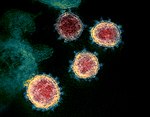 Severe acute respiratory syndrome coronavirus 2
 X-RAY DIFFRACTION /
  Authors
 United States, 2items
  Citation

 Structure visualization
 Downloads & links
 Other downloads


 PDBj
PDBj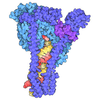
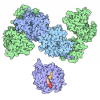
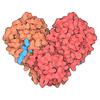

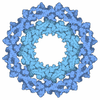
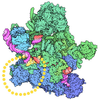
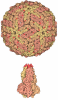
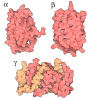
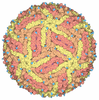
 Assembly


 Escherichia coli BL21(DE3) (bacteria)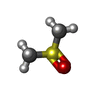
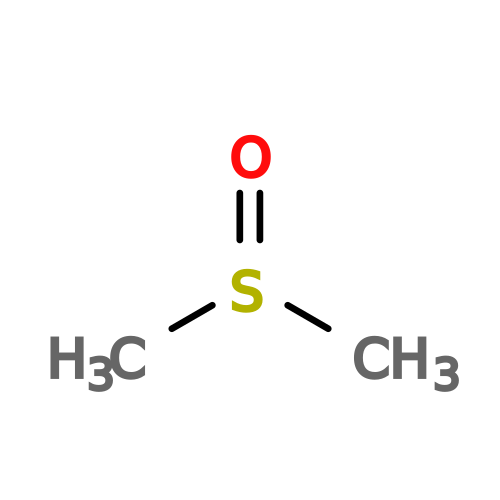 Mass: 78.133 Da / Num. of mol.: 1 / Source method: obtained synthetically / Formula: C2H6OS / Comment: DMSO, precipitant*YM
 Mass: 18.015 Da / Num. of mol.: 431 / Source method: isolated from a natural source / Formula: H2O
 Sample preparation
 Processing