[English] 日本語
Yorodumi
- PDB-6amv: Abl 1b Regulatory Module 'inhibiting state' -

+
Open data


ID or keywords:

Loading...

-
Basic information

Entry
Database: PDB / ID: 6amv
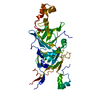
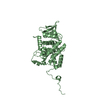
TitleAbl 1b Regulatory Module 'inhibiting state'
ComponentsTyrosine-protein kinase ABL1
KeywordsSIGNALING PROTEIN
Function / homology
Function and homology information


protein localization to cytoplasmic microtubule plus-end / DNA conformation change / response to epinephrine / phospholipase C-inhibiting G protein-coupled receptor signaling pathway / negative regulation of ubiquitin-protein transferase activity / podocyte apoptotic process / regulation of postsynaptic specialization assembly / positive regulation of phospholipase C/protein kinase C signal transduction / regulation of modification of synaptic structure / nicotinate-nucleotide adenylyltransferase activity ...protein localization to cytoplasmic microtubule plus-end / DNA conformation change / response to epinephrine / phospholipase C-inhibiting G protein-coupled receptor signaling pathway / negative regulation of ubiquitin-protein transferase activity / podocyte apoptotic process / regulation of postsynaptic specialization assembly / positive regulation of phospholipase C/protein kinase C signal transduction / regulation of modification of synaptic structure / nicotinate-nucleotide adenylyltransferase activity / delta-catenin binding / Role of ABL in ROBO-SLIT signaling / mitochondrial depolarization / positive regulation of extracellular matrix organization / neuropilin signaling pathway / neuropilin binding / regulation of cell motility / bubble DNA binding / positive regulation of establishment of T cell polarity / cellular response to dopamine / positive regulation of blood vessel branching / proline-rich region binding / mitogen-activated protein kinase binding / regulation of Cdc42 protein signal transduction / regulation of hematopoietic stem cell differentiation / syntaxin binding / positive regulation of dendrite development / regulation of axon extension / regulation of T cell differentiation / positive regulation of cell migration involved in sprouting angiogenesis / Myogenesis / HDR through Single Strand Annealing (SSA) / platelet-derived growth factor receptor-beta signaling pathway / RUNX2 regulates osteoblast differentiation / Fc-gamma receptor signaling pathway involved in phagocytosis / vascular endothelial cell response to oscillatory fluid shear stress / regulation of endocytosis / regulation of microtubule polymerization / negative regulation of long-term synaptic potentiation / myoblast proliferation / associative learning / cardiac muscle cell proliferation / positive regulation of focal adhesion assembly / actin monomer binding / ephrin receptor signaling pathway / positive regulation of vasoconstriction / RHO GTPases Activate WASPs and WAVEs / cellular response to transforming growth factor beta stimulus / positive regulation of T cell migration / endothelial cell migration / negative regulation of double-strand break repair via homologous recombination / regulation of cell adhesion / mismatch repair / ephrin receptor binding / four-way junction DNA binding / ruffle / positive regulation of stress fiber assembly / signal transduction in response to DNA damage / phosphotyrosine residue binding / actin filament polymerization / positive regulation of substrate adhesion-dependent cell spreading / positive regulation of endothelial cell migration / SH2 domain binding / response to endoplasmic reticulum stress / Turbulent (oscillatory, disturbed) flow shear stress activates signaling by PIEZO1 and integrins in endothelial cells / integrin-mediated signaling pathway / protein kinase C binding / protein modification process / regulation of autophagy / protein serine/threonine kinase activator activity / regulation of actin cytoskeleton organization / non-specific protein-tyrosine kinase / FCGR3A-mediated phagocytosis / non-membrane spanning protein tyrosine kinase activity / Regulation of actin dynamics for phagocytic cup formation / intrinsic apoptotic signaling pathway in response to DNA damage / autophagy / positive regulation of fibroblast proliferation / cellular response to hydrogen peroxide / epidermal growth factor receptor signaling pathway / enzyme activator activity / sequence-specific double-stranded DNA binding / kinase activity / Cyclin D associated events in G1 / actin filament binding / positive regulation of neuron apoptotic process / manganese ion binding / mitotic cell cycle / actin cytoskeleton / Recruitment and ATM-mediated phosphorylation of repair and signaling proteins at DNA double strand breaks / positive regulation of cytosolic calcium ion concentration / Factors involved in megakaryocyte development and platelet production / MLL4 and MLL3 complexes regulate expression of PPARG target genes in adipogenesis and hepatic steatosis / growth cone / RUNX1 regulates transcription of genes involved in differentiation of HSCs / actin cytoskeleton organization / cellular response to oxidative stress / protein tyrosine kinase activity / response to oxidative stress / nuclear membrane
Similarity search - Function
F-actin binding / F-actin binding / F-actin binding domain (FABD) / Tyrosine-protein kinase ABL, SH2 domain / : / SH3 domain / SH2 domain / Src homology 2 (SH2) domain profile. / Src homology 2 domains / SH2 domain ...F-actin binding / F-actin binding / F-actin binding domain (FABD) / Tyrosine-protein kinase ABL, SH2 domain / : / SH3 domain / SH2 domain / Src homology 2 (SH2) domain profile. / Src homology 2 domains / SH2 domain / Src homology 3 domains / SH2 domain superfamily / SH3-like domain superfamily / Src homology 3 (SH3) domain profile. / SH3 domain / Tyrosine-protein kinase, catalytic domain / Tyrosine kinase, catalytic domain / Tyrosine protein kinases specific active-site signature. / Tyrosine-protein kinase, active site / Protein tyrosine and serine/threonine kinase / Serine-threonine/tyrosine-protein kinase, catalytic domain / Protein kinase, ATP binding site / Protein kinases ATP-binding region signature. / Protein kinase domain profile. / Protein kinase domain / Protein kinase-like domain superfamily
Similarity search - Domain/homology
Tyrosine-protein kinase ABL1
Similarity search - Component
Biological speciesHomo sapiens (human)
MethodSOLUTION NMR / molecular dynamics
AuthorsKalodimos, C.G. / Saleh, T. / Rossi, P.
Funding support United States, 1items
OrganizationGrant numberCountry
National Institutes of Health/National Institute of General Medical Sciences (NIH/NIGMS)1R35GM122462-01 United States
CitationJournal: Nat. Struct. Mol. Biol. / Year: 2017
Title: Atomic view of the energy landscape in the allosteric regulation of Abl kinase.
Authors: Saleh, T. / Rossi, P. / Kalodimos, C.G.
History
DepositionAug 11, 2017Deposition site: RCSB / Processing site: RCSB
Revision 1.0Sep 27, 2017Provider: repository / Type: Initial release
Revision 1.1Oct 11, 2017Group: Database references / Category: citation
Item: _citation.journal_abbrev / _citation.pdbx_database_id_PubMed / _citation.title
Revision 1.2Nov 22, 2017Group: Database references / Category: citation
Item: _citation.journal_volume / _citation.page_first / _citation.page_last
Revision 1.3Jan 1, 2020Group: Author supporting evidence / Data collection
Category: pdbx_audit_support / pdbx_nmr_software / pdbx_nmr_spectrometer
Item: _pdbx_audit_support.funding_organization / _pdbx_nmr_software.name / _pdbx_nmr_spectrometer.model
Revision 1.4Jun 14, 2023Group: Database references / Other / Category: database_2 / pdbx_database_status
Item: _database_2.pdbx_DOI / _database_2.pdbx_database_accession / _pdbx_database_status.status_code_nmr_data
Revision 1.5May 15, 2024Group: Data collection / Database references / Category: chem_comp_atom / chem_comp_bond / database_2 / Item: _database_2.pdbx_DOI

-
Structure visualization

Structure viewerMolecule:
MolmilJmol/JSmol

Downloads & links

-
Assembly

Deposited unit
A: Tyrosine-protein kinase ABL1


Theoretical massNumber of molelcules
Total (without water)28,3501
Polymers28,3501
Non-polymers00
Water00
1


  • Idetical with deposited unit
  • defined by author
  • Evidence: NO quaternary structure!
TypeNameSymmetry operationNumber
identity operation1_5551
Buried area0 Å2
ΔGint0 kcal/mol
Surface area14490 Å2
NMR ensembles
DataCriteria
Number of conformers (submitted / calculated)20 / 100lowest target function
RepresentativeModel #1lowest energy

-
Components

#1: Protein Tyrosine-protein kinase ABL1 / Abelson murine leukemia viral oncogene homolog 1 / Abelson tyrosine-protein kinase 1 / Proto- ...Abelson murine leukemia viral oncogene homolog 1 / Abelson tyrosine-protein kinase 1 / Proto-oncogene c-Abl / p150


Mass: 28350.389 Da / Num. of mol.: 1 / Fragment: residues 1-255
Source method: isolated from a genetically manipulated source
Source: (gene. exp.) Homo sapiens (human) / Gene: ABL1, ABL, JTK7 / Production host: Escherichia coli BL21 (bacteria)
References: UniProt: P00519, non-specific protein-tyrosine kinase

-
Experimental details

-
Experiment

ExperimentMethod: SOLUTION NMR
NMR experiment
Conditions-IDExperiment-IDSolution-IDSample stateSpectrometer-IDType
111isotropic13D CBCA(CO)NH
121isotropic23D HN(CA)CB
131isotropic12D 1H-13C HSQC aliphatic
141isotropic13D 1H-15N NOESY
151isotropic13D 1H-13C NOESY aliphatic
161isotropic13D 1H-13C NOESY aromatic
171isotropic12D 1H-15N HSQC
181isotropic23D HNCO

-
Sample preparation

DetailsType: solution
Contents: 0.3 mM [U-99% 13C; U-99% 15N] Abl1b, 20 mM potassium phosphate, 5 mM beta-mercaptoethanol, 100 mM potassium chloride, 0.05 % sodium azide, 90% H2O/10% D2O
Label: double-labeled / Solvent system: 90% H2O/10% D2O
Sample
Conc. (mg/ml)ComponentIsotopic labelingSolution-ID
0.3 mMAbl1b[U-99% 13C; U-99% 15N]1
20 mMpotassium phosphatenatural abundance1
5 mMbeta-mercaptoethanolnatural abundance1
100 mMpotassium chloridenatural abundance1
0.05 %sodium azidenatural abundance1
Sample conditionsIonic strength: 0.2 M / Label: condition_1 / pH: 7 / Pressure: 1 atm / Temperature: 298 K

-
NMR measurement

NMR spectrometer
TypeManufacturerModelField strength (MHz)Spectrometer-ID
Bruker AVANCE IIIBrukerAVANCE III8501
Bruker AVANCE IIIBrukerAVANCE III7002

-
Processing

NMR software
NameVersionDeveloperClassification
CNS1.3Brunger, Adams, Clore, Gros, Nilges and Readrefinement
CYANA3.97Guntert, Mumenthaler and Wuthrichstructure calculation
PINEBahrami, Markley, Assadi, and Eghbalniachemical shift assignment
SparkyGoddardpeak picking
TALOSCornilescu, Delaglio and Baxgeometry optimization
RefinementMethod: molecular dynamics / Software ordinal: 1
NMR representativeSelection criteria: lowest energy
NMR ensembleConformer selection criteria: lowest target function / Conformers calculated total number: 100 / Conformers submitted total number: 20

+
About Yorodumi

-
News

-
Feb 9, 2022. New format data for meta-information of EMDB entries

New format data for meta-information of EMDB entries

  • Version 3 of the EMDB header file is now the official format.
  • The previous official version 1.9 will be removed from the archive.

Related info.:EMDB header

External links:wwPDB to switch to version 3 of the EMDB data model

-
Aug 12, 2020. Covid-19 info

Covid-19 info

URL: https://pdbj.org/emnavi/covid19.php

New page: Covid-19 featured information page in EM Navigator.

Related info.:Covid-19 info / Mar 5, 2020. Novel coronavirus structure data

+
Mar 5, 2020. Novel coronavirus structure data

Novel coronavirus structure data

Related info.:Yorodumi Speices / Aug 12, 2020. Covid-19 info

External links:COVID-19 featured content - PDBj / Molecule of the Month (242):Coronavirus Proteases

+
Jan 31, 2019. EMDB accession codes are about to change! (news from PDBe EMDB page)

EMDB accession codes are about to change! (news from PDBe EMDB page)

  • The allocation of 4 digits for EMDB accession codes will soon come to an end. Whilst these codes will remain in use, new EMDB accession codes will include an additional digit and will expand incrementally as the available range of codes is exhausted. The current 4-digit format prefixed with “EMD-” (i.e. EMD-XXXX) will advance to a 5-digit format (i.e. EMD-XXXXX), and so on. It is currently estimated that the 4-digit codes will be depleted around Spring 2019, at which point the 5-digit format will come into force.
  • The EM Navigator/Yorodumi systems omit the EMD- prefix.

Related info.:Q: What is EMD? / ID/Accession-code notation in Yorodumi/EM Navigator

External links:EMDB Accession Codes are Changing Soon! / Contact to PDBj

+
Jul 12, 2017. Major update of PDB

Major update of PDB

  • wwPDB released updated PDB data conforming to the new PDBx/mmCIF dictionary.
  • This is a major update changing the version number from 4 to 5, and with Remediation, in which all the entries are updated.
  • In this update, many items about electron microscopy experimental information are reorganized (e.g. em_software).
  • Now, EM Navigator and Yorodumi are based on the updated data.

External links:wwPDB Remediation / Enriched Model Files Conforming to OneDep Data Standards Now Available in the PDB FTP Archive

-
Yorodumi

Thousand views of thousand structures

  • Yorodumi is a browser for structure data from EMDB, PDB, SASBDB, etc.
  • This page is also the successor to EM Navigator detail page, and also detail information page/front-end page for Omokage search.
  • The word "yorodu" (or yorozu) is an old Japanese word meaning "ten thousand". "mi" (miru) is to see.

Related info.:EMDB / PDB / SASBDB / Comparison of 3 databanks / Yorodumi Search / Aug 31, 2016. New EM Navigator & Yorodumi / Yorodumi Papers / Jmol/JSmol / Function and homology information / Changes in new EM Navigator and Yorodumi

Read more