 Movie
Movie Controller

[English] 日本語
 Yorodumi
- PDB-5yxu: an affinity enhanced T cell receptor in complex with HLA-A0201 re... -
+ Open data

- Basic information
| Entry | Database: PDB / ID: 5yxu | ||||||||||||
|---|---|---|---|---|---|---|---|---|---|---|---|---|---|
| Title | an affinity enhanced T cell receptor in complex with HLA-A0201 restricted HCV NS3 peptide KLVALGINAV | ||||||||||||
 Components Components |
| ||||||||||||
 Keywords Keywords | IMMUNE SYSTEM / affinity enhanced TCR-pHLA complex | ||||||||||||
| Function / homology |  Function and homology information Function and homology informationsymbiont-mediated suppression of host JAK-STAT cascade via inhibition of STAT activity / positive regulation of hexokinase activity / translocation of peptides or proteins into host cell cytoplasm / symbiont-mediated perturbation of host cellular process / Toll-like receptor 2 binding / viral capsid assembly / hepacivirin / adhesion receptor-mediated virion attachment to host cell / TBC/RABGAPs / positive regulation of memory T cell activation ...symbiont-mediated suppression of host JAK-STAT cascade via inhibition of STAT activity / positive regulation of hexokinase activity / translocation of peptides or proteins into host cell cytoplasm / symbiont-mediated perturbation of host cellular process / Toll-like receptor 2 binding / viral capsid assembly / hepacivirin / adhesion receptor-mediated virion attachment to host cell / TBC/RABGAPs / positive regulation of memory T cell activation / T cell mediated cytotoxicity directed against tumor cell target / positive regulation of CD8-positive, alpha-beta T cell activation / CD8-positive, alpha-beta T cell activation / positive regulation of CD8-positive, alpha-beta T cell proliferation / T cell mediated cytotoxicity / host cell mitochondrial membrane / host cell lipid droplet / antigen processing and presentation of endogenous peptide antigen via MHC class I via ER pathway, TAP-dependent / symbiont-mediated transformation of host cell / symbiont-mediated suppression of host TRAF-mediated signal transduction / TAP complex binding / antigen processing and presentation of exogenous peptide antigen via MHC class I / Golgi medial cisterna / positive regulation of cytokinesis / symbiont-mediated perturbation of host cell cycle G1/S transition checkpoint / CD8 receptor binding / protection from natural killer cell mediated cytotoxicity / TAP binding / endoplasmic reticulum exit site / negative regulation of protein secretion / detection of bacterium / antigen processing and presentation of endogenous peptide antigen via MHC class Ib / antigen processing and presentation of endogenous peptide antigen via MHC class I via ER pathway, TAP-independent / 5'-3' RNA polymerase activity / beta-2-microglobulin binding / T cell receptor binding / symbiont-mediated suppression of host JAK-STAT cascade via inhibition of STAT1 activity / host cell mitochondrion / endoplasmic reticulum-Golgi intermediate compartment membrane / symbiont-mediated suppression of host cytoplasmic pattern recognition receptor signaling pathway via inhibition of MAVS activity / regulation of natural killer cell mediated immunity / positive regulation of T cell mediated cytotoxicity / early endosome lumen / Nef mediated downregulation of MHC class I complex cell surface expression / DAP12 interactions / Endosomal/Vacuolar pathway / Antigen Presentation: Folding, assembly and peptide loading of class I MHC / lumenal side of endoplasmic reticulum membrane / regulation of iron ion transport / negative regulation of iron ion transport / negative regulation of forebrain neuron differentiation / SH3 domain binding / antigen processing and presentation of exogenous peptide antigen via MHC class Ib / peptide antigen assembly with MHC class I protein complex / ER to Golgi transport vesicle membrane / positive regulation of type II interferon production / HFE-transferrin receptor complex / MHC class I peptide loading complex / transferrin transport / negative regulation of receptor-mediated endocytosis / cellular response to iron ion / positive regulation of T cell cytokine production / antigen processing and presentation of endogenous peptide antigen via MHC class I / peptide antigen assembly with MHC class II protein complex / MHC class I protein complex / negative regulation of epithelial cell proliferation / cellular response to nicotine / negative regulation of neurogenesis / positive regulation of receptor-mediated endocytosis / MHC class II protein complex / antigen processing and presentation of exogenous peptide antigen via MHC class II / positive regulation of immune response / specific granule lumen / peptide antigen binding / T cell receptor signaling pathway / kinase binding / phagocytic vesicle membrane / positive regulation of T cell activation / Interferon gamma signaling / recycling endosome membrane / Immunoregulatory interactions between a Lymphoid and a non-Lymphoid cell / sensory perception of smell / Interferon alpha/beta signaling / tertiary granule lumen / Modulation by Mtb of host immune system / positive regulation of cellular senescence / MHC class II protein complex binding / DAP12 signaling / late endosome membrane / nucleoside-triphosphate phosphatase / ribonucleoside triphosphate phosphatase activity / E3 ubiquitin ligases ubiquitinate target proteins / viral nucleocapsid / channel activity / ER-Phagosome pathway / early endosome membrane / monoatomic ion transmembrane transport / antibacterial humoral response / clathrin-dependent endocytosis of virus by host cell / amyloid fibril formation Similarity search - Function | ||||||||||||
| Biological species |  Homo sapiens (human) Homo sapiens (human) Hepatitis C virus Hepatitis C virus | ||||||||||||
| Method |  X-RAY DIFFRACTION / Resolution: 2.7 Å X-RAY DIFFRACTION / Resolution: 2.7 Å | ||||||||||||
 Authors Authors | Yi, L. | ||||||||||||
| Funding support |  China, 3items China, 3items
| ||||||||||||
 Citation Citation | Journal: To Be Published Title: an affinity enhanced T cell receptor in complex with HLA-A0201 restricted HCV NS3 peptide KLVALGINAV Authors: Yi, L. | ||||||||||||
| History |
|
- Structure visualization
| Structure viewer | Molecule: MolmilJmol/JSmol |
|---|
- Downloads & links
-Download
| PDBx/mmCIF format | 5yxu.cif.gz | 336.9 KB | Display | PDBx/mmCIF format |
|---|---|---|---|---|
| PDB format | pdb5yxu.ent.gz | 271.1 KB | Display | PDB format |
| PDBx/mmJSON format | 5yxu.json.gz | Tree view | PDBx/mmJSON format | |
| Others |  Other downloads Other downloads |
-Validation report
| Arichive directory | https://data.pdbj.org/pub/pdb/validation_reports/yx/5yxuftp://data.pdbj.org/pub/pdb/validation_reports/yx/5yxu | HTTPS FTP |
|---|
-Related structure data
| Similar structure data |
|---|

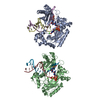


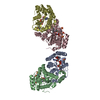

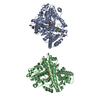
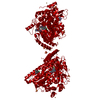
-Links
 PDBj
PDBj
- Assembly
| Deposited unit | 
| ||||||||
|---|---|---|---|---|---|---|---|---|---|
| 1 | 
| ||||||||
| 2 | 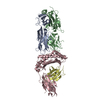
| ||||||||
| Unit cell |
|
-Components
-T cell receptor ... , 2 types, 4 molecules FAGB
| #1: Protein | Mass: 21630.986 Da / Num. of mol.: 2 Source method: isolated from a genetically manipulated source Source: (gene. exp.) Homo sapiens (human) / Production host:   Escherichia coli (E. coli) Escherichia coli (E. coli)#2: Protein | Mass: 27424.521 Da / Num. of mol.: 2 Source method: isolated from a genetically manipulated source Source: (gene. exp.) Homo sapiens (human) / Production host: Escherichia coli (E. coli) |
|---|
-Protein , 2 types, 4 molecules CEDH
| #3: Protein | Mass: 31925.281 Da / Num. of mol.: 2 Source method: isolated from a genetically manipulated source Source: (gene. exp.) Homo sapiens (human) / Gene: HLA-A, HLAA / Production host: Escherichia coli (E. coli) / References: UniProt: P01892, UniProt: P04439*PLUS#4: Protein | Mass: 11819.173 Da / Num. of mol.: 2 Source method: isolated from a genetically manipulated source Source: (gene. exp.) Homo sapiens (human) / Production host: Escherichia coli (E. coli) / References: UniProt: P61769*PLUS |
|---|
-Protein/peptide / Non-polymers , 2 types, 184 molecules IJ
| #5: Protein/peptide | Mass: 998.240 Da / Num. of mol.: 2 Source method: isolated from a genetically manipulated source Source: (gene. exp.) Hepatitis C virus / Production host: Escherichia coli (E. coli) / References: UniProt: P27958*PLUS#6: Water | ChemComp-HOH / | Mass: 18.015 Da / Num. of mol.: 182 / Source method: isolated from a natural source / Formula: H2O |
|---|
-Details
| Has protein modification | Y |
|---|
-Experimental details
-Experiment
| Experiment | Method: X-RAY DIFFRACTION / Number of used crystals: 1 |
|---|
- Sample preparation
| Crystal | Density Matthews: 2.54 Å3/Da / Density % sol: 51.6 % |
|---|---|
| Crystal grow | Temperature: 291 K / Method: vapor diffusion, hanging drop / Details: 15% PEG 3350, 0.2M potassium nitrate |
-Data collection
| Diffraction | Mean temperature: 100 K |
|---|---|
| Diffraction source | Source: SEALED TUBE / Type: OXFORD DIFFRACTION ENHANCE ULTRA / Wavelength: 1.54 Å |
| Detector | Type: OXFORD RUBY CCD / Detector: CCD / Date: Jun 3, 2015 |
| Radiation | Protocol: SINGLE WAVELENGTH / Monochromatic (M) / Laue (L): M / Scattering type: x-ray |
| Radiation wavelength | Wavelength: 1.54 Å / Relative weight: 1 |
| Reflection | Resolution: 2.7→50 Å / Num. obs: 48316 / % possible obs: 99.5 % / Redundancy: 3.02 % / Net I/σ(I): 6.6 |
| Reflection shell | Resolution: 2.7→2.85 Å |
- Processing
| Software |
| ||||||||||||||||||||||||||||||||||||||||||||||||||||||||||||
|---|---|---|---|---|---|---|---|---|---|---|---|---|---|---|---|---|---|---|---|---|---|---|---|---|---|---|---|---|---|---|---|---|---|---|---|---|---|---|---|---|---|---|---|---|---|---|---|---|---|---|---|---|---|---|---|---|---|---|---|---|---|
| Refinement | Resolution: 2.7→17.7 Å / Cor.coef. Fo:Fc: 0.876 / Cor.coef. Fo:Fc free: 0.807 / SU B: 18.62 / SU ML: 0.376 / Cross valid method: THROUGHOUT / σ(F): 0 / ESU R Free: 0.418 Details: HYDROGENS HAVE BEEN ADDED IN THE RIDING POSITIONS U VALUES : REFINED INDIVIDUALLY
| ||||||||||||||||||||||||||||||||||||||||||||||||||||||||||||
| Solvent computation | Ion probe radii: 0.8 Å / Shrinkage radii: 0.8 Å / VDW probe radii: 1.2 Å | ||||||||||||||||||||||||||||||||||||||||||||||||||||||||||||
| Displacement parameters | Biso max: 102.25 Å2 / Biso mean: 29.975 Å2 / Biso min: 2 Å2
| ||||||||||||||||||||||||||||||||||||||||||||||||||||||||||||
| Refinement step | Cycle: final / Resolution: 2.7→17.7 Å
| ||||||||||||||||||||||||||||||||||||||||||||||||||||||||||||
| Refine LS restraints |
| ||||||||||||||||||||||||||||||||||||||||||||||||||||||||||||
| LS refinement shell | Resolution: 2.7→2.768 Å / Rfactor Rfree error: 0 / Total num. of bins used: 20
|
