[English] 日本語
Yorodumi
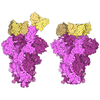
- PDB-45ic: Complex structure of THZ-65 Fab bound to SARS-CoV-1 RBD -

+
Open data


ID or keywords:

Loading...

-
Basic information

Entry
Database: PDB / ID: 45ic
TitleComplex structure of THZ-65 Fab bound to SARS-CoV-1 RBD
Components
  • Spike protein S1
  • THZ-65 Fab Heavy chain
  • THZ-65 Fab Light chain
KeywordsVIRAL PROTEIN/IMMUNE SYSTEM / SARS-CoV-1 / complex / antibody / RBD / VIRAL PROTEIN-IMMUNE SYSTEM complex
Function / homology
Function and homology information


Maturation of spike protein / Translation of Structural Proteins / Virion Assembly and Release / Attachment and Entry / SARS-CoV-1 activates/modulates innate immune responses / symbiont-mediated-mediated suppression of host tetherin activity / positive regulation of viral entry into host cell / membrane fusion / host cell endoplasmic reticulum-Golgi intermediate compartment membrane / receptor-mediated virion attachment to host cell ...Maturation of spike protein / Translation of Structural Proteins / Virion Assembly and Release / Attachment and Entry / SARS-CoV-1 activates/modulates innate immune responses / symbiont-mediated-mediated suppression of host tetherin activity / positive regulation of viral entry into host cell / membrane fusion / host cell endoplasmic reticulum-Golgi intermediate compartment membrane / receptor-mediated virion attachment to host cell / host cell surface receptor binding / symbiont-mediated suppression of host innate immune response / endocytosis involved in viral entry into host cell / fusion of virus membrane with host plasma membrane / fusion of virus membrane with host endosome membrane / viral envelope / host cell plasma membrane / virion membrane / membrane / identical protein binding
Similarity search - Function
Spike (S) protein S1 subunit, receptor-binding domain, SARS-CoV / Spike (S) protein S1 subunit, N-terminal domain, SARS-CoV-like / Coronavirus spike glycoprotein S1, C-terminal / Coronavirus spike glycoprotein S1, C-terminal / Spike glycoprotein, N-terminal domain superfamily / Spike S1 subunit, receptor binding domain superfamily, betacoronavirus / Spike glycoprotein, betacoronavirus / Betacoronavirus spike (S) glycoprotein S1 subunit N-terminal (NTD) domain profile. / Spike glycoprotein S1, N-terminal domain, betacoronavirus-like / Betacoronavirus-like spike glycoprotein S1, N-terminal ...Spike (S) protein S1 subunit, receptor-binding domain, SARS-CoV / Spike (S) protein S1 subunit, N-terminal domain, SARS-CoV-like / Coronavirus spike glycoprotein S1, C-terminal / Coronavirus spike glycoprotein S1, C-terminal / Spike glycoprotein, N-terminal domain superfamily / Spike S1 subunit, receptor binding domain superfamily, betacoronavirus / Spike glycoprotein, betacoronavirus / Betacoronavirus spike (S) glycoprotein S1 subunit N-terminal (NTD) domain profile. / Spike glycoprotein S1, N-terminal domain, betacoronavirus-like / Betacoronavirus-like spike glycoprotein S1, N-terminal / Betacoronavirus spike (S) glycoprotein S1 subunit C-terminal (CTD) domain profile. / Spike (S) protein S1 subunit, receptor-binding domain, betacoronavirus / Betacoronavirus spike glycoprotein S1, receptor binding / Spike glycoprotein S2 superfamily, coronavirus / Spike glycoprotein S2, coronavirus, heptad repeat 1 / Spike glycoprotein S2, coronavirus, heptad repeat 2 / Coronavirus spike (S) glycoprotein S2 subunit heptad repeat 1 (HR1) region profile. / Coronavirus spike (S) glycoprotein S2 subunit heptad repeat 2 (HR2) region profile. / Spike glycoprotein S2, coronavirus / Coronavirus spike glycoprotein S2
Similarity search - Domain/homology
Biological speciesHomo sapiens (human)
Severe acute respiratory syndrome-related coronavirus
MethodX-RAY DIFFRACTION / SYNCHROTRON / SAD / Resolution: 2.78 Å
AuthorsWang, X. / Guo, F.
Funding support1items
OrganizationGrant numberCountry
Not funded
CitationJournal: Immunity / Year: 2026
Title: Twenty-year persistence of SARS-CoV-1 immune imprinting shapes antibody responses to SARS-CoV-2 infection.
Authors: Qi Zhang / Peng Chen / Fenglin Guo / Runhong Zhou / Ruihan Guo / Xiaofei Ge / Qianqian Yang / Xin Xie / Wei Xia / Junping Fan / Ziqing Yang / Yan Xu / Huiyu Huang / Jinqian Li / Han Wang / ...Authors: Qi Zhang / Peng Chen / Fenglin Guo / Runhong Zhou / Ruihan Guo / Xiaofei Ge / Qianqian Yang / Xin Xie / Wei Xia / Junping Fan / Ziqing Yang / Yan Xu / Huiyu Huang / Jinqian Li / Han Wang / Huiyu Liao / Xuanling Shi / Na Liu / Yuting Chen / Zhiwei Chen / Jianzhu Ma / Xinquan Wang / Tong Zhang / Linqi Zhang /
Abstract: Antibody imprinting is well recognized, yet its long-term dynamics and epitope specificity remain poorly understood. Here, we studied individuals sequentially infected with SARS-CoV-1 (SARS-1) and ...Antibody imprinting is well recognized, yet its long-term dynamics and epitope specificity remain poorly understood. Here, we studied individuals sequentially infected with SARS-CoV-1 (SARS-1) and SARS-CoV-2 (SARS-2) over two decades and found durable imprinting of antibody responses following SARS-2 BF.7 breakthrough infection. Approximately 60% of isolated monoclonal antibodies were SARS-1 imprinted and targeted conserved receptor-binding domain regions, whereas 37% overcame imprinting to recognize the SARS-2 receptor-binding motif overlapping the ACE2-binding site. Notably, some SARS-1-only antibodies retained germline-like features and neutralizing activity 20 years after infection. One exceptionally imprinted broadly neutralizing antibody, THZ937, protected hamsters against contact and airborne transmission of Omicron EG.5.1, demonstrating the functional relevance of durable imprinted antibodies. Together, these findings define the remarkable longevity and molecular basis of antibody imprinting and provide insights for pan-sarbecovirus vaccine design.
History
DepositionAug 29, 2026Deposition site: PDBJ / Processing site: PDBC
Revision 1.0Sep 16, 2026Provider: repository / Type: Initial release

-
Structure visualization

Structure viewerMolecule:
MolmilJmol/JSmol

Downloads & links

-
Assembly

Deposited unit
D: THZ-65 Fab Light chain
E: Spike protein S1
F: THZ-65 Fab Heavy chain
A: THZ-65 Fab Light chain
B: Spike protein S1
C: THZ-65 Fab Heavy chain


Theoretical massNumber of molelcules
Total (without water)137,5996
Polymers137,5996
Non-polymers00
Water4,828268
1
D: THZ-65 Fab Light chain
E: Spike protein S1
F: THZ-65 Fab Heavy chain


Theoretical massNumber of molelcules
Total (without water)68,8003
Polymers68,8003
Non-polymers00
Water543
TypeNameSymmetry operationNumber
identity operation1_555x,y,z1
Buried area5280 Å2
ΔGint-29 kcal/mol
Surface area27940 Å2
MethodPISA
2
A: THZ-65 Fab Light chain
B: Spike protein S1
C: THZ-65 Fab Heavy chain


Theoretical massNumber of molelcules
Total (without water)68,8003
Polymers68,8003
Non-polymers00
Water543
TypeNameSymmetry operationNumber
identity operation1_555x,y,z1
Buried area5190 Å2
ΔGint-29 kcal/mol
Surface area28160 Å2
MethodPISA
Unit cell
Length a, b, c (Å)95.690, 99.909, 186.585
Angle α, β, γ (deg.)90.00, 90.00, 90.00
Int Tables number19
Space group name H-MP212121

-
Components

#1: Antibody THZ-65 Fab Light chain


Mass: 22361.686 Da / Num. of mol.: 2
Source method: isolated from a genetically manipulated source
Source: (gene. exp.) Homo sapiens (human) / Production host: Homo sapiens (human)
#2: Protein Spike protein S1


Mass: 21888.674 Da / Num. of mol.: 2 / Fragment: RBD
Source method: isolated from a genetically manipulated source
Source: (gene. exp.) Severe acute respiratory syndrome-related coronavirus
Gene: S, 2 / Production host: Homo sapiens (human) / References: UniProt: P59594
#3: Antibody THZ-65 Fab Heavy chain


Mass: 24549.363 Da / Num. of mol.: 2
Source method: isolated from a genetically manipulated source
Source: (gene. exp.) Homo sapiens (human) / Production host: Homo sapiens (human)
#4: Water ChemComp-HOH / water


Mass: 18.015 Da / Num. of mol.: 268 / Source method: isolated from a natural source / Formula: H2O
Has protein modificationY

-
Experimental details

-
Experiment

ExperimentMethod: X-RAY DIFFRACTION / Number of used crystals: 1

-
Sample preparation

CrystalDensity Matthews: 3.14 Å3/Da / Density % sol: 60.89 %
Crystal growTemperature: 291.5 K / Method: vapor diffusion, sitting drop
Details: 0.1 M MES monohydrate pH 6.5, 12% w/v Polyethylene glycol 20,000

-
Data collection

DiffractionMean temperature: 100 K / Serial crystal experiment: N
Diffraction sourceSource: SYNCHROTRON / Site: SSRF / Beamline: BL02U1 / Wavelength: 0.97918 Å
DetectorType: DECTRIS PILATUS 6M / Detector: PIXEL / Date: Jul 20, 2024
RadiationProtocol: SINGLE WAVELENGTH / Monochromatic (M) / Laue (L): M / Scattering type: x-ray
Radiation wavelengthWavelength: 0.97918 Å / Relative weight: 1
ReflectionResolution: 2.78→52.8 Å / Num. obs: 45756 / % possible obs: 99.79 % / Redundancy: 13 % / CC1/2: 0.993 / Net I/σ(I): 3.97
Reflection shellResolution: 2.78→2.879 Å / Num. unique obs: 4508 / CC1/2: 0.897

-
Processing

Software
NameVersionClassification
PHENIX(1.18.2_3874: ???)refinement
HKL-2000data scaling
HKL-2000data reduction
PHASERphasing
RefinementMethod to determine structure: SAD / Resolution: 2.78→52.8 Å / SU ML: 0.3 / Cross valid method: FREE R-VALUE / σ(F): 1.33 / Phase error: 25.87 / Stereochemistry target values: ML
RfactorNum. reflection% reflection
Rfree0.2381 2165 4.74 %
Rwork0.1901 --
obs0.1924 45670 99.81 %
Solvent computationShrinkage radii: 0.9 Å / VDW probe radii: 1.11 Å / Solvent model: FLAT BULK SOLVENT MODEL
Refinement stepCycle: LAST / Resolution: 2.78→52.8 Å
ProteinNucleic acidLigandSolventTotal
Num. atoms9636 0 0 268 9904
Refine LS restraints
Refine-IDTypeDev idealNumber
X-RAY DIFFRACTIONf_bond_d0.0099890
X-RAY DIFFRACTIONf_angle_d1.16613498
X-RAY DIFFRACTIONf_dihedral_angle_d16.3573484
X-RAY DIFFRACTIONf_chiral_restr0.0631502
X-RAY DIFFRACTIONf_plane_restr0.0081734
LS refinement shell
Resolution (Å)Rfactor RfreeNum. reflection RfreeRfactor RworkNum. reflection RworkRefine-ID% reflection obs (%)
2.78-2.840.30511520.25622834X-RAY DIFFRACTION100
2.84-2.920.3361290.24792875X-RAY DIFFRACTION100
2.92-2.990.2881200.23062876X-RAY DIFFRACTION100
2.99-3.080.26341570.21912858X-RAY DIFFRACTION100
3.08-3.180.28351400.21522865X-RAY DIFFRACTION100
3.18-3.30.23031210.21772895X-RAY DIFFRACTION100
3.3-3.430.25521470.21372868X-RAY DIFFRACTION100
3.43-3.580.25841740.20122855X-RAY DIFFRACTION100
3.58-3.770.23521520.18762857X-RAY DIFFRACTION100
3.77-4.010.25251310.1762921X-RAY DIFFRACTION100
4.01-4.320.19051420.1572916X-RAY DIFFRACTION100
4.32-4.750.20131320.14272925X-RAY DIFFRACTION100
4.75-5.440.20471430.15322921X-RAY DIFFRACTION100
5.44-6.850.21481670.17812970X-RAY DIFFRACTION100
6.85-52.80.22231580.20243069X-RAY DIFFRACTION99

+
About Yorodumi

-
News

-
Feb 9, 2022. New format data for meta-information of EMDB entries

New format data for meta-information of EMDB entries

  • Version 3 of the EMDB header file is now the official format.
  • The previous official version 1.9 will be removed from the archive.

Related info.:EMDB header

External links:wwPDB to switch to version 3 of the EMDB data model

-
Aug 12, 2020. Covid-19 info

Covid-19 info

URL: https://pdbj.org/emnavi/covid19.php

New page: Covid-19 featured information page in EM Navigator.

Related info.:Covid-19 info / Mar 5, 2020. Novel coronavirus structure data

+
Mar 5, 2020. Novel coronavirus structure data

Novel coronavirus structure data

Related info.:Yorodumi Speices / Aug 12, 2020. Covid-19 info

External links:COVID-19 featured content - PDBj / Molecule of the Month (242):Coronavirus Proteases

+
Jan 31, 2019. EMDB accession codes are about to change! (news from PDBe EMDB page)

EMDB accession codes are about to change! (news from PDBe EMDB page)

  • The allocation of 4 digits for EMDB accession codes will soon come to an end. Whilst these codes will remain in use, new EMDB accession codes will include an additional digit and will expand incrementally as the available range of codes is exhausted. The current 4-digit format prefixed with “EMD-” (i.e. EMD-XXXX) will advance to a 5-digit format (i.e. EMD-XXXXX), and so on. It is currently estimated that the 4-digit codes will be depleted around Spring 2019, at which point the 5-digit format will come into force.
  • The EM Navigator/Yorodumi systems omit the EMD- prefix.

Related info.:Q: What is EMD? / ID/Accession-code notation in Yorodumi/EM Navigator

External links:EMDB Accession Codes are Changing Soon! / Contact to PDBj

+
Jul 12, 2017. Major update of PDB

Major update of PDB

  • wwPDB released updated PDB data conforming to the new PDBx/mmCIF dictionary.
  • This is a major update changing the version number from 4 to 5, and with Remediation, in which all the entries are updated.
  • In this update, many items about electron microscopy experimental information are reorganized (e.g. em_software).
  • Now, EM Navigator and Yorodumi are based on the updated data.

External links:wwPDB Remediation / Enriched Model Files Conforming to OneDep Data Standards Now Available in the PDB FTP Archive

-
Yorodumi

Thousand views of thousand structures

  • Yorodumi is a browser for structure data from EMDB, PDB, SASBDB, etc.
  • This page is also the successor to EM Navigator detail page, and also detail information page/front-end page for Omokage search.
  • The word "yorodu" (or yorozu) is an old Japanese word meaning "ten thousand". "mi" (miru) is to see.

Related info.:EMDB / PDB / SASBDB / Comparison of 3 databanks / Yorodumi Search / Aug 31, 2016. New EM Navigator & Yorodumi / Yorodumi Papers / Jmol/JSmol / Function and homology information / Changes in new EM Navigator and Yorodumi

Read more