 Movie
Movie Controller


+ Open data

- Basic information
| Entry | Database: PDB / ID: 35tl | |||||||||||||||||||||||||||
|---|---|---|---|---|---|---|---|---|---|---|---|---|---|---|---|---|---|---|---|---|---|---|---|---|---|---|---|---|
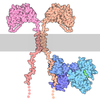
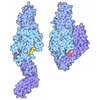
| Title | PD-L1 complexed with Germinal-designed anti-PD-L1 scFv H5 | |||||||||||||||||||||||||||
 Components Components |
| |||||||||||||||||||||||||||
 Keywords Keywords | DE NOVO PROTEIN / scfv / designed / binder | |||||||||||||||||||||||||||
| Function / homology |  Function and homology information Function and homology informationnegative regulation of tumor necrosis factor superfamily cytokine production / positive regulation of activated CD8-positive, alpha-beta T cell apoptotic process / negative regulation of CD8-positive, alpha-beta T cell activation / Regulation of PD-L1(CD274) translation / negative regulation of T cell mediated immune response to tumor cell / negative regulation of CD4-positive, alpha-beta T cell proliferation / TRIF-dependent toll-like receptor signaling pathway / STAT3 nuclear events downstream of ALK signaling / negative regulation of activated T cell proliferation / negative regulation of interleukin-10 production ...negative regulation of tumor necrosis factor superfamily cytokine production / positive regulation of activated CD8-positive, alpha-beta T cell apoptotic process / negative regulation of CD8-positive, alpha-beta T cell activation / Regulation of PD-L1(CD274) translation / negative regulation of T cell mediated immune response to tumor cell / negative regulation of CD4-positive, alpha-beta T cell proliferation / TRIF-dependent toll-like receptor signaling pathway / STAT3 nuclear events downstream of ALK signaling / negative regulation of activated T cell proliferation / negative regulation of interleukin-10 production / negative regulation of T cell activation / negative regulation of type II interferon production / positive regulation of interleukin-10 production / Co-inhibition by PD-1 / negative regulation of T cell proliferation / negative regulation of T cell receptor signaling pathway / T cell costimulation / response to cytokine / positive regulation of T cell proliferation / endomembrane system / PD-L1(CD274) glycosylation and translocation to plasma membrane / AMPK-induced ERAD and lysosome mediated degradation of PD-L1(CD274) / GSK3B-mediated proteasomal degradation of PD-L1(CD274) / recycling endosome membrane / SPOP-mediated proteasomal degradation of PD-L1(CD274) / cellular response to lipopolysaccharide / early endosome membrane / transcription coactivator activity / cell surface receptor signaling pathway / nuclear speck / immune response / receptor ligand activity / external side of plasma membrane / Golgi membrane / endoplasmic reticulum membrane / signal transduction / extracellular exosome / nucleoplasm / extracellular region / plasma membrane / cytosol Similarity search - Function | |||||||||||||||||||||||||||
| Biological species |  Homo sapiens (human) Homo sapiens (human)synthetic construct (others) | |||||||||||||||||||||||||||
| Method | ELECTRON MICROSCOPY / single particle reconstruction / cryo EM / Resolution: 3.93 Å | |||||||||||||||||||||||||||
 Authors Authors | Zhang, J.L. / Rao, B. / Feng, L. | |||||||||||||||||||||||||||
| Funding support |  United States, 1items United States, 1items
| |||||||||||||||||||||||||||
 Citation Citation | Journal: Nat Biotechnol / Year: 2026 Title: Efficient generation of epitope-targeted antibodies with Germinal. Authors: Luis S Mille-Fragoso / Claudia L Driscoll / John N Wang / Haoyu Dai / Talal Widatalla / Jim L Zhang / Xiaowei Zhang / Bing Rao / Liang Feng / Brian L Hie / Xiaojing J Gao / Abstract: Obtaining antibodies to specific protein targets is a widely important yet experimentally laborious process. Meanwhile, computational methods for antibody design have been limited by low success ...Obtaining antibodies to specific protein targets is a widely important yet experimentally laborious process. Meanwhile, computational methods for antibody design have been limited by low success rates that require resource-intensive screening. Here we introduce Germinal, a broadly enabling generative pipeline that designs antibodies against specific epitopes with nanomolar binding affinities while requiring only low-n experimental testing. Our method co-optimizes antibody structure and sequence by integrating a structure predictor with an antibody-specific protein language model to perform de novo design of functional complementarity-determining regions onto a user-specified structural framework. When tested against four diverse protein targets, Germinal designed functional antibodies across all targets and binder formats, testing only 43-101 designs for each antigen. Validated designs also exhibited robust expression in mammalian cells and high sequence and structural novelty. We provide open-source code and full computational and experimental protocols to facilitate wide adoption. #1: Journal: bioRxiv / Year: 2025 Title: Efficient generation of epitope-targeted antibodies with Germinal. Authors: Luis S Mille-Fragoso / John N Wang / Claudia L Driscoll / Haoyu Dai / Talal Widatalla / Xiaowei Zhang / Brian L Hie / Xiaojing J Gao / Abstract: Obtaining novel antibodies against specific protein targets is a widely important yet experimentally laborious process. Meanwhile, computational methods for antibody design have been limited by low ...Obtaining novel antibodies against specific protein targets is a widely important yet experimentally laborious process. Meanwhile, computational methods for antibody design have been limited by low success rates that currently require resource-intensive screening. Here, we introduce Germinal, a broadly enabling generative framework that designs antibodies against specific epitopes with nanomolar binding affinities while requiring only low-n experimental testing. Our method co-optimizes antibody structure and sequence by integrating a structure predictor with an antibody-specific protein language model to perform design of functional complementarity-determining regions (CDRs) onto a user-specified structural framework. When tested against four diverse protein targets, Germinal achieved an experimental success rate of 4-22% across all targets, testing only 43-101 designs for each antigen. Validated nanobodies also exhibited robust expression in mammalian cells and nanomolar binding affinities. We provide open-source code and full computational and experimental protocols to facilitate wide adoption. Germinal represents a milestone in efficient, epitope-targeted antibody design, with notable implications for the development of molecular tools and therapeutics. | |||||||||||||||||||||||||||
| History |
|
- Structure visualization
| Structure viewer | Molecule: MolmilJmol/JSmol |
|---|
- Downloads & links
-Download
| PDBx/mmCIF format | 35tl.cif.gz | 80 KB | Display | PDBx/mmCIF format |
|---|---|---|---|---|
| PDB format | pdb35tl.ent.gz | 53.5 KB | Display | PDB format |
| PDBx/mmJSON format | 35tl.json.gz | Tree view | PDBx/mmJSON format | |
| Others |  Other downloads Other downloads |
-Validation report
| Arichive directory | https://data.pdbj.org/pub/pdb/validation_reports/5t/35tlftp://data.pdbj.org/pub/pdb/validation_reports/5t/35tl | HTTPS FTP |
|---|
-Related structure data
| Related structure data |  77181MC M: map data used to model this data C: citing same article ( |
|---|---|
| Similar structure data |
-Links
 PDBj
PDBj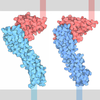
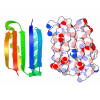
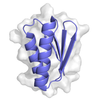
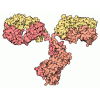
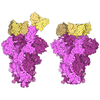


- Assembly
| Deposited unit | 
|
|---|---|
| 1 |
|
-Components
| #1: Protein | Mass: 33318.312 Da / Num. of mol.: 1 Source method: isolated from a genetically manipulated source Source: (gene. exp.) Homo sapiens (human) / Gene: CD274, B7H1, PDCD1L1, PDCD1LG1, PDL1 / Production host: Homo sapiens (human) / References: UniProt: Q9NZQ7 |
|---|---|
| #2: Antibody | Mass: 23806.922 Da / Num. of mol.: 1 Source method: isolated from a genetically manipulated source Source: (gene. exp.) synthetic construct (others) / Production host: Homo sapiens (human) |
| #3: Antibody | Mass: 23478.154 Da / Num. of mol.: 1 Source method: isolated from a genetically manipulated source Source: (gene. exp.) synthetic construct (others) / Production host: Homo sapiens (human) |
| Has protein modification | Y |
-Experimental details
-Experiment
| Experiment | Method: ELECTRON MICROSCOPY |
|---|---|
| EM experiment | Aggregation state: PARTICLE / 3D reconstruction method: single particle reconstruction |
- Sample preparation
| Component | Name: PD-L1 complexed with Germinal-designed anti-PD-L1 scFv H5 Type: COMPLEX / Entity ID: all / Source: RECOMBINANT |
|---|---|
| Molecular weight | Experimental value: NO |
| Source (natural) | Organism: synthetic construct (others) |
| Source (recombinant) | Organism: Homo sapiens (human) |
| Buffer solution | pH: 7.4 |
| Specimen | Embedding applied: NO / Shadowing applied: NO / Staining applied: NO / Vitrification applied: YES |
| Vitrification | Cryogen name: ETHANE |
- Electron microscopy imaging
| Experimental equipment |  Model: Titan Krios / Image courtesy: FEI Company |
|---|---|
| Microscopy | Model: TFS KRIOS |
| Electron gun | Electron source:  FIELD EMISSION GUN / Accelerating voltage: 300 kV / Illumination mode: FLOOD BEAM FIELD EMISSION GUN / Accelerating voltage: 300 kV / Illumination mode: FLOOD BEAM |
| Electron lens | Mode: BRIGHT FIELD / Nominal defocus max: 2500 nm / Nominal defocus min: 1000 nm |
| Image recording | Electron dose: 50 e/Å2 / Film or detector model: FEI FALCON IV (4k x 4k) |
- Processing
| EM software |
| ||||||||||||||||||||||||
|---|---|---|---|---|---|---|---|---|---|---|---|---|---|---|---|---|---|---|---|---|---|---|---|---|---|
| CTF correction | Type: NONE | ||||||||||||||||||||||||
| 3D reconstruction | Resolution: 3.93 Å / Resolution method: FSC 0.143 CUT-OFF / Num. of particles: 94644 / Symmetry type: POINT | ||||||||||||||||||||||||
| Refinement | Highest resolution: 3.93 Å Stereochemistry target values: REAL-SPACE (WEIGHTED MAP SUM AT ATOM CENTERS) | ||||||||||||||||||||||||
| Refine LS restraints |
|
