Movie
Movie Controller


+ Open data

- Basic information
| Entry | Database: PDB / ID: 30kz | ||||||||||||||||||||||||
|---|---|---|---|---|---|---|---|---|---|---|---|---|---|---|---|---|---|---|---|---|---|---|---|---|---|
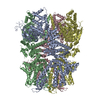
| Title | Human Trpm4 at 8 degrees Celsius | ||||||||||||||||||||||||
 Components Components | Transient receptor potential cation channel subfamily M member 4 | ||||||||||||||||||||||||
 Keywords Keywords | MEMBRANE PROTEIN / TRP channel / ion channel | ||||||||||||||||||||||||
| Function / homology |  Function and homology information Function and homology informationpositive regulation of atrial cardiac muscle cell action potential / positive regulation of regulation of vascular associated smooth muscle cell membrane depolarization / sodium channel complex / regulation of T cell cytokine production / negative regulation of bone mineralization / membrane depolarization during AV node cell action potential / membrane depolarization during bundle of His cell action potential / membrane depolarization during Purkinje myocyte cell action potential / regulation of ventricular cardiac muscle cell action potential / metal ion transport ...positive regulation of atrial cardiac muscle cell action potential / positive regulation of regulation of vascular associated smooth muscle cell membrane depolarization / sodium channel complex / regulation of T cell cytokine production / negative regulation of bone mineralization / membrane depolarization during AV node cell action potential / membrane depolarization during bundle of His cell action potential / membrane depolarization during Purkinje myocyte cell action potential / regulation of ventricular cardiac muscle cell action potential / metal ion transport / calcium-activated cation channel activity / sodium ion import across plasma membrane / dendritic cell chemotaxis / sodium channel activity / TRP channels / cellular response to ATP / regulation of heart rate by cardiac conduction / positive regulation of fat cell differentiation / monoatomic cation transmembrane transport / protein sumoylation / positive regulation of vasoconstriction / negative regulation of osteoblast differentiation / positive regulation of heart rate / positive regulation of adipose tissue development / positive regulation of insulin secretion involved in cellular response to glucose stimulus / calcium-mediated signaling / transmembrane transport / calcium channel activity / calcium ion transmembrane transport / positive regulation of canonical Wnt signaling pathway / Sensory perception of sweet, bitter, and umami (glutamate) taste / positive regulation of cytosolic calcium ion concentration / protein homotetramerization / neuronal cell body / calcium ion binding / positive regulation of cell population proliferation / Golgi apparatus / endoplasmic reticulum / ATP binding / membrane / identical protein binding / plasma membrane Similarity search - Function | ||||||||||||||||||||||||
| Biological species |  Homo sapiens (human) Homo sapiens (human) | ||||||||||||||||||||||||
| Method | ELECTRON MICROSCOPY / single particle reconstruction / cryo EM / Resolution: 3.4 Å | ||||||||||||||||||||||||
 Authors Authors | Schneiter, D. / Ekundayo, B.E. / Stahlberg, H. / Abriel, H. | ||||||||||||||||||||||||
| Funding support |  Switzerland, 1items Switzerland, 1items
| ||||||||||||||||||||||||
 Citation Citation | Journal: bioRxiv / Year: 2026 Title: Temperature-dependent ligand relocation reveals plasticity of TRPM4 inhibition. Authors: Dominic Schneiter / Jean-Sébastien Rougier / Hugues Abriel / Henning Stahlberg / Babatunde Ekundayo Abstract: Transient receptor potential melastatin 4 (TRPM4) is a Ca²⁺-activated cation channel whose pharmacology is shaped by its molecular environment. It remains poorly understood how temperature and ...Transient receptor potential melastatin 4 (TRPM4) is a Ca²⁺-activated cation channel whose pharmacology is shaped by its molecular environment. It remains poorly understood how temperature and membrane context influence inhibitor recognition. Here we combine cryo-electron microscopy of membrane-derived vesicles and detergent-solubilized TRPM4 to investigate lipid-associated architecture and binding of the potent anthranilic anilide inhibitor PBA. We find that membrane vesicles preserve a native-like paralipid environment and reveal lipid binding patterns highly similar to those observed in GDN, supporting detergent-solubilized TRPM4 as a structurally relevant system for ligand analysis. Strikingly, PBA occupies distinct binding pockets at 8 °C and 37 °C. At low temperature, PBA binds in a previously described inhibitor pocket formed by S3, S4, the S4-S5 linker and the TRP helix, whereas at physiological temperature it relocates to a distinct site within the S1-S4 domain proximal to the Ca²⁺ regulatory region. These findings reveal temperature-dependent plasticity in TRPM4 ligand recognition. | ||||||||||||||||||||||||
| History |
|
- Structure visualization
| Structure viewer | Molecule: MolmilJmol/JSmol |
|---|
- Downloads & links
-Download
| PDBx/mmCIF format | 30kz.cif.gz | 1.3 MB | Display | PDBx/mmCIF format |
|---|---|---|---|---|
| PDB format | pdb30kz.ent.gz | Display | PDB format | |
| PDBx/mmJSON format | 30kz.json.gz | Tree view | PDBx/mmJSON format | |
| Others |  Other downloads Other downloads |
-Validation report
| Arichive directory | https://data.pdbj.org/pub/pdb/validation_reports/0k/30kzftp://data.pdbj.org/pub/pdb/validation_reports/0k/30kz | HTTPS FTP |
|---|
-Related structure data
| Related structure data |  57865MC  30khC  30kwC  30laC  30ldC M: map data used to model this data C: citing same article ( |
|---|---|
| Similar structure data |


-Links
 PDBj
PDBj- Assembly
| Deposited unit | 
|
|---|---|
| 1 |
|
-Components
| #1: Protein | Mass: 134456.484 Da / Num. of mol.: 4 Source method: isolated from a genetically manipulated source Source: (gene. exp.) Homo sapiens (human) / Gene: TRPM4, LTRPC4 / Production host: Homo sapiens (human) / References: UniProt: Q8TD43#2: Chemical | ChemComp-A1J74 / Mass: 339.342 Da / Num. of mol.: 8 / Source method: obtained synthetically / Formula: C19H17NO5 / Feature type: SUBJECT OF INVESTIGATION #3: Chemical | ChemComp-CA /   Mass: 40.078 Da / Num. of mol.: 4 / Source method: obtained synthetically / Formula: Ca Mass: 40.078 Da / Num. of mol.: 4 / Source method: obtained synthetically / Formula: CaHas ligand of interest | Y | Has protein modification | N | |
|---|
-Experimental details
-Experiment
| Experiment | Method: ELECTRON MICROSCOPY |
|---|---|
| EM experiment | Aggregation state: PARTICLE / 3D reconstruction method: single particle reconstruction |
- Sample preparation
| Component | Name: Human Trpm4 / Type: COMPLEX / Entity ID: #1 / Source: RECOMBINANT |
|---|---|
| Source (natural) | Organism: Homo sapiens (human) |
| Source (recombinant) | Organism: Homo sapiens (human) |
| Buffer solution | pH: 7.5 |
| Specimen | Embedding applied: NO / Shadowing applied: NO / Staining applied: NO / Vitrification applied: YES |
| Vitrification | Cryogen name: ETHANE |
- Electron microscopy imaging
| Experimental equipment |  Model: Titan Krios / Image courtesy: FEI Company |
|---|---|
| Microscopy | Model: TFS KRIOS |
| Electron gun | Electron source:  FIELD EMISSION GUN / Accelerating voltage: 300 kV / Illumination mode: FLOOD BEAM FIELD EMISSION GUN / Accelerating voltage: 300 kV / Illumination mode: FLOOD BEAM |
| Electron lens | Mode: BRIGHT FIELD / Nominal defocus max: 2200 nm / Nominal defocus min: 800 nm |
| Image recording | Electron dose: 50 e/Å2 / Film or detector model: TFS FALCON 4i (4k x 4k) |
- Processing
| EM software |
| ||||||||||||||||
|---|---|---|---|---|---|---|---|---|---|---|---|---|---|---|---|---|---|
| CTF correction | Type: PHASE FLIPPING AND AMPLITUDE CORRECTION | ||||||||||||||||
| 3D reconstruction | Resolution: 3.4 Å / Resolution method: FSC 0.143 CUT-OFF / Num. of particles: 16518 / Symmetry type: POINT | ||||||||||||||||
| Atomic model building | PDB-ID: 9B92 Accession code: 9B92 / Source name: PDB / Type: experimental model |