[English] 日本語
Yorodumi
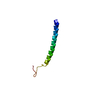
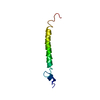
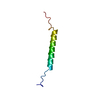
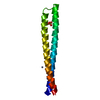
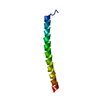
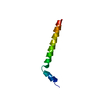
- PDB-2llm: Structure of amyloid precursor protein's transmembrane domain -

+
Open data


ID or keywords:

Loading...

-
Basic information

Entry
Database: PDB / ID: 2llm
TitleStructure of amyloid precursor protein's transmembrane domain
ComponentsAmyloid beta A4 protein
KeywordsPROTEIN FIBRIL / Alzheimer's disease
Function / homology
Function and homology information


amyloid-beta complex / growth cone lamellipodium / cellular response to norepinephrine stimulus / collateral sprouting in absence of injury / growth cone filopodium / microglia development / Formyl peptide receptors bind formyl peptides and many other ligands / regulation of Wnt signaling pathway / axo-dendritic transport / axon midline choice point recognition ...amyloid-beta complex / growth cone lamellipodium / cellular response to norepinephrine stimulus / collateral sprouting in absence of injury / growth cone filopodium / microglia development / Formyl peptide receptors bind formyl peptides and many other ligands / regulation of Wnt signaling pathway / axo-dendritic transport / axon midline choice point recognition / hippocampal neuron apoptotic process / regulation of synapse structure or activity / astrocyte activation involved in immune response / NMDA selective glutamate receptor signaling pathway / regulation of spontaneous synaptic transmission / mating behavior / growth factor receptor binding / peptidase activator activity / Insertion of tail-anchored proteins into the endoplasmic reticulum membrane / positive regulation of amyloid fibril formation / Golgi-associated vesicle / PTB domain binding / astrocyte projection / Lysosome Vesicle Biogenesis / Deregulated CDK5 triggers multiple neurodegenerative pathways in Alzheimer's disease models / neuron remodeling / nuclear envelope lumen / TRAF6 mediated NF-kB activation / dendrite development / positive regulation of protein metabolic process / signaling receptor activator activity / negative regulation of long-term synaptic potentiation / transition metal ion binding / Advanced glycosylation endproduct receptor signaling / The NLRP3 inflammasome / modulation of excitatory postsynaptic potential / regulation of multicellular organism growth / main axon / intracellular copper ion homeostasis / ECM proteoglycans / response to insulin-like growth factor stimulus / positive regulation of T cell migration / regulation of presynapse assembly / neuronal dense core vesicle / Purinergic signaling in leishmaniasis infection / cellular response to manganese ion / Notch signaling pathway / positive regulation of chemokine production / swimming behavior / neuron projection maintenance / extracellular matrix organization / clathrin-coated pit / positive regulation of mitotic cell cycle / axonogenesis / Mitochondrial protein degradation / ionotropic glutamate receptor signaling pathway / platelet alpha granule lumen / astrocyte activation / positive regulation of calcium-mediated signaling / response to interleukin-1 / regulation of neuron apoptotic process / cellular response to cAMP / cellular response to copper ion / positive regulation of glycolytic process / endosome lumen / trans-Golgi network membrane / positive regulation of interleukin-1 beta production / protein serine/threonine kinase binding / dendritic shaft / positive regulation of long-term synaptic potentiation / learning / central nervous system development / Post-translational protein phosphorylation / adult locomotory behavior / serine-type endopeptidase inhibitor activity / locomotory behavior / microglial cell activation / cellular response to nerve growth factor stimulus / positive regulation of non-canonical NF-kappaB signal transduction / TAK1-dependent IKK and NF-kappa-B activation / synapse organization / visual learning / recycling endosome / positive regulation of interleukin-6 production / positive regulation of JNK cascade / Golgi lumen / response to lead ion / regulation of long-term neuronal synaptic plasticity / cognition / Regulation of Insulin-like Growth Factor (IGF) transport and uptake by Insulin-like Growth Factor Binding Proteins (IGFBPs) / cellular response to amyloid-beta / endocytosis / neuron projection development / positive regulation of tumor necrosis factor production / positive regulation of inflammatory response / calcium ion transport / Platelet degranulation / regulation of translation / heparin binding / regulation of gene expression
Similarity search - Function
Single alpha-helices involved in coiled-coils or other helix-helix interfaces - #1670 / Amyloidogenic glycoprotein, copper-binding / Amyloidogenic glycoprotein, copper-binding domain conserved site / Amyloidogenic glycoprotein, copper-binding domain superfamily / Copper-binding of amyloid precursor, CuBD / Amyloid precursor protein (APP) copper-binding (CuBD) domain signature. / Amyloidogenic glycoprotein, heparin-binding / Amyloid A4 N-terminal heparin-binding / Amyloidogenic glycoprotein, amyloid-beta peptide superfamily / Beta-amyloid peptide (beta-APP) ...Single alpha-helices involved in coiled-coils or other helix-helix interfaces - #1670 / Amyloidogenic glycoprotein, copper-binding / Amyloidogenic glycoprotein, copper-binding domain conserved site / Amyloidogenic glycoprotein, copper-binding domain superfamily / Copper-binding of amyloid precursor, CuBD / Amyloid precursor protein (APP) copper-binding (CuBD) domain signature. / Amyloidogenic glycoprotein, heparin-binding / Amyloid A4 N-terminal heparin-binding / Amyloidogenic glycoprotein, amyloid-beta peptide superfamily / Beta-amyloid peptide (beta-APP) / Amyloidogenic glycoprotein, amyloid-beta peptide / Beta-amyloid precursor protein C-terminal / Amyloidogenic glycoprotein, intracellular domain, conserved site / Beta-amyloid precursor protein C-terminus / Amyloid precursor protein (APP) intracellular domain signature. / Amyloidogenic glycoprotein, extracellular / Amyloidogenic glycoprotein, E2 domain / E2 domain superfamily / Amyloidogenic glycoprotein, heparin-binding domain superfamily / E2 domain of amyloid precursor protein / Amyloid precursor protein (APP) E1 domain profile. / Amyloid precursor protein (APP) E2 domain profile. / amyloid A4 / Amyloidogenic glycoprotein / Proteinase inhibitor I2, Kunitz, conserved site / Pancreatic trypsin inhibitor (Kunitz) family signature. / BPTI/Kunitz family of serine protease inhibitors. / Pancreatic trypsin inhibitor Kunitz domain / Kunitz/Bovine pancreatic trypsin inhibitor domain / Pancreatic trypsin inhibitor (Kunitz) family profile. / Pancreatic trypsin inhibitor Kunitz domain superfamily / Single alpha-helices involved in coiled-coils or other helix-helix interfaces / Helix non-globular / Special / PH-like domain superfamily
Similarity search - Domain/homology
Amyloid-beta precursor protein
Similarity search - Component
Biological speciesHomo sapiens (human)
MethodSOLUTION NMR / simulated annealing
Model detailsfewest violations, model 1
AuthorsNadezhdin, K.D. / Bocharova, O.V. / Bocharov, E.V. / Arseniev, A.S.
CitationJournal: Acta Naturae / Year: 2011
Title: Structural and dynamic study of the transmembrane domain of the amyloid precursor protein.
Authors: Nadezhdin, K.D. / Bocharova, O.V. / Bocharov, E.V. / Arseniev, A.S.
History
DepositionNov 15, 2011Deposition site: BMRB / Processing site: RCSB
Revision 1.0Jun 20, 2012Provider: repository / Type: Initial release
Revision 1.1Jun 14, 2023Group: Data collection / Database references / Other
Category: database_2 / pdbx_database_status ...database_2 / pdbx_database_status / pdbx_nmr_software / pdbx_nmr_spectrometer / struct_ref_seq_dif
Item: _database_2.pdbx_DOI / _database_2.pdbx_database_accession ..._database_2.pdbx_DOI / _database_2.pdbx_database_accession / _pdbx_database_status.status_code_nmr_data / _pdbx_nmr_software.name / _pdbx_nmr_spectrometer.model / _struct_ref_seq_dif.details
Revision 1.2May 15, 2024Group: Data collection / Database references / Category: chem_comp_atom / chem_comp_bond / database_2 / Item: _database_2.pdbx_DOI

-
Structure visualization

Structure viewerMolecule:
MolmilJmol/JSmol

Downloads & links

-
Assembly

Deposited unit
A: Amyloid beta A4 protein


Theoretical massNumber of molelcules
Total (without water)4,4501
Polymers4,4501
Non-polymers00
Water00
1


  • Idetical with deposited unit
  • defined by author
TypeNameSymmetry operationNumber
identity operation1_555x,y,z1
NMR ensembles
DataCriteria
Number of conformers (submitted / calculated)20 / 20structures with the least restraint violations
RepresentativeModel #1fewest violations

-
Components

#1: Protein/peptide Amyloid beta A4 protein / ABPP / APPI / APP / Alzheimer disease amyloid protein / Cerebral vascular amyloid peptide / CVAP / ...ABPP / APPI / APP / Alzheimer disease amyloid protein / Cerebral vascular amyloid peptide / CVAP / PreA4 / Protease nexin-II / PN-II / N-APP / Soluble APP-alpha / S-APP-alpha / Soluble APP-beta / S-APP-beta / C99 / Beta-amyloid protein 42 / Beta-APP42 / Beta-amyloid protein 40 / Beta-APP40 / C83 / P3(42) / P3(40) / C80


Mass: 4450.460 Da / Num. of mol.: 1 / Fragment: UNP residues 686-726
Source method: isolated from a genetically manipulated source
Source: (gene. exp.) Homo sapiens (human) / Gene: APP, A4, AD1 / Production host: Escherichia coli (E. coli) / References: UniProt: P05067

-
Experimental details

-
Experiment

ExperimentMethod: SOLUTION NMR
NMR experiment
Conditions-IDExperiment-IDSolution-IDType
1112D 1H-15N HSQC
1212D 1H-13C HSQC
1313D HNCO
1413D HNCA
1513D HN(CO)CA
1613D (H)CCH-TOCSY
1713D 1H-13C NOESY aliphatic
1822D 1H-15N HSQC
1923D 1H-15N NOESY
11023D 1H-15N TOCSY

-
Sample preparation

Details
Solution-IDContentsSolvent system
10.3-1 mM [U-100% 13C; U-100% 15N] APPjmtm, 21-70 mM [U-100% 2H] DPC, 95% H2O/5% D2O95% H2O/5% D2O
20.3-1 mM [U-100% 15N] APPjmtm, 21-70 mM DPC, 95% H2O/5% D2O95% H2O/5% D2O
Sample
UnitsComponentIsotopic labelingConc. range (mg/ml)Solution-ID
mMAPPjmtm-1[U-100% 13C; U-100% 15N]0.3-11
mMDPC-2[U-100% 2H]21-701
mMAPPjmtm-3[U-100% 15N]0.3-12
mMDPC-421-702
Sample conditionsIonic strength: 20 / pH: 4.6 / Pressure: ambient / Temperature: 318 K

-
NMR measurement

NMR spectrometer
TypeManufacturerModelField strength (MHz)Spectrometer-ID
Bruker AvanceBrukerAVANCE6001
Bruker AvanceBrukerAVANCE8002

-
Processing

NMR software
NameVersionDeveloperClassification
TopSpinBruker Biospincollection
TopSpinBruker Biospinprocessing
CYANA2.1Guntert, Mumenthaler and Wuthrichstructure solution
CYANA2.1Guntert, Mumenthaler and Wuthrichrefinement
MOLMOLKoradi, Billeter and Wuthrichgeometry optimization
MOLMOLKoradi, Billeter and Wuthrichvisualization
TALOS+Cornilescu, Delaglio and Baxrefinement
TALOS+Cornilescu, Delaglio and Baxstructure solution
CARAR.L.J.Kellerchemical shift assignment
CARAR.L.J.Kellerdata analysis
CARAR.L.J.Kellerpeak picking
RefinementMethod: simulated annealing / Software ordinal: 1
NMR representativeSelection criteria: fewest violations
NMR ensembleConformer selection criteria: structures with the least restraint violations
Conformers calculated total number: 20 / Conformers submitted total number: 20

+
About Yorodumi

-
News

-
Feb 9, 2022. New format data for meta-information of EMDB entries

New format data for meta-information of EMDB entries

  • Version 3 of the EMDB header file is now the official format.
  • The previous official version 1.9 will be removed from the archive.

Related info.:EMDB header

External links:wwPDB to switch to version 3 of the EMDB data model

-
Aug 12, 2020. Covid-19 info

Covid-19 info

URL: https://pdbj.org/emnavi/covid19.php

New page: Covid-19 featured information page in EM Navigator.

Related info.:Covid-19 info / Mar 5, 2020. Novel coronavirus structure data

+
Mar 5, 2020. Novel coronavirus structure data

Novel coronavirus structure data

Related info.:Yorodumi Speices / Aug 12, 2020. Covid-19 info

External links:COVID-19 featured content - PDBj / Molecule of the Month (242):Coronavirus Proteases

+
Jan 31, 2019. EMDB accession codes are about to change! (news from PDBe EMDB page)

EMDB accession codes are about to change! (news from PDBe EMDB page)

  • The allocation of 4 digits for EMDB accession codes will soon come to an end. Whilst these codes will remain in use, new EMDB accession codes will include an additional digit and will expand incrementally as the available range of codes is exhausted. The current 4-digit format prefixed with “EMD-” (i.e. EMD-XXXX) will advance to a 5-digit format (i.e. EMD-XXXXX), and so on. It is currently estimated that the 4-digit codes will be depleted around Spring 2019, at which point the 5-digit format will come into force.
  • The EM Navigator/Yorodumi systems omit the EMD- prefix.

Related info.:Q: What is EMD? / ID/Accession-code notation in Yorodumi/EM Navigator

External links:EMDB Accession Codes are Changing Soon! / Contact to PDBj

+
Jul 12, 2017. Major update of PDB

Major update of PDB

  • wwPDB released updated PDB data conforming to the new PDBx/mmCIF dictionary.
  • This is a major update changing the version number from 4 to 5, and with Remediation, in which all the entries are updated.
  • In this update, many items about electron microscopy experimental information are reorganized (e.g. em_software).
  • Now, EM Navigator and Yorodumi are based on the updated data.

External links:wwPDB Remediation / Enriched Model Files Conforming to OneDep Data Standards Now Available in the PDB FTP Archive

-
Yorodumi

Thousand views of thousand structures

  • Yorodumi is a browser for structure data from EMDB, PDB, SASBDB, etc.
  • This page is also the successor to EM Navigator detail page, and also detail information page/front-end page for Omokage search.
  • The word "yorodu" (or yorozu) is an old Japanese word meaning "ten thousand". "mi" (miru) is to see.

Related info.:EMDB / PDB / SASBDB / Comparison of 3 databanks / Yorodumi Search / Aug 31, 2016. New EM Navigator & Yorodumi / Yorodumi Papers / Jmol/JSmol / Function and homology information / Changes in new EM Navigator and Yorodumi

Read more