- PDB-2af2: Solution structure of disulfide reduced and copper depleted Human... -
+
Open data
ID or keywords:
Loading...
-
Basic information
Entry
Database: PDB / ID: 2af2
Title
Solution structure of disulfide reduced and copper depleted Human Superoxide Dismutase
Components
Superoxide dismutase [Cu-Zn]
Keywords
OXIDOREDUCTASE / Human superoxide dismutase / solution structure / homodimeric protein / disulfide bond reduced / copper depleted protein / Structural Genomics / Structural Proteomics in Europe / SPINE
Function / homology
Function and homology information
regulation of T cell differentiation in thymus / positive regulation of oxidative stress-induced intrinsic apoptotic signaling pathway / regulation of organ growth / response to antipsychotic drug / neurofilament cytoskeleton organization / myeloid cell homeostasis / peripheral nervous system myelin maintenance / response to superoxide / response to carbon monoxide / regulation of GTPase activity ...regulation of T cell differentiation in thymus / positive regulation of oxidative stress-induced intrinsic apoptotic signaling pathway / regulation of organ growth / response to antipsychotic drug / neurofilament cytoskeleton organization / myeloid cell homeostasis / peripheral nervous system myelin maintenance / response to superoxide / response to carbon monoxide / regulation of GTPase activity / relaxation of vascular associated smooth muscle / auditory receptor cell stereocilium organization / anterograde axonal transport / protein phosphatase 2B binding / dense core granule / Oxidoreductases; Acting on a sulfur group of donors / retina homeostasis / hydrogen peroxide biosynthetic process / cellular response to potassium ion / muscle cell cellular homeostasis / retrograde axonal transport / superoxide metabolic process / heart contraction / response to copper ion / superoxide dismutase / Detoxification of Reactive Oxygen Species / thymus development / superoxide dismutase activity / cellular response to cadmium ion / regulation of multicellular organism growth / cellular response to ATP / response to axon injury / transmission of nerve impulse / reactive oxygen species metabolic process / placenta development / embryo implantation / sensory perception of sound / positive regulation of superoxide anion generation / response to amphetamine / removal of superoxide radicals / axon cytoplasm / ovarian follicle development / positive regulation of phagocytosis / Gene and protein expression by JAK-STAT signaling after Interleukin-12 stimulation / regulation of mitochondrial membrane potential / locomotory behavior / dendrite cytoplasm / glutathione metabolic process / response to hydrogen peroxide / positive regulation of cytokine production / negative regulation of inflammatory response / response to nutrient levels / mitochondrial intermembrane space / regulation of blood pressure / small GTPase binding / Platelet degranulation / peroxisome / negative regulation of neuron apoptotic process / response to heat / protein-folding chaperone binding / cytoplasmic vesicle / spermatogenesis / positive regulation of MAPK cascade / response to ethanol / intracellular iron ion homeostasis / lysosome / positive regulation of apoptotic process / mitochondrial matrix / copper ion binding / neuronal cell body / : / protein homodimerization activity / protein-containing complex / mitochondrion / extracellular exosome / zinc ion binding / nucleoplasm / extracellular region / identical protein binding / nucleus / cytosol / cytoplasm Similarity search - Function
Pearlman, D. A., Case, D. A., Caldwell, J. W., Ross, W. S., Cheatham, T. E., Ferguson, D. M., Seibel, G. L., Singh, U. C., Weiner, P. K., andKollman, P. A
In the structure databanks used in Yorodumi, some data are registered as the other names, "COVID-19 virus" and "2019-nCoV". Here are the details of the virus and the list of structure data.
Jan 31, 2019. EMDB accession codes are about to change! (news from PDBe EMDB page)
EMDB accession codes are about to change! (news from PDBe EMDB page)
The allocation of 4 digits for EMDB accession codes will soon come to an end. Whilst these codes will remain in use, new EMDB accession codes will include an additional digit and will expand incrementally as the available range of codes is exhausted. The current 4-digit format prefixed with “EMD-” (i.e. EMD-XXXX) will advance to a 5-digit format (i.e. EMD-XXXXX), and so on. It is currently estimated that the 4-digit codes will be depleted around Spring 2019, at which point the 5-digit format will come into force.
The EM Navigator/Yorodumi systems omit the EMD- prefix.
Related info.:Q: What is EMD? / ID/Accession-code notation in Yorodumi/EM Navigator
Yorodumi is a browser for structure data from EMDB, PDB, SASBDB, etc.
This page is also the successor to EM Navigator detail page, and also detail information page/front-end page for Omokage search.
The word "yorodu" (or yorozu) is an old Japanese word meaning "ten thousand". "mi" (miru) is to see.
Related info.:EMDB / PDB / SASBDB / Comparison of 3 databanks / Yorodumi Search / Aug 31, 2016. New EM Navigator & Yorodumi / Yorodumi Papers / Jmol/JSmol / Function and homology information / Changes in new EM Navigator and Yorodumi
 Movie
Movie Controller

 Yorodumi
 Open data
 Basic information
 Components
 Keywords
 Function and homology information
 Homo sapiens (human)
 Authors
 Citation
 Structure visualization
 Downloads & links
 Other downloads
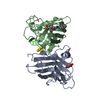
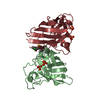
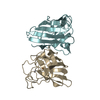

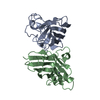
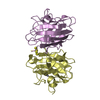
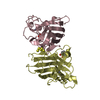
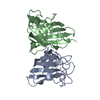
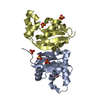
 PDBj
PDBj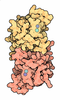
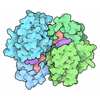
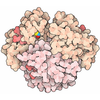
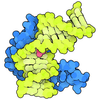
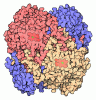
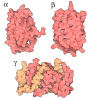
 Assembly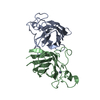

 Escherichia coli (E. coli) / Strain (production host): TOPP1 / References: UniProt: P00441, superoxide dismutase
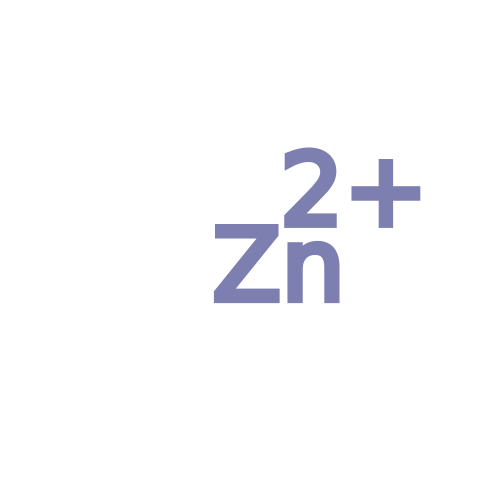 Mass: 65.409 Da / Num. of mol.: 2 / Source method: obtained synthetically / Formula: Zn
 HNCA
HNCA Sample preparation
 Processing