- PDB-29os: AD fold in mouse injected with seeds of AD -
+
Open data
ID or keywords:
Loading...
-
Basic information
Entry
Database: PDB / ID: 29os
Title
AD fold in mouse injected with seeds of AD
Components
Isoform Tau-A of Microtubule-associated protein tau
Keywords
STRUCTURAL PROTEIN / Amyloid / prion / tau / Alzheimer's Disease.
Function / homology
Function and homology information
negative regulation of tubulin deacetylation / Caspase-mediated cleavage of cytoskeletal proteins / negative regulation of intracellular transport / positive regulation of mesenchymal stem cell migration / positive regulation of long-term synaptic depression / PKR-mediated signaling / axon extension / adult walking behavior / mRNA transport / intrinsic apoptotic signaling pathway in response to oxidative stress ...negative regulation of tubulin deacetylation / Caspase-mediated cleavage of cytoskeletal proteins / negative regulation of intracellular transport / positive regulation of mesenchymal stem cell migration / positive regulation of long-term synaptic depression / PKR-mediated signaling / axon extension / adult walking behavior / mRNA transport / intrinsic apoptotic signaling pathway in response to oxidative stress / axo-dendritic transport / mitochondrion transport along microtubule / positive regulation of mitochondrial membrane potential / microtubule stabilizing activity / neurofibrillary tangle / microtubule lateral binding / tubulin complex / positive regulation of protein localization to synapse / regulation of microtubule-based movement / negative regulation of protein localization to mitochondrion / intracellular distribution of mitochondria / lipoprotein particle binding / negative regulation of mitochondrial membrane potential / microtubule polymerization / response to hyperoxia / apolipoprotein binding / regulation of calcium-mediated signaling / main axon / glial cell projection / regulation of microtubule polymerization or depolymerization / axoneme / axonal growth cone / negative regulation of mitochondrial fission / protein polymerization / positive regulation of axon extension / axolemma / regulation of cellular response to heat / positive regulation of microtubule polymerization / axonogenesis / heat shock protein binding / positive regulation of superoxide anion generation / positive regulation of protein localization / supramolecular fiber organization / synapse assembly / somatodendritic compartment / response to nutrient / nuclear periphery / protein phosphatase 2A binding / enzyme inhibitor activity / positive regulation of neuron projection development / SH3 domain binding / neuron migration / regulation of microtubule cytoskeleton organization / microtubule cytoskeleton organization / memory / Hsp90 protein binding / regulation of autophagy / protein homooligomerization / synapse organization / response to lead ion / neuron projection development / cytoplasmic ribonucleoprotein granule / microtubule cytoskeleton / microtubule / protein-folding chaperone binding / growth cone / cell body / microtubule binding / amyloid fibril formation / cytoplasmic side of plasma membrane / learning or memory / postsynaptic density / membrane raft / negative regulation of gene expression / axon / neuronal cell body / DNA damage response / dendrite / protein kinase binding / protein-containing complex binding / enzyme binding / DNA binding / extracellular region / identical protein binding / nucleus / plasma membrane / cytosol / cytoplasm Similarity search - Function
Microtubule-associated protein Tau / Microtubule associated protein, tubulin-binding repeat / Tau and MAP protein, tubulin-binding repeat / Tau and MAP proteins tubulin-binding repeat signature. / Tau and MAP proteins tubulin-binding repeat profile. / : Similarity search - Domain/homology
Journal: Nature / Year: 2026 Title: Prion-like transmission of human tau strains in the mouse brain. Authors: Sofia Lövestam / Aki Shimozawa / Airi Tarutani / Reiko Ohtani / Masami Masuda-Suzukake / Kazuko Hasegawa / Andrew C Robinson / Yuko Saito / Shigeo Murayama / Mari Yoshida / Hisaomi Suzuki / ...Authors: Sofia Lövestam / Aki Shimozawa / Airi Tarutani / Reiko Ohtani / Masami Masuda-Suzukake / Kazuko Hasegawa / Andrew C Robinson / Yuko Saito / Shigeo Murayama / Mari Yoshida / Hisaomi Suzuki / Mitsumoto Onaya / Masato Hasegawa / Michel Goedert / Sjors H W Scheres / Abstract: Most neurodegenerative diseases are thought to spread through the brain by prion-like mechanisms, in which filamentous protein assemblies self-propagate by templated seeding. Distinct conformations ...Most neurodegenerative diseases are thought to spread through the brain by prion-like mechanisms, in which filamentous protein assemblies self-propagate by templated seeding. Distinct conformations of amyloid filaments may provide the physical basis for the strains that lead to different diseases. However, a central pillar of the prion hypothesis, that strains retain their structural identity upon transmission, has not been demonstrated. Here we show that the injection of tau filaments from the brains of individuals with Alzheimer's disease or corticobasal degeneration into the brains of wild-type mice leads to the seeded assembly of amyloid filaments made of mouse tau with the same structures as those of the seeds. Thus, we show that, similar to prion strains, tau filaments propagate through templated seeding, and that the mouse is a suitable model to study the molecular mechanisms by which distinct tau folds drive disease-specific pathology in the brain.
History
Deposition
Mar 27, 2026
Deposition site: PDBE / Processing site: PDBE
Revision 1.0
May 27, 2026
Provider: repository / Type: Initial release
Revision 1.0
May 27, 2026
Data content type: EM metadata / Data content type: EM metadata / Provider: repository / Type: Initial release
Revision 1.0
May 27, 2026
Data content type: FSC / Data content type: FSC / Provider: repository / Type: Initial release
Revision 1.0
May 27, 2026
Data content type: Half map / Part number: 1 / Data content type: Half map / Provider: repository / Type: Initial release
Revision 1.0
May 27, 2026
Data content type: Half map / Part number: 2 / Data content type: Half map / Provider: repository / Type: Initial release
Revision 1.0
May 27, 2026
Data content type: Image / Data content type: Image / Provider: repository / Type: Initial release
Revision 1.0
May 27, 2026
Data content type: Primary map / Data content type: Primary map / Provider: repository / Type: Initial release
Data content type: EM metadata / Data content type: EM metadata / EM metadata / Group: Database references / Experimental summary / Data content type: EM metadata / EM metadata / EM metadata / Category: citation / citation_author / em_admin Data content type: EM metadata / EM metadata ...EM metadata / EM metadata / EM metadata / EM metadata / EM metadata / EM metadata / EM metadata / EM metadata / EM metadata / EM metadata Item: _citation.country / _citation.journal_abbrev ..._citation.country / _citation.journal_abbrev / _citation.journal_id_ASTM / _citation.journal_id_CSD / _citation.journal_id_ISSN / _citation.pdbx_database_id_DOI / _citation.pdbx_database_id_PubMed / _citation.title / _citation.year / _em_admin.last_update
A: Isoform Tau-A of Microtubule-associated protein tau B: Isoform Tau-A of Microtubule-associated protein tau C: Isoform Tau-A of Microtubule-associated protein tau D: Isoform Tau-A of Microtubule-associated protein tau E: Isoform Tau-A of Microtubule-associated protein tau F: Isoform Tau-A of Microtubule-associated protein tau
In the structure databanks used in Yorodumi, some data are registered as the other names, "COVID-19 virus" and "2019-nCoV". Here are the details of the virus and the list of structure data.
Jan 31, 2019. EMDB accession codes are about to change! (news from PDBe EMDB page)
EMDB accession codes are about to change! (news from PDBe EMDB page)
The allocation of 4 digits for EMDB accession codes will soon come to an end. Whilst these codes will remain in use, new EMDB accession codes will include an additional digit and will expand incrementally as the available range of codes is exhausted. The current 4-digit format prefixed with “EMD-” (i.e. EMD-XXXX) will advance to a 5-digit format (i.e. EMD-XXXXX), and so on. It is currently estimated that the 4-digit codes will be depleted around Spring 2019, at which point the 5-digit format will come into force.
The EM Navigator/Yorodumi systems omit the EMD- prefix.
Related info.:Q: What is EMD? / ID/Accession-code notation in Yorodumi/EM Navigator
Yorodumi is a browser for structure data from EMDB, PDB, SASBDB, etc.
This page is also the successor to EM Navigator detail page, and also detail information page/front-end page for Omokage search.
The word "yorodu" (or yorozu) is an old Japanese word meaning "ten thousand". "mi" (miru) is to see.
Related info.:EMDB / PDB / SASBDB / Comparison of 3 databanks / Yorodumi Search / Aug 31, 2016. New EM Navigator & Yorodumi / Yorodumi Papers / Jmol/JSmol / Function and homology information / Changes in new EM Navigator and Yorodumi
 Movie
Movie Controller


 Open data
 Basic information
 Components
 Keywords
 Function and homology information
 Mus musculus (house mouse)
 Authors
 United Kingdom, 1items
  Citation
 Structure visualization
 Downloads & links
 Other downloads


 PDBj
PDBj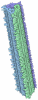
 Assembly
 Sample preparation
 Electron microscopy imaging
 FIELD EMISSION GUN / Accelerating voltage: 300 kV / Illumination mode: FLOOD BEAM
 Processing