 Movie
Movie Controller

[English] 日本語
 Yorodumi
- PDB-29hh: Cryo-EM structure of the CUL1-RBX1-SKP1-FBXO22 SCF ubiquition lig... -
+ Open data

- Basic information
| Entry | Database: PDB / ID: 29hh | |||||||||||||||
|---|---|---|---|---|---|---|---|---|---|---|---|---|---|---|---|---|
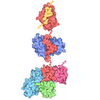
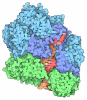
| Title | Cryo-EM structure of the CUL1-RBX1-SKP1-FBXO22 SCF ubiquition ligase in complex with NSD2, UNC10088 and Bach1 | |||||||||||||||
 Components Components |
| |||||||||||||||
 Keywords Keywords | LIGASE / Ubiquitin Ligase / Targeted protein degradation / cullin-RING ligase / SKP1 CUL1 F box SCF / Nuclear receptor binding SET domain-containing 2 NSD2 | |||||||||||||||
| Function / homology |  Function and homology information Function and homology information[histone H3]-lysine36 N-dimethyltransferase / Regulation of HMOX1 expression and activity / regulation of skeletal muscle fiber development / histone H4K20 methyltransferase activity / histone H3K36 dimethyltransferase activity / Parkin-FBXW7-Cul1 ubiquitin ligase complex / histone H3K36 trimethyltransferase activity / synaptic assembly at neuromuscular junction / F-box domain binding / ligand-modulated transcription factor activity ...[histone H3]-lysine36 N-dimethyltransferase / Regulation of HMOX1 expression and activity / regulation of skeletal muscle fiber development / histone H4K20 methyltransferase activity / histone H3K36 dimethyltransferase activity / Parkin-FBXW7-Cul1 ubiquitin ligase complex / histone H3K36 trimethyltransferase activity / synaptic assembly at neuromuscular junction / F-box domain binding / ligand-modulated transcription factor activity / histone H3K36 methyltransferase activity / negative regulation of beige fat cell differentiation / PcG protein complex / cullin-RING-type E3 NEDD8 transferase / NEDD8 transferase activity / PRC1 complex / cullin-RING ubiquitin ligase complex / negative regulation of mitophagy / regulation of xenophagy / maintenance of protein location in nucleus / cellular response to chemical stress / Loss of Function of FBXW7 in Cancer and NOTCH1 Signaling / Cul7-RING ubiquitin ligase complex / regulation of cell cycle process / neural crest cell differentiation / RNA polymerase II transcription initiation surveillance / positive regulation of protein autoubiquitination / protein neddylation / ubiquitin ligase activator activity / regulation of BMP signaling pathway / NEDD8 ligase activity / regulation of mitophagy / NFE2L2 regulating anti-oxidant/detoxification enzymes / negative regulation of response to oxidative stress / regulation of centrosome duplication / histone H3 methyltransferase activity / protein K27-linked ubiquitination / VCB complex / Cul5-RING ubiquitin ligase complex / ubiquitin-ubiquitin ligase activity / ubiquitin-dependent protein catabolic process via the C-end degron rule pathway / regulation of TOR signaling / Cul2-RING ubiquitin ligase complex / negative regulation of DNA-templated DNA replication / SCF ubiquitin ligase complex / regulation of mitotic cytokinesis / regulation of DNA damage checkpoint / negative regulation of type I interferon production / Cul3-RING ubiquitin ligase complex / regulation of miRNA-mediated gene silencing / regulation of natural killer cell activation / SCF-dependent proteasomal ubiquitin-dependent protein catabolic process / Prolactin receptor signaling / regulation of cell cycle phase transition / Cul4-RING E3 ubiquitin ligase complex / regulation of stem cell population maintenance / Cul4A-RING E3 ubiquitin ligase complex / Cul4B-RING E3 ubiquitin ligase complex / ubiquitin ligase complex scaffold activity / negative regulation of adipose tissue development / regulation of cellular response to stress / limb development / protein monoubiquitination / cullin family protein binding / centrosome duplication / regulation of DNA-templated DNA replication initiation / cilium assembly / ubiquitin-like ligase-substrate adaptor activity / intrinsic apoptotic signaling pathway / ribosome-associated ubiquitin-dependent protein catabolic process / signal transduction in response to DNA damage / ubiquitin ligase complex / negative regulation of insulin receptor signaling pathway / Nuclear events stimulated by ALK signaling in cancer / regulation of cellular response to insulin stimulus / protein K48-linked ubiquitination / transcription-coupled nucleotide-excision repair / post-translational protein modification / positive regulation of TORC1 signaling / regulation of embryonic development / molecular function activator activity / replication fork processing / cellular response to amino acid stimulus / protein modification process / regulation of mitotic cell cycle / negative regulation of canonical NF-kappaB signal transduction / site of DNA damage / Regulation of BACH1 activity / T cell activation / MAP3K8 (TPL2)-dependent MAPK1/3 activation / G1/S transition of mitotic cell cycle / Heme signaling / negative regulation of canonical Wnt signaling pathway / Nonhomologous End-Joining (NHEJ) / epigenetic regulation of gene expression / SCF-beta-TrCP mediated degradation of Emi1 / NIK-->noncanonical NF-kB signaling / Vpu mediated degradation of CD4 / Dectin-1 mediated noncanonical NF-kB signaling / Degradation of DVL Similarity search - Function | |||||||||||||||
| Biological species |  Homo sapiens (human) Homo sapiens (human) | |||||||||||||||
| Method | ELECTRON MICROSCOPY / single particle reconstruction / cryo EM / Resolution: 4.2 Å | |||||||||||||||
 Authors Authors | Amann, S.J. / Robertson, K.C. / Grishkovskaya, I. / Liu, T. / James, L.I. / Brown, N.B. / Haselbach, D. | |||||||||||||||
| Funding support |  United States, 2items United States, 2items
| |||||||||||||||
 Citation Citation | Journal: Nat Commun / Year: 2026 Title: Structural basis of NSD2 degradation via targeted recruitment of SCF-FBXO22. Authors: Kevin C Robertson / Sascha J Amann / Tongkun Liu / Adam V Funk / Xianxi Wang / Irina Grishkovskaya / Aamir Mehmood / John R Tabor / Jacqueline L Norris-Drouin / Cheryl H Arrowsmith / Jon L ...Authors: Kevin C Robertson / Sascha J Amann / Tongkun Liu / Adam V Funk / Xianxi Wang / Irina Grishkovskaya / Aamir Mehmood / John R Tabor / Jacqueline L Norris-Drouin / Cheryl H Arrowsmith / Jon L Collins / Yinglong Miao / Michael J Emanuele / David Haselbach / Lindsey I James / Nicholas G Brown /   Abstract: Targeted protein degradation (TPD) through the ubiquitin-proteasome system is driven by compound-mediated polyubiquitination of a protein-of-interest by an E3 ubiquitin (Ub) ligase. Relatively few ...Targeted protein degradation (TPD) through the ubiquitin-proteasome system is driven by compound-mediated polyubiquitination of a protein-of-interest by an E3 ubiquitin (Ub) ligase. Relatively few E3s have been successfully utilized for TPD and the governing principles of functional ternary complex formation between the E3, degrader, and protein target remain elusive. FBXO22 has recently been harnessed for TPD applications by degraders that covalently modify its cysteine residues. Here, we reveal that the aldehyde derivative of UNC10088 promotes cooperative binding of FBXO22 to NSD2, a histone methyltransferase and oncogenic protein, leading to a cryo-EM structure of the SKP1-CUL1-F-box (SCF)-FBXO22 complex with NSD2. This structure revealed a conformational change in the FBXO22 loop surrounding C326, further exposing the cysteine for covalent recruitment. Additional medicinal chemistry efforts led to the discovery of benzaldehyde-based non-prodrug degraders that similarly engage C326 of FBXO22 and potently degrade NSD2. Unlike many degraders, our molecules recruit NSD2 to a different surface of FBXO22 than the known FBXO22 substrate BACH1, allowing for concurrent complex formation and structural determination of SCF bound to both the neosubstrate NSD2 and native substrate BACH1. Overall, we demonstrate the biochemical and structural basis for NSD2 degradation, revealing key principles for efficient and selective TPD by SCF. #1: Journal: Acta Crystallogr D Struct Biol / Year: 2019 Title: Macromolecular structure determination using X-rays, neutrons and electrons: recent developments in Phenix. Authors: Dorothee Liebschner / Pavel V Afonine / Matthew L Baker / Gábor Bunkóczi / Vincent B Chen / Tristan I Croll / Bradley Hintze / Li Wei Hung / Swati Jain / Airlie J McCoy / Nigel W Moriarty ...Authors: Dorothee Liebschner / Pavel V Afonine / Matthew L Baker / Gábor Bunkóczi / Vincent B Chen / Tristan I Croll / Bradley Hintze / Li Wei Hung / Swati Jain / Airlie J McCoy / Nigel W Moriarty / Robert D Oeffner / Billy K Poon / Michael G Prisant / Randy J Read / Jane S Richardson / David C Richardson / Massimo D Sammito / Oleg V Sobolev / Duncan H Stockwell / Thomas C Terwilliger / Alexandre G Urzhumtsev / Lizbeth L Videau / Christopher J Williams / Paul D Adams /   Abstract: Diffraction (X-ray, neutron and electron) and electron cryo-microscopy are powerful methods to determine three-dimensional macromolecular structures, which are required to understand biological ...Diffraction (X-ray, neutron and electron) and electron cryo-microscopy are powerful methods to determine three-dimensional macromolecular structures, which are required to understand biological processes and to develop new therapeutics against diseases. The overall structure-solution workflow is similar for these techniques, but nuances exist because the properties of the reduced experimental data are different. Software tools for structure determination should therefore be tailored for each method. Phenix is a comprehensive software package for macromolecular structure determination that handles data from any of these techniques. Tasks performed with Phenix include data-quality assessment, map improvement, model building, the validation/rebuilding/refinement cycle and deposition. Each tool caters to the type of experimental data. The design of Phenix emphasizes the automation of procedures, where possible, to minimize repetitive and time-consuming manual tasks, while default parameters are chosen to encourage best practice. A graphical user interface provides access to many command-line features of Phenix and streamlines the transition between programs, project tracking and re-running of previous tasks. | |||||||||||||||
| History |
|
- Structure visualization
| Structure viewer | Molecule: MolmilJmol/JSmol |
|---|
- Downloads & links
-Download
| PDBx/mmCIF format | 29hh.cif.gz | 375.8 KB | Display | PDBx/mmCIF format |
|---|---|---|---|---|
| PDB format | pdb29hh.ent.gz | Display | PDB format | |
| PDBx/mmJSON format | 29hh.json.gz | Tree view | PDBx/mmJSON format | |
| Others |  Other downloads Other downloads |
-Validation report
| Arichive directory | https://data.pdbj.org/pub/pdb/validation_reports/9h/29hhftp://data.pdbj.org/pub/pdb/validation_reports/9h/29hh | HTTPS FTP |
|---|
-Related structure data
| Related structure data |  57179MC  29hgC  29hiC M: map data used to model this data C: citing same article ( |
|---|---|
| Similar structure data |


-Links
 PDBj
PDBj
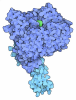
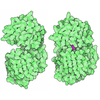
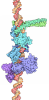
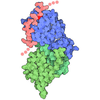
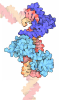
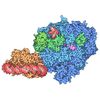
- Assembly
| Deposited unit | 
|
|---|---|
| 1 |
|
-Components
-Protein , 6 types, 7 molecules ABCDEGH
| #1: Protein | Mass: 44562.270 Da / Num. of mol.: 1 Source method: isolated from a genetically manipulated source Source: (gene. exp.) Homo sapiens (human) / Gene: FBXO22, FBX22 / Production host:  Trichoplusia ni (cabbage looper) / References: UniProt: Q8NEZ5 Trichoplusia ni (cabbage looper) / References: UniProt: Q8NEZ5 |
|---|---|
| #2: Protein | Mass: 152515.469 Da / Num. of mol.: 1 Source method: isolated from a genetically manipulated source Source: (gene. exp.) Homo sapiens (human) / Gene: NSD2, KIAA1090, MMSET, TRX5, WHSC1 / Production host: Trichoplusia ni (cabbage looper)References: UniProt: O96028, [histone H3]-lysine36 N-dimethyltransferase |
| #3: Protein | Mass: 18679.965 Da / Num. of mol.: 1 Source method: isolated from a genetically manipulated source Source: (gene. exp.) Homo sapiens (human) / Gene: SKP1, EMC19, OCP2, SKP1A, TCEB1L / Production host: Trichoplusia ni (cabbage looper) / References: UniProt: P63208 |
| #4: Protein | Mass: 89800.367 Da / Num. of mol.: 1 Source method: isolated from a genetically manipulated source Source: (gene. exp.) Homo sapiens (human) / Gene: CUL1 / Production host: Trichoplusia ni (cabbage looper) / References: UniProt: Q13616 |
| #5: Protein | Mass: 12289.977 Da / Num. of mol.: 1 Source method: isolated from a genetically manipulated source Source: (gene. exp.) Homo sapiens (human) / Gene: RBX1, RNF75, ROC1 / Production host: Trichoplusia ni (cabbage looper)References: UniProt: P62877, RING-type E3 ubiquitin transferase, cullin-RING-type E3 NEDD8 transferase |
| #6: Protein | Mass: 82052.586 Da / Num. of mol.: 2 Source method: isolated from a genetically manipulated source Source: (gene. exp.) Homo sapiens (human) / Gene: BACH1 / Production host:   Escherichia coli (E. coli) / References: UniProt: O14867 Escherichia coli (E. coli) / References: UniProt: O14867 |
-Non-polymers , 1 types, 1 molecules
| #7: Chemical | ChemComp-A1J20 / ~{ Mass: 608.684 Da / Num. of mol.: 1 / Source method: obtained synthetically / Formula: C35H36N4O6 / Feature type: SUBJECT OF INVESTIGATION |
|---|
-Details
| Has ligand of interest | Y |
|---|---|
| Has protein modification | N |
-Experimental details
-Experiment
| Experiment | Method: ELECTRON MICROSCOPY |
|---|---|
| EM experiment | Aggregation state: PARTICLE / 3D reconstruction method: single particle reconstruction |
- Sample preparation
| Component | Name: SCF FBXO22, NSD2, UNC10088 / Type: COMPLEX / Entity ID: #1-#6 / Source: RECOMBINANT | ||||||||||||||||||||
|---|---|---|---|---|---|---|---|---|---|---|---|---|---|---|---|---|---|---|---|---|---|
| Molecular weight | Experimental value: NO | ||||||||||||||||||||
| Source (natural) | Organism: Homo sapiens (human) | ||||||||||||||||||||
| Source (recombinant) | Organism: Trichoplusia ni (cabbage looper) | ||||||||||||||||||||
| Buffer solution | pH: 8 | ||||||||||||||||||||
| Buffer component |
| ||||||||||||||||||||
| Specimen | Embedding applied: NO / Shadowing applied: NO / Staining applied: NO / Vitrification applied: YES | ||||||||||||||||||||
| Vitrification | Instrument: LEICA EM GP / Cryogen name: ETHANE / Humidity: 75 % / Chamber temperature: 277 K |
- Electron microscopy imaging
| Experimental equipment |  Model: Titan Krios / Image courtesy: FEI Company |
|---|---|
| Microscopy | Model: TFS KRIOS |
| Electron gun | Electron source:  FIELD EMISSION GUN / Accelerating voltage: 300 kV / Illumination mode: FLOOD BEAM FIELD EMISSION GUN / Accelerating voltage: 300 kV / Illumination mode: FLOOD BEAM |
| Electron lens | Mode: BRIGHT FIELD / Nominal defocus max: 2000 nm / Nominal defocus min: 1000 nm / Alignment procedure: COMA FREE |
| Specimen holder | Cryogen: NITROGEN |
| Image recording | Electron dose: 50 e/Å2 / Film or detector model: FEI FALCON IV (4k x 4k) |
- Processing
| EM software |
| ||||||||||||
|---|---|---|---|---|---|---|---|---|---|---|---|---|---|
| CTF correction | Type: PHASE FLIPPING AND AMPLITUDE CORRECTION | ||||||||||||
| 3D reconstruction | Resolution: 4.2 Å / Resolution method: FSC 0.143 CUT-OFF / Num. of particles: 73358 / Algorithm: FOURIER SPACE / Symmetry type: POINT | ||||||||||||
| Atomic model building | Protocol: FLEXIBLE FIT / Space: REAL | ||||||||||||
| Atomic model building | Source name: AlphaFold / Type: in silico model |
