ResB-like domain / ResB-like family / Cytochrome c-type biogenesis protein CcsA/CcmC / Cytochrome c assembly protein / Cytochrome C assembly protein Similarity search - Domain/homology
PROTOPORPHYRIN IX CONTAINING FE / PHOSPHATIDYLETHANOLAMINE / Cytochrome c biogenesis protein (CcsA) Similarity search - Component
Biological species
Bacteroides thetaiotaomicron VPI-5482 (bacteria)
Method
ELECTRON MICROSCOPY / single particle reconstruction / cryo EM / Resolution: 2.91 Å
Journal: J Biol Inorg Chem / Year: 2026 Title: Heme handling in the system II heme lyase CcsBA from Bacteroides thetaiotaomicron. Authors: Julia Seifermann / Lorena Ilcu / Céline Moog / Lin Zhang / Oliver Einsle / Abstract: Cytochrome c biogenesis in bacteria relies on complex membrane-bound machineries that facilitate the covalent attachment of heme to apocytochrome c. System II, mediated by the bifunctional protein ...Cytochrome c biogenesis in bacteria relies on complex membrane-bound machineries that facilitate the covalent attachment of heme to apocytochrome c. System II, mediated by the bifunctional protein CcsBA, is prevalent in Gram-positive and some Gram-negative bacteria, as well as chloroplasts. Here, we report a 2.9 Å resolution cryo-EM structure of a W703C mutant of CcsBA from Bacteroides thetaiotaomicron, revealing its conformation in the heme-loaded, closed state. Comparative analysis with the previously published Helicobacter hepaticus CcsBA structure shows a conserved membrane architecture and WxWD domain organization, but notable differences in the arrangement of the periplasmic domain and the active site configuration. The W703C mutation allowed heme occupancy in the active site without inducing the open conformation, implicating the native W703 in regulating structural transitions critical for heme attachment. Our findings suggest that while the open conformation facilitates heme ligation, it is not essential for heme translocation. This work expands the understanding of structure-function relationships in System II cytochrome c maturation and highlights the potential regulatory role of the periplasmic domain conformational dynamics.
History
Deposition
Apr 19, 2026
Deposition site: PDBJ / Processing site: PDBJ
Revision 1.0
Sep 9, 2026
Provider: repository / Type: Initial release
Revision 1.0
Sep 9, 2026
Data content type: EM metadata / Data content type: EM metadata / Provider: repository / Type: Initial release
In the structure databanks used in Yorodumi, some data are registered as the other names, "COVID-19 virus" and "2019-nCoV". Here are the details of the virus and the list of structure data.
Jan 31, 2019. EMDB accession codes are about to change! (news from PDBe EMDB page)
EMDB accession codes are about to change! (news from PDBe EMDB page)
The allocation of 4 digits for EMDB accession codes will soon come to an end. Whilst these codes will remain in use, new EMDB accession codes will include an additional digit and will expand incrementally as the available range of codes is exhausted. The current 4-digit format prefixed with “EMD-” (i.e. EMD-XXXX) will advance to a 5-digit format (i.e. EMD-XXXXX), and so on. It is currently estimated that the 4-digit codes will be depleted around Spring 2019, at which point the 5-digit format will come into force.
The EM Navigator/Yorodumi systems omit the EMD- prefix.
Related info.:Q: What is EMD? / ID/Accession-code notation in Yorodumi/EM Navigator
Yorodumi is a browser for structure data from EMDB, PDB, SASBDB, etc.
This page is also the successor to EM Navigator detail page, and also detail information page/front-end page for Omokage search.
The word "yorodu" (or yorozu) is an old Japanese word meaning "ten thousand". "mi" (miru) is to see.
Related info.:EMDB / PDB / SASBDB / Comparison of 3 databanks / Yorodumi Search / Aug 31, 2016. New EM Navigator & Yorodumi / Yorodumi Papers / Jmol/JSmol / Function and homology information / Changes in new EM Navigator and Yorodumi
 Movie
Movie Controller


 Open data
 Basic information
 Components
 Keywords
 Function and homology information
 Bacteroides thetaiotaomicron VPI-5482 (bacteria)
 Authors
 Germany, European Union, 5items
  Citation
 Structure visualization
 Downloads & links
 Other downloads
 PDBj
PDBj Assembly
 Escherichia coli (E. coli) / References: UniProt: Q89ZE7
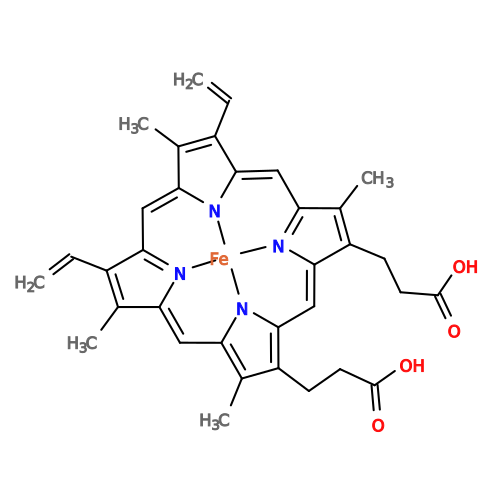 Mass: 616.487 Da / Num. of mol.: 2 / Source method: obtained synthetically / Formula: C34H32FeN4O4 / Feature type: SUBJECT OF INVESTIGATION
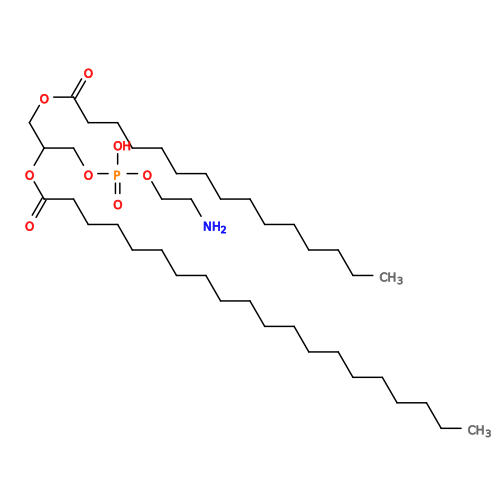 Mass: 734.039 Da / Num. of mol.: 1 / Source method: obtained synthetically / Formula: C40H80NO8P / Comment: phospholipid*YM
 Sample preparation
 Electron microscopy imaging
 FIELD EMISSION GUN / Accelerating voltage: 300 kV / Illumination mode: SPOT SCAN
 Processing