Journal: J Struct Biol X / Year: 2026 Title: Structural insights into interdomain interactions in APS kinase. Authors: Ryo Hatanaka / Yukiko Ohsumi / Hiroki Matsui / Ayuna Inoguchi / Hina Yuasa / Fumika Mi-Ichi / Jun-Ichi Kishikawa / Tomoo Shiba / Abstract: The biosynthetic pathway of 3'-phosphoadenosine-5'-phosphosulfate (PAPS) is a universal and essential metabolic process in many organisms, providing the activated sulfate donor required for the ...The biosynthetic pathway of 3'-phosphoadenosine-5'-phosphosulfate (PAPS) is a universal and essential metabolic process in many organisms, providing the activated sulfate donor required for the synthesis of diverse sulfated metabolites. However, this pathway has undergone substantial evolutionary diversification among species. In , PAPS biosynthesis occurs within the mitosomes, mitochondrion-related organelles (MROs), representing a distinctive example of lineage-specific evolutionary adaptation. PAPS synthesis proceeds through a conserved two-step process, which is sequentially catalyzed by ATP sulfurylase (AS) and adenosine 5'-phosphosulfate (APS) kinase (APSK). In this study, we focused on APSK (APSK). APSK contains an additional AS-like domain (SLD), although its functional role remains unclear. Here, we determined the crystal structure of full-length APSK at 2.60 Å resolution and the structure of the truncated APSK lacking APS kinase domain (KD) (APSK) at 2.10 Å resolution. Structural analyses revealed that the SLD engages in dynamic contacts with the KD. Furthermore, deletion of the domain and mutational analyses indicated that the SLD significantly influences the catalytic activity of the KD. Based on these findings, we propose a new regulatory mechanism in which transient interdomain interactions modulate APS kinase activity, representing an unique evolutionary adaptation of .
Mass: 18.015 Da / Num. of mol.: 13 / Source method: isolated from a natural source / Formula: H2O
Has ligand of interest
Y
Has protein modification
N
-
Experimental details
-
Experiment
Experiment
Method: X-RAY DIFFRACTION / Number of used crystals: 1
-
Sample preparation
Crystal
Density Matthews: 2.91 Å3/Da / Density % sol: 57.7 %
Crystal grow
Temperature: 293 K / Method: vapor diffusion, hanging drop / pH: 8 Details: 10 mM Tris-HCl (pH 8.0) 100 mM NaCl 1 mM TCEP 5 mM APS 5 mM AMP-PNP 5 mM MgCl2 0.24 M K2SO4 16% PEG3400
-
Data collection
Diffraction
Mean temperature: 100 K / Serial crystal experiment: N
In the structure databanks used in Yorodumi, some data are registered as the other names, "COVID-19 virus" and "2019-nCoV". Here are the details of the virus and the list of structure data.
Jan 31, 2019. EMDB accession codes are about to change! (news from PDBe EMDB page)
EMDB accession codes are about to change! (news from PDBe EMDB page)
The allocation of 4 digits for EMDB accession codes will soon come to an end. Whilst these codes will remain in use, new EMDB accession codes will include an additional digit and will expand incrementally as the available range of codes is exhausted. The current 4-digit format prefixed with “EMD-” (i.e. EMD-XXXX) will advance to a 5-digit format (i.e. EMD-XXXXX), and so on. It is currently estimated that the 4-digit codes will be depleted around Spring 2019, at which point the 5-digit format will come into force.
The EM Navigator/Yorodumi systems omit the EMD- prefix.
Related info.:Q: What is EMD? / ID/Accession-code notation in Yorodumi/EM Navigator
Yorodumi is a browser for structure data from EMDB, PDB, SASBDB, etc.
This page is also the successor to EM Navigator detail page, and also detail information page/front-end page for Omokage search.
The word "yorodu" (or yorozu) is an old Japanese word meaning "ten thousand". "mi" (miru) is to see.
Related info.:EMDB / PDB / SASBDB / Comparison of 3 databanks / Yorodumi Search / Aug 31, 2016. New EM Navigator & Yorodumi / Yorodumi Papers / Jmol/JSmol / Function and homology information / Changes in new EM Navigator and Yorodumi
 Movie
Movie Controller

 Yorodumi
 Open data
 Basic information
 Components
 Keywords
 Function and homology information
 Entamoeba histolytica (eukaryote)
 X-RAY DIFFRACTION /
  Authors
 Japan, 1items
  Citation
 Structure visualization
 Downloads & links
 Other downloads

 PDBj
PDBj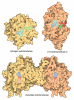
 Assembly


 Escherichia coli (E. coli) / References: UniProt: A0A5K1U9J0, adenylyl-sulfate kinase
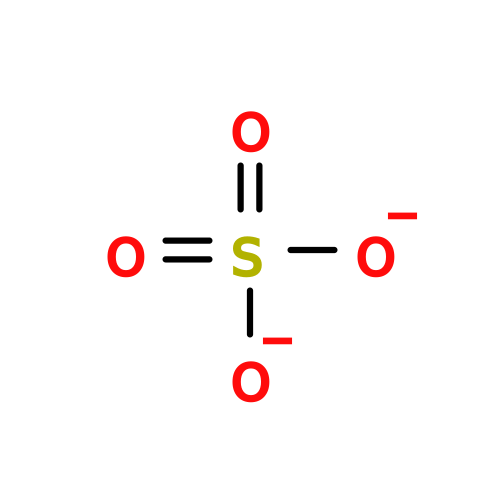 Mass: 96.063 Da / Num. of mol.: 4 / Source method: obtained synthetically / Formula: SO4 / Feature type: SUBJECT OF INVESTIGATION
 Mass: 18.015 Da / Num. of mol.: 13 / Source method: isolated from a natural source / Formula: H2O
 Sample preparation
 Processing