 Movie
Movie Controller


+ Open data

- Basic information
| Entry | Database: PDB / ID: 23bx | |||||||||
|---|---|---|---|---|---|---|---|---|---|---|
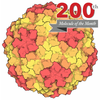
| Title | CryoEM structure of EV-D68 US/KY/14-18953 mature virion | |||||||||
 Components Components |
| |||||||||
 Keywords Keywords | VIRAL PROTEIN / EV-D68 / MFSD6 | |||||||||
| Function / homology |  Function and homology information Function and homology informationsymbiont-mediated suppression of cytoplasmic pattern recognition receptor signaling pathway / host cell mitochondrion / symbiont-mediated suppression of host cytoplasmic pattern recognition receptor signaling pathway via inhibition of MDA-5 activity / picornain 2A / symbiont-mediated suppression of host mRNA export from nucleus / symbiont genome entry into host cell via pore formation in plasma membrane / picornain 3C / T=pseudo3 icosahedral viral capsid / protein sequestering activity / host cell cytoplasmic vesicle membrane ...symbiont-mediated suppression of cytoplasmic pattern recognition receptor signaling pathway / host cell mitochondrion / symbiont-mediated suppression of host cytoplasmic pattern recognition receptor signaling pathway via inhibition of MDA-5 activity / picornain 2A / symbiont-mediated suppression of host mRNA export from nucleus / symbiont genome entry into host cell via pore formation in plasma membrane / picornain 3C / T=pseudo3 icosahedral viral capsid / protein sequestering activity / host cell cytoplasmic vesicle membrane / ribonucleoside triphosphate phosphatase activity / nucleoside-triphosphate phosphatase / channel activity / monoatomic ion transmembrane transport / symbiont-mediated suppression of host toll-like receptor signaling pathway / symbiont-mediated suppression of host NF-kappaB cascade / RNA helicase activity / symbiont-mediated suppression of host innate immune response / endocytosis involved in viral entry into host cell / symbiont-mediated activation of host autophagy / RNA-directed RNA polymerase / cysteine-type endopeptidase activity / viral RNA genome replication / RNA-directed RNA polymerase activity / virion attachment to host cell / host cell nucleus / structural molecule activity / proteolysis / DNA-templated transcription / RNA binding / zinc ion binding / ATP binding / cytoplasm Similarity search - Function | |||||||||
| Biological species |  enterovirus D68 enterovirus D68 | |||||||||
| Method | ELECTRON MICROSCOPY / single particle reconstruction / cryo EM / Resolution: 2.62 Å | |||||||||
 Authors Authors | Liang, S.J. / Lou, Z.Y. | |||||||||
| Funding support |  China, 1items China, 1items
| |||||||||
 Citation Citation | Journal: Nat Commun / Year: 2026 Title: A dual-receptor checkpoint primes enterovirus D68 for respiratory cell entry. Authors: Shengjian Liang / Haoran Guo / Zhili Xu / Zan Liu / Wanying Yang / Xiaoke Liu / Zhenyu Wei / Jichao Hou / Wei Huang / Wei Wang / Jiachen Li / Wendong Ma / Zhikang Deng / Haocong Qian / Yaxin ...Authors: Shengjian Liang / Haoran Guo / Zhili Xu / Zan Liu / Wanying Yang / Xiaoke Liu / Zhenyu Wei / Jichao Hou / Wei Huang / Wei Wang / Jiachen Li / Wendong Ma / Zhikang Deng / Haocong Qian / Yaxin Wang / Jialin Liu / Zihe Rao / Wei Wei / Zhiyong Lou / Abstract: MFSD6 is a newly identified receptor that mediates the invasion of respiratory cells by enterovirus D68 (EV-D68), a non-polio enterovirus that causes severe respiratory disease and poliomyelitis-like ...MFSD6 is a newly identified receptor that mediates the invasion of respiratory cells by enterovirus D68 (EV-D68), a non-polio enterovirus that causes severe respiratory disease and poliomyelitis-like illness in children. Here, we report near-atomic-resolution cryo-electron microscopy (cryo-EM) structures of historical and contemporary AFM-associated EV-D68 strains, together with their complexes bound to the third extracellular loop of MFSD6 (MFSD6-L3). These structures uncover a previously unrecognized "binary gating switch" mechanism of virus-receptor engagement that differs from the reported model. In this mechanism, the N200-V208 segment of MFSD6, carrying a glycosylated Asn207, inserts into one capsomer, whereas the sialyl-Gal-terminated glycan of MFSD6 engages an adjacent capsomer. Neu5Ac binding induces conformational rearrangements that expel the pocket factor, destabilize the virion, and prime infection. Functional analyses further define the contributions of the receptor-contacting residues and glycans to viral attachment and entry. Together, our findings refine the molecular basis of EV-D68 recognition of MFSD6 and reveal a glycan-mediated dual-lock mechanism that may enhance receptor specificity, prevent premature uncoating, and ensure productive infection only upon engagement of the correct host receptor. These results provide broader insight into enterovirus tropism and establish a framework for structure-guided antiviral design. | |||||||||
| History |
|
- Structure visualization
| Structure viewer | Molecule: MolmilJmol/JSmol |
|---|
- Downloads & links
-Download
| PDBx/mmCIF format | 23bx.cif.gz | 171.2 KB | Display | PDBx/mmCIF format |
|---|---|---|---|---|
| PDB format | pdb23bx.ent.gz | 132.2 KB | Display | PDB format |
| PDBx/mmJSON format | 23bx.json.gz | Tree view | PDBx/mmJSON format | |
| Others |  Other downloads Other downloads |
-Validation report
| Arichive directory | https://data.pdbj.org/pub/pdb/validation_reports/3b/23bxftp://data.pdbj.org/pub/pdb/validation_reports/3b/23bx | HTTPS FTP |
|---|
-Related structure data
| Related structure data |  68851MC  23ayC  23bgC  23psC  9vv0C  9w0dC  9w0eC  9w0iC  9w0jC  9w0kC  9w34C  9w4oC  9w4yC M: map data used to model this data C: citing same article ( |
|---|---|
| Similar structure data |


-Links
 PDBj
PDBj
- Assembly
| Deposited unit | 
|
|---|---|
| 1 |
|
-Components
| #1: Protein | Mass: 32858.281 Da / Num. of mol.: 1 Source method: isolated from a genetically manipulated source Source: (gene. exp.) enterovirus D68 / Production host:  Homo sapiens (human) Homo sapiens (human)References: UniProt: A0A8D5ZMD3, picornain 2A, nucleoside-triphosphate phosphatase, picornain 3C, RNA-directed RNA polymerase |
|---|---|
| #2: Protein | Mass: 26630.186 Da / Num. of mol.: 1 Source method: isolated from a genetically manipulated source Source: (gene. exp.) enterovirus D68 / Production host: Homo sapiens (human)References: UniProt: A0A3S7XUI9, picornain 2A, nucleoside-triphosphate phosphatase, picornain 3C, RNA-directed RNA polymerase |
| #3: Protein | Mass: 27282.035 Da / Num. of mol.: 1 Source method: isolated from a genetically manipulated source Source: (gene. exp.) enterovirus D68 / Production host: Homo sapiens (human)References: UniProt: A0A097BW19, picornain 2A, nucleoside-triphosphate phosphatase, picornain 3C, RNA-directed RNA polymerase |
| #4: Protein/peptide | Mass: 4210.649 Da / Num. of mol.: 1 Source method: isolated from a genetically manipulated source Source: (gene. exp.) enterovirus D68 / Production host: Homo sapiens (human) / References: UniProt: Q68T42 |
| #5: Chemical | ChemComp-SPH /  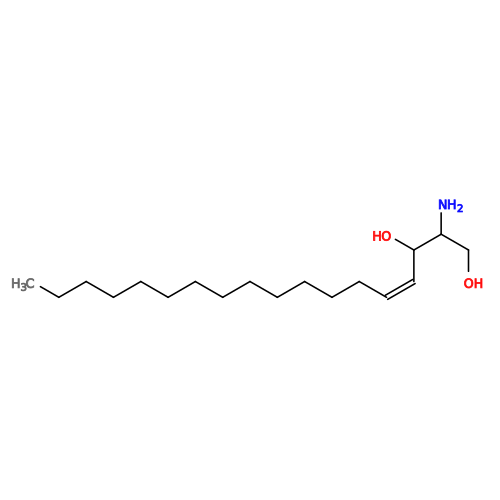 Mass: 299.492 Da / Num. of mol.: 1 / Source method: obtained synthetically / Formula: C18H37NO2 Mass: 299.492 Da / Num. of mol.: 1 / Source method: obtained synthetically / Formula: C18H37NO2 |
| Has ligand of interest | N |
| Has protein modification | N |
-Experimental details
-Experiment
| Experiment | Method: ELECTRON MICROSCOPY |
|---|---|
| EM experiment | Aggregation state: PARTICLE / 3D reconstruction method: single particle reconstruction |
- Sample preparation
| Component | Name: enterovirus D68 / Type: VIRUS / Entity ID: #1-#4 / Source: NATURAL |
|---|---|
| Source (natural) | Organism: enterovirus D68 |
| Details of virus | Empty: NO / Enveloped: NO / Isolate: STRAIN / Type: VIRION |
| Buffer solution | pH: 7.4 |
| Specimen | Embedding applied: NO / Shadowing applied: NO / Staining applied: NO / Vitrification applied: YES |
| Vitrification | Cryogen name: ETHANE |
- Electron microscopy imaging
| Experimental equipment |  Model: Titan Krios / Image courtesy: FEI Company |
|---|---|
| Microscopy | Model: TFS KRIOS |
| Electron gun | Electron source:  FIELD EMISSION GUN / Accelerating voltage: 300 kV / Illumination mode: FLOOD BEAM FIELD EMISSION GUN / Accelerating voltage: 300 kV / Illumination mode: FLOOD BEAM |
| Electron lens | Mode: BRIGHT FIELD / Nominal defocus max: 2000 nm / Nominal defocus min: 1000 nm |
| Image recording | Electron dose: 50 e/Å2 / Film or detector model: TFS FALCON 4i (4k x 4k) |
- Processing
| EM software |
| ||||||||||||||||||||||||
|---|---|---|---|---|---|---|---|---|---|---|---|---|---|---|---|---|---|---|---|---|---|---|---|---|---|
| CTF correction | Type: PHASE FLIPPING AND AMPLITUDE CORRECTION | ||||||||||||||||||||||||
| 3D reconstruction | Resolution: 2.62 Å / Resolution method: FSC 0.143 CUT-OFF / Num. of particles: 114120 / Symmetry type: POINT | ||||||||||||||||||||||||
| Refinement | Highest resolution: 2.62 Å Stereochemistry target values: REAL-SPACE (WEIGHTED MAP SUM AT ATOM CENTERS) | ||||||||||||||||||||||||
| Refine LS restraints |
|
