Biotechnology and Biological Sciences Research Council (BBSRC)
BB/T019948/1, BB/S002774/1, BB/M009122/1
United Kingdom
Other private
Georgina Sweet Award for Women in Quantitative Biomedical Science
Citation
Journal: Nat Commun / Year: 2026 Title: Structural basis for independent pore function of Vpb4 from Bacillus thuringiensis. Authors: Raymond Wirawan / W David Jamieson / Hannah M Baird / Colin Berry / Christopher J Lupton / Hari Venugopal / Luis E Valentin-Alvarado / Hannah L Best / D Dafydd Jones / Lainey J Williamson / ...Authors: Raymond Wirawan / W David Jamieson / Hannah M Baird / Colin Berry / Christopher J Lupton / Hari Venugopal / Luis E Valentin-Alvarado / Hannah L Best / D Dafydd Jones / Lainey J Williamson / Husam Sabah Auhim / Oliver K Castell / Michelle A Dunstone / Bradley A Spicer / Abstract: The Bacterial_Exotoxin_B family constitutes translocating pore-forming proteins that function as the binding (B) component in the binary AB Toxin mechanism. While the two-component system of the ...The Bacterial_Exotoxin_B family constitutes translocating pore-forming proteins that function as the binding (B) component in the binary AB Toxin mechanism. While the two-component system of the family is consistent among well-characterised members, the single-component Vpb4 subclass from entomopathogenic Bacillus thuringiensis challenges this dogma. Here, through single-particle cryo-electron microscopy, we elucidate the inserted pore structure of a Vpb4 member, Vpb4Aa2, at 2.2 Å resolution. The structure reveals distinguishing features from other family members: missing molecular bottleneck and neutrally charged β-barrel. Accordingly, preliminary electrophysiology studies show greater ion flux by Vpb4Aa2 compared to archetypal family member, PA. Through our findings, structure-guided database search allows identification of putative Vpb4-like proteins, which suggest a broader class of single-component proteins within the larger family. This provides mechanistic understanding of the differences between independent pores and translocating pores, with implications in the agricultural industry for screening and identification of future pest control candidates.
In the structure databanks used in Yorodumi, some data are registered as the other names, "COVID-19 virus" and "2019-nCoV". Here are the details of the virus and the list of structure data.
Jan 31, 2019. EMDB accession codes are about to change! (news from PDBe EMDB page)
EMDB accession codes are about to change! (news from PDBe EMDB page)
The allocation of 4 digits for EMDB accession codes will soon come to an end. Whilst these codes will remain in use, new EMDB accession codes will include an additional digit and will expand incrementally as the available range of codes is exhausted. The current 4-digit format prefixed with “EMD-” (i.e. EMD-XXXX) will advance to a 5-digit format (i.e. EMD-XXXXX), and so on. It is currently estimated that the 4-digit codes will be depleted around Spring 2019, at which point the 5-digit format will come into force.
The EM Navigator/Yorodumi systems omit the EMD- prefix.
Related info.:Q: What is EMD? / ID/Accession-code notation in Yorodumi/EM Navigator
Yorodumi is a browser for structure data from EMDB, PDB, SASBDB, etc.
This page is also the successor to EM Navigator detail page, and also detail information page/front-end page for Omokage search.
The word "yorodu" (or yorozu) is an old Japanese word meaning "ten thousand". "mi" (miru) is to see.
Related info.:EMDB / PDB / SASBDB / Comparison of 3 databanks / Yorodumi Search / Aug 31, 2016. New EM Navigator & Yorodumi / Yorodumi Papers / Jmol/JSmol / Function and homology information / Changes in new EM Navigator and Yorodumi
 Movie
Movie Controller


 Open data
 Basic information
 Components
 Keywords
 Function and homology information
 Bacillus thuringiensis (bacteria)
 Authors
 United Kingdom, 2items
  Citation
 Structure visualization
 Downloads & links
 Other downloads


 PDBj
PDBj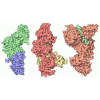
 Assembly
 Escherichia coli BL21(DE3) (bacteria) / References: UniProt: V9I0N3
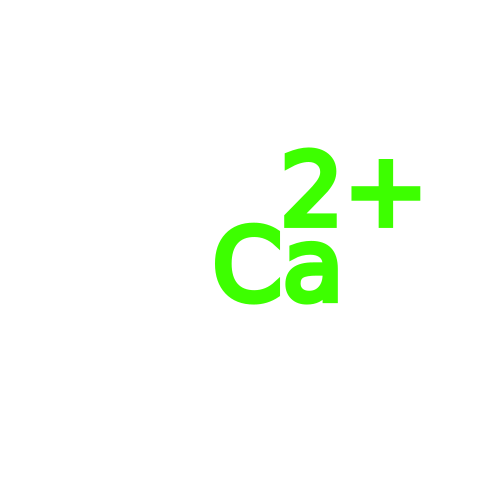 Mass: 40.078 Da / Num. of mol.: 3 / Source method: obtained synthetically / Formula: Ca / Feature type: SUBJECT OF INVESTIGATION
 Sample preparation
 Electron microscopy imaging
 FIELD EMISSION GUN / Accelerating voltage: 300 kV / Illumination mode: FLOOD BEAM
 Processing