 Movie
Movie Controller


+ Open data

- Basic information
| Entry | Database: PDB / ID: 22fr | |||||||||
|---|---|---|---|---|---|---|---|---|---|---|
| Title | Structure of apo Cdr1 | |||||||||
 Components Components | Pleiotropic ABC efflux transporter of multiple drugs CDR1 | |||||||||
 Keywords Keywords | MEMBRANE PROTEIN / Candida albicans / Multidrug resistance / Substrate efflux cycle | |||||||||
| Function / homology |  Function and homology information Function and homology informationfluconazole transmembrane transporter activity / fluconazole transport / azole transmembrane transporter activity / corticosterone binding / azole transmembrane transport / estradiol binding / aminophospholipid flippase activity / phosphatidylethanolamine floppase activity / phosphatidylserine floppase activity / phosphatidylcholine floppase activity ...fluconazole transmembrane transporter activity / fluconazole transport / azole transmembrane transporter activity / corticosterone binding / azole transmembrane transport / estradiol binding / aminophospholipid flippase activity / phosphatidylethanolamine floppase activity / phosphatidylserine floppase activity / phosphatidylcholine floppase activity / xenobiotic detoxification by transmembrane export across the plasma membrane / phospholipid translocation / xenobiotic transmembrane transporter activity / ABC-type transporter activity / cellular response to xenobiotic stimulus / ribonucleoside triphosphate phosphatase activity / extracellular vesicle / nucleotide binding / cell surface / ATP hydrolysis activity / ATP binding / membrane / plasma membrane Similarity search - Function | |||||||||
| Biological species |  Candida albicans SC5314 (yeast) Candida albicans SC5314 (yeast) | |||||||||
| Method | ELECTRON MICROSCOPY / single particle reconstruction / cryo EM / Resolution: 2.74 Å | |||||||||
 Authors Authors | Wang, Z. / Yang, S. / Zhang, B. / Yu, X. | |||||||||
| Funding support |  China, 1items China, 1items
| |||||||||
 Citation Citation | Journal: Sci Adv / Year: 2026 Title: Cryo-EM structures of Cdr1 reveal snapshots of substrate transport and diverse inhibitor recognition. Authors: Zhen Wang / Shuting Yang / Binyu Zhang / Hengyi Jiang / Yinxia Li / Rongchao Gao / Yulong Wang / Fengying Fan / Lili Dong / Jiaxuan Qiu / Xiurui Li / Yue Zhou / Alastair I H Murchie / Xuekui Yu / Abstract: In -a World Health Organization fungal priority pathogen-overexpression of the adenosine triphosphate (ATP)-binding cassette transporter Cdr1 drives multidrug resistance. We present seven cryo- ...In -a World Health Organization fungal priority pathogen-overexpression of the adenosine triphosphate (ATP)-binding cassette transporter Cdr1 drives multidrug resistance. We present seven cryo-electron microscopy structures capturing substrate entry and expulsion. An inward-facing transmembrane channel with three on-off substrate binding sites defines a proposed entry pathway for a single substrate molecule. Coordinated ATP binding to both nucleotide-binding domains induces transmembrane domain closure, driving the substrate expulsion; adenosine diphosphate release following ATP hydrolysis resets the transporter to an inward-open conformation, enabling substrate entry for the next translocation cycle. Structures with three structurally diverse inhibitors resolve two distinct binding modes: one occupying all three substrate sites and another specifically binding two extracellular-proximal sites. These findings provide snapshots of the substrate translocation cycle and structural blueprints for antifungal drug design. | |||||||||
| History |
|
- Structure visualization
| Structure viewer | Molecule: MolmilJmol/JSmol |
|---|
- Downloads & links
-Download
| PDBx/mmCIF format | 22fr.cif.gz | 254.3 KB | Display | PDBx/mmCIF format |
|---|---|---|---|---|
| PDB format | pdb22fr.ent.gz | 198.8 KB | Display | PDB format |
| PDBx/mmJSON format | 22fr.json.gz | Tree view | PDBx/mmJSON format | |
| Others |  Other downloads Other downloads |
-Validation report
| Arichive directory | https://data.pdbj.org/pub/pdb/validation_reports/2f/22frftp://data.pdbj.org/pub/pdb/validation_reports/2f/22fr | HTTPS FTP |
|---|
-Related structure data
| Related structure data |  68246MC  9vsuC  9vsvC  9vswC  9vszC  9vt1C  9vt2C  9vtmC  9vtnC  9vtoC M: map data used to model this data C: citing same article ( |
|---|---|
| Similar structure data |


-Links
 PDBj
PDBj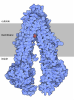
- Assembly
| Deposited unit | 
|
|---|---|
| 1 |
|
-Components
| #1: Protein | Mass: 170159.656 Da / Num. of mol.: 1 Source method: isolated from a genetically manipulated source Source: (gene. exp.) Candida albicans SC5314 (yeast) / Gene: CDR1, CAALFM_C305220WA, CaO19.13421, CaO19.6000 / Production host:  Homo sapiens (human) / References: UniProt: Q5ANA3 Homo sapiens (human) / References: UniProt: Q5ANA3 |
|---|---|
| Has protein modification | Y |
-Experimental details
-Experiment
| Experiment | Method: ELECTRON MICROSCOPY |
|---|---|
| EM experiment | Aggregation state: PARTICLE / 3D reconstruction method: single particle reconstruction |
- Sample preparation
| Component | Name: Apo Cdr1 / Type: COMPLEX / Entity ID: all / Source: RECOMBINANT |
|---|---|
| Source (natural) | Organism: Candida albicans SC5314 (yeast) |
| Source (recombinant) | Organism: Homo sapiens (human) |
| Buffer solution | pH: 7.5 |
| Specimen | Embedding applied: NO / Shadowing applied: NO / Staining applied: NO / Vitrification applied: YES |
| Vitrification | Cryogen name: ETHANE |
- Electron microscopy imaging
| Experimental equipment |  Model: Titan Krios / Image courtesy: FEI Company |
|---|---|
| Microscopy | Model: TFS KRIOS |
| Electron gun | Electron source:  FIELD EMISSION GUN / Accelerating voltage: 300 kV / Illumination mode: FLOOD BEAM FIELD EMISSION GUN / Accelerating voltage: 300 kV / Illumination mode: FLOOD BEAM |
| Electron lens | Mode: BRIGHT FIELD / Nominal defocus max: 2100 nm / Nominal defocus min: 1500 nm |
| Image recording | Electron dose: 60 e/Å2 / Film or detector model: GATAN K3 BIOQUANTUM (6k x 4k) |
- Processing
| EM software |
| ||||||||||||||||
|---|---|---|---|---|---|---|---|---|---|---|---|---|---|---|---|---|---|
| CTF correction | Type: PHASE FLIPPING AND AMPLITUDE CORRECTION | ||||||||||||||||
| 3D reconstruction | Resolution: 2.74 Å / Resolution method: FSC 0.143 CUT-OFF / Num. of particles: 410230 / Symmetry type: POINT |
