Japan Agency for Medical Research and Development (AMED)
JP21am0101118
Japan
Japan Agency for Medical Research and Development (AMED)
JP25ama121004
Japan
Citation
Journal: Microb Biotechnol / Year: 2026 Title: Cryo-EM Structures of Alcohol Oxidase Isozymes Reveal Structural Determinants of Cofactor Variation and Enzymatic Activity in Ogataea methanolica. Authors: Hao-Liang Cai / Atsuhiro Shimada / Tasuku Hamaguchi / Akira Mizoguchi / Koji Yonekura / Kyohei Tsuchiyama / Masaya Shimada / Akio Ebihara / Kazutoshi Tani / Tomoyuki Nakagawa / Abstract: Ogataea methanolica is a methylotrophic yeast that can produce diverse recombinant proteins using methanol as the sole carbon and energy source. Unlike most yeast species, which possess a single ...Ogataea methanolica is a methylotrophic yeast that can produce diverse recombinant proteins using methanol as the sole carbon and energy source. Unlike most yeast species, which possess a single alcohol oxidase, O. methanolica encodes two isoenzymes, Mod1p and Mod2p. This study examines the structural and functional differences between Mod1p and Mod2p homooctamers. Both enzymes were purified from MOD-disrupted strains and analysed using cryogenic electron microscopy, achieving resolutions of 1.9 and 2.7 Å for Mod1p and Mod2p, respectively. The two isozymes assemble as tetramers of dimers stabilized by extensive intersubunit interactions, largely mediated by protruding loop regions and C-terminal extensions. Despite overall structural similarities, Mod1p and Mod2p exhibit subtle differences in surface charge distribution and sequence composition within the FAD-binding domain. These variations correlate with distinct cofactor preferences, with Mod1p binding arabityl FAD and Mod2p binding canonical FAD. Thin-section electron microscopy further revealed that Mod1p and Mod2p form both homomeric and hybrid octamers that assemble into peroxisomal crystalloids essential for methanol metabolism. Collectively, our findings provide mechanistic insight into alcohol oxidase diversity in methylotrophic yeasts, advancing our understanding of methanol utilization and its applications in biotechnology.
History
Deposition
Dec 15, 2025
Deposition site: PDBJ / Processing site: PDBJ
Revision 1.0
Apr 29, 2026
Provider: repository / Type: Initial release
Revision 1.0
Apr 29, 2026
Data content type: EM metadata / Data content type: EM metadata / Provider: repository / Type: Initial release
Revision 1.0
Apr 29, 2026
Data content type: FSC / Data content type: FSC / Provider: repository / Type: Initial release
Revision 1.0
Apr 29, 2026
Data content type: Half map / Part number: 1 / Data content type: Half map / Provider: repository / Type: Initial release
Revision 1.0
Apr 29, 2026
Data content type: Half map / Part number: 2 / Data content type: Half map / Provider: repository / Type: Initial release
Revision 1.0
Apr 29, 2026
Data content type: Image / Data content type: Image / Provider: repository / Type: Initial release
Revision 1.0
Apr 29, 2026
Data content type: Primary map / Data content type: Primary map / Provider: repository / Type: Initial release
In the structure databanks used in Yorodumi, some data are registered as the other names, "COVID-19 virus" and "2019-nCoV". Here are the details of the virus and the list of structure data.
Jan 31, 2019. EMDB accession codes are about to change! (news from PDBe EMDB page)
EMDB accession codes are about to change! (news from PDBe EMDB page)
The allocation of 4 digits for EMDB accession codes will soon come to an end. Whilst these codes will remain in use, new EMDB accession codes will include an additional digit and will expand incrementally as the available range of codes is exhausted. The current 4-digit format prefixed with “EMD-” (i.e. EMD-XXXX) will advance to a 5-digit format (i.e. EMD-XXXXX), and so on. It is currently estimated that the 4-digit codes will be depleted around Spring 2019, at which point the 5-digit format will come into force.
The EM Navigator/Yorodumi systems omit the EMD- prefix.
Related info.:Q: What is EMD? / ID/Accession-code notation in Yorodumi/EM Navigator
Yorodumi is a browser for structure data from EMDB, PDB, SASBDB, etc.
This page is also the successor to EM Navigator detail page, and also detail information page/front-end page for Omokage search.
The word "yorodu" (or yorozu) is an old Japanese word meaning "ten thousand". "mi" (miru) is to see.
Related info.:EMDB / PDB / SASBDB / Comparison of 3 databanks / Yorodumi Search / Aug 31, 2016. New EM Navigator & Yorodumi / Yorodumi Papers / Jmol/JSmol / Function and homology information / Changes in new EM Navigator and Yorodumi
 Movie
Movie Controller


 Open data
 Basic information
 Components
 Keywords
 Function and homology information
 Ogataea methanolica (fungus)
 Authors
 Japan, 2items
  Citation
 Structure visualization
 Downloads & links
 Other downloads


 PDBj
PDBj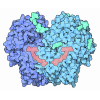
 Assembly
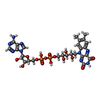
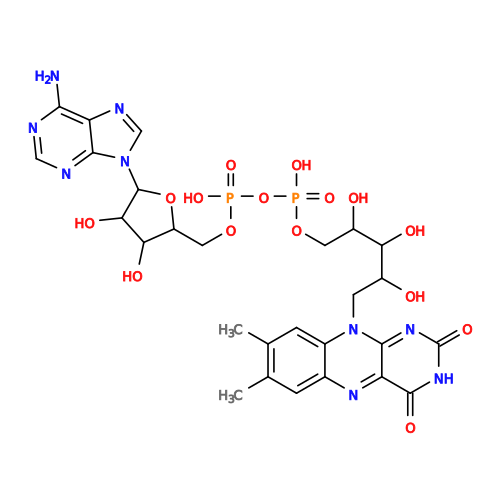 Mass: 785.550 Da / Num. of mol.: 8 / Source method: obtained synthetically / Formula: C27H33N9O15P2 / Feature type: SUBJECT OF INVESTIGATION / Comment: FAD*YM
 Mass: 18.015 Da / Num. of mol.: 2315 / Source method: isolated from a natural source / Formula: H2O
 Sample preparation
 Electron microscopy imaging
 FIELD EMISSION GUN / Accelerating voltage: 300 kV / Illumination mode: FLOOD BEAM
 Processing
