 Movie
Movie Controller


+ Open data

- Basic information
| Entry | Database: PDB / ID: 21fi | |||||||||||||||||||||
|---|---|---|---|---|---|---|---|---|---|---|---|---|---|---|---|---|---|---|---|---|---|---|
| Title | Cryo-EM structure of DddT in closed DMSP-bound conformation | |||||||||||||||||||||
 Components Components | DddT | |||||||||||||||||||||
 Keywords Keywords | TRANSPORT PROTEIN / Trimer / Psychrobacter sp. D2 / Dimethylsulfoniopropionate transporter / Closed DMSP-bound conformation | |||||||||||||||||||||
| Function / homology | 3-(dimethyl-lambda~4~-sulfanyl)propanoic acid Function and homology information Function and homology information | |||||||||||||||||||||
| Biological species |  Psychrobacter sp. D2 (bacteria) Psychrobacter sp. D2 (bacteria) | |||||||||||||||||||||
| Method | ELECTRON MICROSCOPY / single particle reconstruction / cryo EM / Resolution: 2.52 Å | |||||||||||||||||||||
 Authors Authors | Zhu, W.J. / Wang, P. | |||||||||||||||||||||
| Funding support |  China, 1items China, 1items
| |||||||||||||||||||||
 Citation Citation | Journal: EMBO J / Year: 2026 Title: Structural insights into bacterial dimethylsulfoniopropionate import by BCCT-family transporters. Authors: Yu-Zhong Zhang / Wen-Jing Zhu / Kang Li / Hai-Tao Ding / Motoyuki Hattori / Shuaimeng Liu / Chang Ge / Qi-Long Qin / Zhao-Jie Teng / Ning-Hua Liu / Hai-Yan Cao / Chun-Yang Li / Xiu-Lan Chen ...Authors: Yu-Zhong Zhang / Wen-Jing Zhu / Kang Li / Hai-Tao Ding / Motoyuki Hattori / Shuaimeng Liu / Chang Ge / Qi-Long Qin / Zhao-Jie Teng / Ning-Hua Liu / Hai-Yan Cao / Chun-Yang Li / Xiu-Lan Chen / Qing-Tao Shen / Jonathan D Todd / Lu-Ning Liu / Peng Wang /  Abstract: Dimethylsulfoniopropionate (DMSP) is a ubiquitous marine organosulfur compound central to microbial stress responses, chemotaxis, and nutrient cycling. Its catabolism produces dimethylsulfide (DMS), ...Dimethylsulfoniopropionate (DMSP) is a ubiquitous marine organosulfur compound central to microbial stress responses, chemotaxis, and nutrient cycling. Its catabolism produces dimethylsulfide (DMS), a climate-active gas, and plays a key role in the global sulfur cycle. However, the molecular basis of DMSP import, underpinning its microbial metabolism, remains poorly understood. Here, we identify and characterize the BCCT-family transporter DddT from Psychrobacter sp. D2, a marine gamma-proteobacterium that utilizes DMSP as a carbon source. DddT is essential for DMSP uptake and functions as a Na-coupled symporter driven by the transmembrane sodium gradient. Using cryo-electron microscopy, we determined DddT structures in multiple conformational states, revealing its Na-dependent transport mechanism involving two sodium ions, one coordinated by a previously uncharacterized binding site. Sequence analysis shows that DddT-like proteins with conserved sodium-binding features are widespread in marine bacteria, suggesting this Na-coupled transport mechanism represents a broadly conserved feature of the BCCT family. Our findings provide mechanistic insights into sodium-driven substrate uptake and marine sulfur cycling. | |||||||||||||||||||||
| History |
|
- Structure visualization
| Structure viewer | Molecule: MolmilJmol/JSmol |
|---|
- Downloads & links
-Download
| PDBx/mmCIF format | 21fi.cif.gz | 193.2 KB | Display | PDBx/mmCIF format |
|---|---|---|---|---|
| PDB format | pdb21fi.ent.gz | 155.4 KB | Display | PDB format |
| PDBx/mmJSON format | 21fi.json.gz | Tree view | PDBx/mmJSON format | |
| Others |  Other downloads Other downloads |
-Validation report
| Arichive directory | https://data.pdbj.org/pub/pdb/validation_reports/1f/21fiftp://data.pdbj.org/pub/pdb/validation_reports/1f/21fi | HTTPS FTP |
|---|
-Related structure data
| Related structure data |  67626MC  21ffC  21fhC  21fjC  21fkC M: map data used to model this data C: citing same article ( |
|---|---|
| Similar structure data |


-Links
 PDBj
PDBj- Assembly
| Deposited unit | 
|
|---|---|
| 1 | 
|
| 2 |
|
| 3 | 
|
| Symmetry | Point symmetry: (Schoenflies symbol: C3 (3 fold cyclic)) |
-Components
| #1: Protein | Mass: 54909.449 Da / Num. of mol.: 1 Source method: isolated from a genetically manipulated source Source: (gene. exp.) Psychrobacter sp. D2 (bacteria) / Production host:  Escherichia coli (E. coli) Escherichia coli (E. coli) | ||||||
|---|---|---|---|---|---|---|---|
| #2: Chemical | ChemComp-DQY / 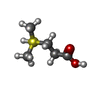  Mass: 136.213 Da / Num. of mol.: 1 / Source method: obtained synthetically / Formula: C5H12O2S / Feature type: SUBJECT OF INVESTIGATION Mass: 136.213 Da / Num. of mol.: 1 / Source method: obtained synthetically / Formula: C5H12O2S / Feature type: SUBJECT OF INVESTIGATION | ||||||
| #3: Chemical |   Mass: 22.990 Da / Num. of mol.: 2 / Source method: obtained synthetically / Formula: Na / Feature type: SUBJECT OF INVESTIGATION Mass: 22.990 Da / Num. of mol.: 2 / Source method: obtained synthetically / Formula: Na / Feature type: SUBJECT OF INVESTIGATION#4: Water | ChemComp-HOH / |  Mass: 18.015 Da / Num. of mol.: 3 / Source method: isolated from a natural source / Formula: H2O Mass: 18.015 Da / Num. of mol.: 3 / Source method: isolated from a natural source / Formula: H2OHas ligand of interest | Y | Has protein modification | N | |
-Experimental details
-Experiment
| Experiment | Method: ELECTRON MICROSCOPY |
|---|---|
| EM experiment | Aggregation state: PARTICLE / 3D reconstruction method: single particle reconstruction |
- Sample preparation
| Component | Name: DddT in closed DMSP-bound conformation / Type: COMPLEX / Entity ID: #1 / Source: RECOMBINANT |
|---|---|
| Source (natural) | Organism: Psychrobacter sp. D2 (bacteria) |
| Source (recombinant) | Organism: Escherichia coli (E. coli) |
| Buffer solution | pH: 8 |
| Specimen | Embedding applied: NO / Shadowing applied: NO / Staining applied: NO / Vitrification applied: YES |
| Vitrification | Cryogen name: ETHANE |
- Electron microscopy imaging
| Experimental equipment |  Model: Titan Krios / Image courtesy: FEI Company |
|---|---|
| Microscopy | Model: TFS KRIOS |
| Electron gun | Electron source:  FIELD EMISSION GUN / Accelerating voltage: 300 kV / Illumination mode: SPOT SCAN FIELD EMISSION GUN / Accelerating voltage: 300 kV / Illumination mode: SPOT SCAN |
| Electron lens | Mode: BRIGHT FIELD / Nominal defocus max: 1600 nm / Nominal defocus min: 800 nm |
| Image recording | Electron dose: 60 e/Å2 / Film or detector model: TFS FALCON 4i (4k x 4k) |
- Processing
| EM software |
| ||||||||||||||||||||||||
|---|---|---|---|---|---|---|---|---|---|---|---|---|---|---|---|---|---|---|---|---|---|---|---|---|---|
| CTF correction | Type: NONE | ||||||||||||||||||||||||
| 3D reconstruction | Resolution: 2.52 Å / Resolution method: FSC 0.143 CUT-OFF / Num. of particles: 446735 / Symmetry type: POINT | ||||||||||||||||||||||||
| Refinement | Highest resolution: 2.52 Å Stereochemistry target values: REAL-SPACE (WEIGHTED MAP SUM AT ATOM CENTERS) | ||||||||||||||||||||||||
| Refine LS restraints |
|
