 Movie
Movie Controller

[English] 日本語
 Yorodumi
- PDB-21bh: Cryo-EM structure of type VII CRISPR-Cas complex at the target en... -
+ Open data

- Basic information
| Entry | Database: PDB / ID: 21bh | ||||||||||||||||||||||||
|---|---|---|---|---|---|---|---|---|---|---|---|---|---|---|---|---|---|---|---|---|---|---|---|---|---|
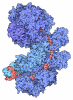
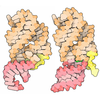
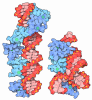
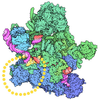
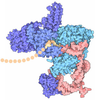
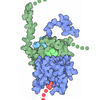
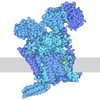
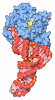
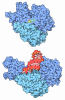
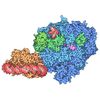
| Title | Cryo-EM structure of type VII CRISPR-Cas complex at the target engagement state | ||||||||||||||||||||||||
 Components Components |
| ||||||||||||||||||||||||
 Keywords Keywords | ANTIVIRAL PROTEIN/RNA / a protein complex / ANTIVIRAL PROTEIN-RNA complex | ||||||||||||||||||||||||
| Function / homology | RNA / RNA (> 10) Function and homology information Function and homology information | ||||||||||||||||||||||||
| Biological species | metagenome (others) | ||||||||||||||||||||||||
| Method | ELECTRON MICROSCOPY / single particle reconstruction / cryo EM / Resolution: 3.1 Å | ||||||||||||||||||||||||
 Authors Authors | Zhang, H. / Zhang, S. | ||||||||||||||||||||||||
| Funding support |  China, 1items China, 1items
| ||||||||||||||||||||||||
 Citation Citation | Journal: Nucleic Acids Res / Year: 2026 Title: Allosteric activation mechanism of the type VII CRISPR-Cas system. Authors: Shuqin Zhang / Yingcan Liu / Wenqi Wu / Zhikun Liu / Qiuqiu He / Tongyao Wang / Jie Yang / Hang Yin / Zhiyong Yuan / Heng Zhang / Abstract: Type VII CRISPR-Cas system, evolutionarily associated with type III systems, utilizes a Cascade complex formed by Cas5 and catalytically inactive Cas7 copies for target RNA binding, but instead ...Type VII CRISPR-Cas system, evolutionarily associated with type III systems, utilizes a Cascade complex formed by Cas5 and catalytically inactive Cas7 copies for target RNA binding, but instead incorporates a specialized Cas14 ribonuclease for target cleavage. Here, we report a high-quality cryo-EM structure at the target engagement state with a shortened crRNA and elucidate how the recruited Cas14 captures the target RNA and undergoes target-mediated activation. The signature Cas14 is homologous to eukaryotic CPSF73 and prokaryotic RNase J, comprising two conserved subdomains, MβL and β-CASP. Different from canonical type III systems, 5'-end target RNA, rather than 3'-end, is bent into the positively charged binding channel formed by the two subdomains to access the conserved catalytic pocket on Cas14. Two special structural features, α1 helix from Cas7 and α10 helix from Cas14, promote the bent target RNA docking into the catalytic pocket of Cas14 nuclease in concert. A dual-functional loop, displaced by the entering target RNA, induces a closed-to-open transition between the two subdomains for nuclease activation. More importantly, the flipped dual-functional loop also maintains the stabilization of incoming target RNA. Altogether, our work provides a more comprehensive understanding of type VII system mechanism, laying a mechanistic foundation for RNA-targeting tool development. | ||||||||||||||||||||||||
| History |
|
- Structure visualization
| Structure viewer | Molecule: MolmilJmol/JSmol |
|---|
- Downloads & links
-Download
| PDBx/mmCIF format | 21bh.cif.gz | 647.3 KB | Display | PDBx/mmCIF format |
|---|---|---|---|---|
| PDB format | pdb21bh.ent.gz | 516.4 KB | Display | PDB format |
| PDBx/mmJSON format | 21bh.json.gz | Tree view | PDBx/mmJSON format | |
| Others |  Other downloads Other downloads |
-Validation report
| Arichive directory | https://data.pdbj.org/pub/pdb/validation_reports/1b/21bhftp://data.pdbj.org/pub/pdb/validation_reports/1b/21bh | HTTPS FTP |
|---|
-Related structure data
| Related structure data |  67552MC M: map data used to model this data C: citing same article ( |
|---|---|
| Similar structure data |
-Links
 PDBj
PDBj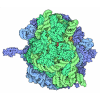
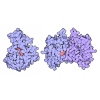
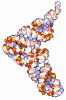
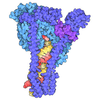
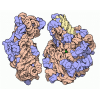
- Assembly
| Deposited unit | 
|
|---|---|
| 1 |
|
-Components
-Protein , 3 types, 12 molecules BCDEFJOGHIKL
| #1: Protein | Mass: 22255.604 Da / Num. of mol.: 7 Source method: isolated from a genetically manipulated source Source: (gene. exp.) metagenome (others) / Production host:   Escherichia coli (E. coli) Escherichia coli (E. coli)#2: Protein | | Mass: 27139.533 Da / Num. of mol.: 1 Source method: isolated from a genetically manipulated source Source: (gene. exp.) metagenome (others) / Production host: Escherichia coli (E. coli)#3: Protein | Mass: 70468.898 Da / Num. of mol.: 4 Source method: isolated from a genetically manipulated source Source: (gene. exp.) metagenome (others) / Production host: Escherichia coli (E. coli) |
|---|
-RNA chain , 2 types, 2 molecules MN
| #4: RNA chain | Mass: 17270.176 Da / Num. of mol.: 1 Source method: isolated from a genetically manipulated source Source: (gene. exp.) metagenome (others) / Production host: Escherichia coli (E. coli) |
|---|---|
| #5: RNA chain | Mass: 19354.707 Da / Num. of mol.: 1 Source method: isolated from a genetically manipulated source Source: (gene. exp.) metagenome (others) / Production host: Escherichia coli (E. coli) |
-Non-polymers , 1 types, 9 molecules 
| #6: Chemical | ChemComp-ZN / 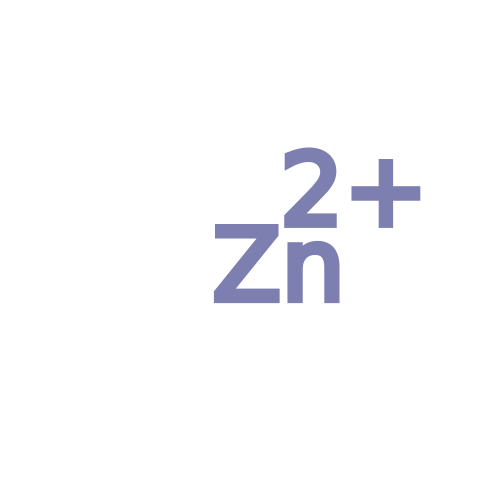 Mass: 65.409 Da / Num. of mol.: 9 / Source method: obtained synthetically / Formula: Zn Mass: 65.409 Da / Num. of mol.: 9 / Source method: obtained synthetically / Formula: Zn |
|---|
-Details
| Has ligand of interest | N |
|---|---|
| Has protein modification | N |
-Experimental details
-Experiment
| Experiment | Method: ELECTRON MICROSCOPY |
|---|---|
| EM experiment | Aggregation state: PARTICLE / 3D reconstruction method: single particle reconstruction |
- Sample preparation
| Component | Name: Cryo-EM structure of type VII CRISPR-Cas complex at the target engagement state Type: COMPLEX / Entity ID: #3, #1-#2, #4-#5 / Source: RECOMBINANT |
|---|---|
| Source (natural) | Organism: metagenome (others) |
| Source (recombinant) | Organism: Escherichia coli (E. coli) |
| Buffer solution | pH: 7.5 |
| Specimen | Embedding applied: NO / Shadowing applied: NO / Staining applied: NO / Vitrification applied: YES |
| Vitrification | Cryogen name: ETHANE |
- Electron microscopy imaging
| Microscopy | Model: JEOL CRYO ARM 300 |
|---|---|
| Electron gun | Electron source:  FIELD EMISSION GUN / Accelerating voltage: 300 kV / Illumination mode: FLOOD BEAM FIELD EMISSION GUN / Accelerating voltage: 300 kV / Illumination mode: FLOOD BEAM |
| Electron lens | Mode: BRIGHT FIELD / Nominal defocus max: 2500 nm / Nominal defocus min: 500 nm |
| Image recording | Electron dose: 40 e/Å2 / Film or detector model: GATAN K3 (6k x 4k) |
- Processing
| EM software |
| |||||||||
|---|---|---|---|---|---|---|---|---|---|---|
| CTF correction | Type: PHASE FLIPPING ONLY | |||||||||
| 3D reconstruction | Resolution: 3.1 Å / Resolution method: FSC 0.143 CUT-OFF / Num. of particles: 65006 / Symmetry type: POINT |
