 Movie
Movie Controller

[English] 日本語
 Yorodumi
- PDB-14cv: Structure of liver pyruvate kinase in complex with allosteric sit... -
+ Open data

- Basic information
| Entry | Database: PDB / ID: 14cv | ||||||
|---|---|---|---|---|---|---|---|
| Title | Structure of liver pyruvate kinase in complex with allosteric site binder 8h | ||||||
 Components Components | Isoform L-type of Pyruvate kinase PKLR | ||||||
 Keywords Keywords | TRANSFERASE / Pyruvate kinase / fluorescence / allosteric site | ||||||
| Function / homology |  Function and homology information Function and homology informationpyruvate kinase complex / SARS-CoV-1-host interactions / pyruvate biosynthetic process / ChREBP activates metabolic gene expression / pyruvate kinase / pyruvate kinase activity / Pyruvate metabolism / monosaccharide binding / Glycolysis / response to metal ion ...pyruvate kinase complex / SARS-CoV-1-host interactions / pyruvate biosynthetic process / ChREBP activates metabolic gene expression / pyruvate kinase / pyruvate kinase activity / Pyruvate metabolism / monosaccharide binding / Glycolysis / response to metal ion / canonical glycolysis / response to ATP / Regulation of gene expression in beta cells / potassium ion binding / response to glucose / response to cAMP / cellular response to epinephrine stimulus / response to nutrient / glycolytic process / cellular response to insulin stimulus / response to hypoxia / magnesium ion binding / extracellular exosome / cytosol Similarity search - Function | ||||||
| Biological species |  Homo sapiens (human) Homo sapiens (human) | ||||||
| Method |  X-RAY DIFFRACTION / SYNCHROTRON / MOLECULAR REPLACEMENT / Resolution: 3.074 Å X-RAY DIFFRACTION / SYNCHROTRON / MOLECULAR REPLACEMENT / Resolution: 3.074 Å | ||||||
 Authors Authors | Lulla, A. / Rodriguez Rivero, A. / Grotli, M. / Hyvonen, M. | ||||||
 Citation Citation | Journal: Rsc Med Chem / Year: 2026 Title: Symmetry-Guided Fusion Converts Weak Liver Pyruvate Kinase inhibitors into potent Allosteric Activators Authors: Monjas, L. / Rodriguez-Rivero, A. / Fuchtbauer, A.F.F. / Nilsson, O. / Haversen, L. / Lulla, A. / Brear, P. / Rutberg, M. / Bergh, P.O. / Boren, J. / MARDINOGLU, A. / Hyvonen, M. / Grotli, M. | ||||||
| History |
|
- Structure visualization
| Structure viewer | Molecule: MolmilJmol/JSmol |
|---|
- Downloads & links
-Download
| PDBx/mmCIF format | 14cv.cif.gz | 649.9 KB | Display | PDBx/mmCIF format |
|---|---|---|---|---|
| PDB format | pdb14cv.ent.gz | 543.7 KB | Display | PDB format |
| PDBx/mmJSON format | 14cv.json.gz | Tree view | PDBx/mmJSON format | |
| Others |  Other downloads Other downloads |
-Validation report
| Arichive directory | https://data.pdbj.org/pub/pdb/validation_reports/4c/14cvftp://data.pdbj.org/pub/pdb/validation_reports/4c/14cv | HTTPS FTP |
|---|
-Group deposition
| ID | G_1002372 (12 entries) |
|---|---|
| Title | Z-shaped allosteric ligands as activators of liver pyruvate kinase |
| Type | undefined |
| Description | Allosteric modulators binding to liver pyruvate kinase |


-Related structure data
| Similar structure data |
|---|
-Links
 PDBj
PDBj
- Assembly
| Deposited unit | 
| ||||||||
|---|---|---|---|---|---|---|---|---|---|
| 1 | 
| ||||||||
| 2 | 
| ||||||||
| Unit cell |
|
-Components
-Protein / Sugars , 2 types, 16 molecules ABCDEFGH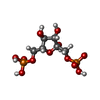
| #1: Protein | Mass: 48285.379 Da / Num. of mol.: 8 Source method: isolated from a genetically manipulated source Source: (gene. exp.) Homo sapiens (human) / Gene: PKLR, PK1, PKL / Production host:   Escherichia coli (E. coli) / References: UniProt: P30613, pyruvate kinase Escherichia coli (E. coli) / References: UniProt: P30613, pyruvate kinase#2: Sugar | ChemComp-FBP / 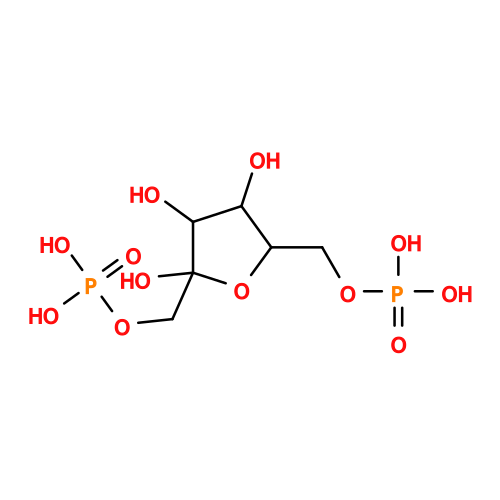 Type: D-saccharide, beta linking / Mass: 340.116 Da / Num. of mol.: 8 / Source method: obtained synthetically / Formula: C6H14O12P2 Type: D-saccharide, beta linking / Mass: 340.116 Da / Num. of mol.: 8 / Source method: obtained synthetically / Formula: C6H14O12P2 |
|---|
-Non-polymers , 5 types, 318 molecules 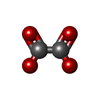


| #3: Chemical | ChemComp-OXL / 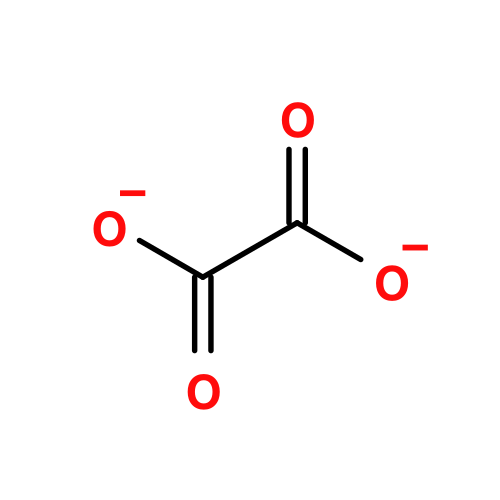 Mass: 88.019 Da / Num. of mol.: 8 / Source method: obtained synthetically / Formula: C2O4 Mass: 88.019 Da / Num. of mol.: 8 / Source method: obtained synthetically / Formula: C2O4#4: Chemical | ChemComp-WWI / Mass: 504.486 Da / Num. of mol.: 4 / Source method: obtained synthetically / Formula: C22H16O10S2 / Feature type: SUBJECT OF INVESTIGATION #5: Chemical | ChemComp-MG /  Mass: 24.305 Da / Num. of mol.: 8 / Source method: obtained synthetically / Formula: Mg Mass: 24.305 Da / Num. of mol.: 8 / Source method: obtained synthetically / Formula: Mg#6: Chemical | ChemComp-K /  Mass: 39.098 Da / Num. of mol.: 9 / Source method: obtained synthetically / Formula: K Mass: 39.098 Da / Num. of mol.: 9 / Source method: obtained synthetically / Formula: K#7: Water | ChemComp-HOH / | Mass: 18.015 Da / Num. of mol.: 289 / Source method: isolated from a natural source / Formula: H2O |
|---|
-Details
| Has ligand of interest | Y |
|---|---|
| Has protein modification | N |
-Experimental details
-Experiment
| Experiment | Method: X-RAY DIFFRACTION / Number of used crystals: 1 |
|---|
- Sample preparation
| Crystal | Density Matthews: 2.71 Å3/Da / Density % sol: 54.62 % |
|---|---|
| Crystal grow | Temperature: 291 K / Method: vapor diffusion, hanging drop / pH: 7.5 Details: 100 mM HEPES/MOPS, 10% PEG8000, 20% ethylene glycol, 10 mM phenylalanine, 20 mM sodium oxalate |
-Data collection
| Diffraction | Mean temperature: 100 K / Serial crystal experiment: N |
|---|---|
| Diffraction source | Source: SYNCHROTRON / Site: SLS  / Beamline: X06SA / Wavelength: 1.00002 Å / Beamline: X06SA / Wavelength: 1.00002 Å |
| Detector | Type: DECTRIS EIGER X 16M / Detector: PIXEL / Date: May 20, 2020 |
| Radiation | Protocol: SINGLE WAVELENGTH / Monochromatic (M) / Laue (L): M / Scattering type: x-ray / Wavelength: 1.00002 |
| Radiation wavelength | Wavelength: 1.00002 Å / Relative weight: 1 |
| Reflection | Resolution: 3.074→98.337 Å / Num. obs: 48012 / % possible obs: 91.5 % / Redundancy: 7.1 % / CC1/2: 0.997 / Rmerge(I) obs: 0.16 / Rpim(I) all: 0.064 / Net I/σ(I): 6 / Num. measured all: 339339 |
| Reflection shell | Resolution: 3.074→3.385 Å / % possible obs: 79.1 % / Redundancy: 7.3 % / Rmerge(I) obs: 1.154 / Num. measured all: 17633 / Num. unique obs: 2402 / CC1/2: 0.815 / Net I/σ(I) obs: 1.6 |
- Processing
| Software |
| ||||||||||||||||||||||||||||||||||||||||||||||||||||||||||||
|---|---|---|---|---|---|---|---|---|---|---|---|---|---|---|---|---|---|---|---|---|---|---|---|---|---|---|---|---|---|---|---|---|---|---|---|---|---|---|---|---|---|---|---|---|---|---|---|---|---|---|---|---|---|---|---|---|---|---|---|---|---|
| Refinement | Method to determine structure: MOLECULAR REPLACEMENT / Resolution: 3.074→101.06 Å / Cor.coef. Fo:Fc: 0.926 / Cor.coef. Fo:Fc free: 0.915 / Cross valid method: THROUGHOUT / SU Rfree Blow DPI: 0.831
| ||||||||||||||||||||||||||||||||||||||||||||||||||||||||||||
| Displacement parameters | Biso mean: 82.53 Å2
| ||||||||||||||||||||||||||||||||||||||||||||||||||||||||||||
| Refine analyze | Luzzati coordinate error obs: 0.675 Å | ||||||||||||||||||||||||||||||||||||||||||||||||||||||||||||
| Refinement step | Cycle: LAST / Resolution: 3.074→101.06 Å
| ||||||||||||||||||||||||||||||||||||||||||||||||||||||||||||
| Refine LS restraints |
| ||||||||||||||||||||||||||||||||||||||||||||||||||||||||||||
| LS refinement shell | Resolution: 3.07→3.24 Å
|
