 Movie
Movie Controller


+ Open data

- Basic information
| Entry | Database: PDB / ID: 11ll | |||||||||
|---|---|---|---|---|---|---|---|---|---|---|
| Title | Particulate methane monooxygenase in membrane arrays | |||||||||
 Components Components | (Particulate methane monooxygenase ...) x 3 | |||||||||
 Keywords Keywords | OXIDOREDUCTASE / particulate methane monooxygenase | |||||||||
| Function / homology |  Function and homology information Function and homology informationmethane monooxygenase (particulate) / methane monooxygenase (soluble) / methane monooxygenase [NAD(P)H] activity / membrane Similarity search - Function | |||||||||
| Biological species |  Methylococcus capsulatus str. Bath (bacteria) Methylococcus capsulatus str. Bath (bacteria) | |||||||||
| Method | ELECTRON MICROSCOPY / single particle reconstruction / cryo EM / Resolution: 7 Å | |||||||||
 Authors Authors | Tucci, F.J. / Miller, C.G. / Rosenzweig, A.C. | |||||||||
| Funding support |  United States, 1items United States, 1items
| |||||||||
 Citation Citation | Journal: J Biol Chem / Year: 2026 Title: Membrane properties modulate methane oxidation by particulate methane monooxygenase. Authors: Callie G Miller / Frank J Tucci / Genevieve R Nemeth / Sergey Stolyar / Mary E Lidstrom / Amy C Rosenzweig / Abstract: The copper-dependent membrane monooxygenases particulate methane monooxygenase (pMMO) and ammonia monooxygenase (AMO) oxidize methane to methanol and ammonia to hydroxylamine, respectively. These ...The copper-dependent membrane monooxygenases particulate methane monooxygenase (pMMO) and ammonia monooxygenase (AMO) oxidize methane to methanol and ammonia to hydroxylamine, respectively. These enzymes, which are important targets for biotechnology, reside in intracytoplasmic membranes (ICMs) where they form densely packed hexagonal arrays. While cryoEM structures of pMMO and AMO in ICMs have revealed closely associated lipids, little is known about how specific lipids and membrane morphologies influence activity. Here we show through cryoelectron tomography (cryoET) that three species of methane- and ammonia-oxidizing bacteria exhibit different types of ICM ultrastructure. Reconstitution of Methylococcus capsulatus (Bath) pMMO into liposomes replicated the array structure, allowing a systematic dissection of how liposome diameter and composition affect activity. Proteoliposome activity is inversely correlated with liposome size, suggesting that pMMO activity may be higher in membranes with increased surface curvature. Further, a comparison of lipids isolated from methanotrophs (native lipids), phosphatidylcholine (PC), and phosphoethanolamine (PE) showed that PE confers increased activity, with maximal activity observed for unsaturated PEs. Methane solubility measurements indicate that these enhancements are specific to pMMO. Cardiolipin further increases activity, consistent with its enrichment in M. capsulatus (Bath) cells. To assess pMMO-pMMO interactions in the ICMs, a 6 Å resolution cryoelectron microscopy (cryoEM) structure of three neighboring pMMO trimers was determined, revealing their arrangement in the array as well as specific residues and lipids mediating interaction interfaces. Taken together, these findings provide insight into the impact of the membrane environment on pMMO function and establish a platform for examining pMMOs and AMOs in tunable lipid environments. | |||||||||
| History |
|
- Structure visualization
| Structure viewer | Molecule: MolmilJmol/JSmol |
|---|
- Downloads & links
-Download
| PDBx/mmCIF format | 11ll.cif.gz | 1.9 MB | Display | PDBx/mmCIF format |
|---|---|---|---|---|
| PDB format | pdb11ll.ent.gz | Display | PDB format | |
| PDBx/mmJSON format | 11ll.json.gz | Tree view | PDBx/mmJSON format | |
| Others |  Other downloads Other downloads |
-Validation report
| Arichive directory | https://data.pdbj.org/pub/pdb/validation_reports/1l/11llftp://data.pdbj.org/pub/pdb/validation_reports/1l/11ll | HTTPS FTP |
|---|
-Related structure data
| Related structure data |  75807MC M: map data used to model this data C: citing same article ( |
|---|---|
| Similar structure data |
-Links
 PDBj
PDBj- Assembly
| Deposited unit | 
|
|---|---|
| 1 |
|
-Components
-Particulate methane monooxygenase ... , 3 types, 27 molecules AaAbAcAdAeAfAgAhAiBaBbBcBdBeBfBgBhBiCaCbCcCdCeCfCgChCi
| #1: Protein | Mass: 42832.887 Da / Num. of mol.: 9 / Source method: isolated from a natural source Source: (natural) Methylococcus capsulatus str. Bath (bacteria)References: UniProt: G1UBD1 #2: Protein | Mass: 27954.148 Da / Num. of mol.: 9 / Source method: isolated from a natural source Source: (natural) Methylococcus capsulatus str. Bath (bacteria)References: UniProt: Q603F1, methane monooxygenase (soluble) #3: Protein | Mass: 27855.434 Da / Num. of mol.: 9 / Source method: isolated from a natural source Source: (natural) Methylococcus capsulatus str. Bath (bacteria)References: UniProt: Q607G3, methane monooxygenase (particulate) |
|---|
-Non-polymers , 3 types, 1882 molecules 
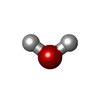
| #4: Chemical | ChemComp-CU /  Mass: 63.546 Da / Num. of mol.: 12 / Source method: obtained synthetically / Formula: Cu Mass: 63.546 Da / Num. of mol.: 12 / Source method: obtained synthetically / Formula: Cu#5: Chemical | ChemComp-A1A0P / ( Mass: 703.970 Da / Num. of mol.: 171 / Source method: isolated from a natural source / Formula: C38H74NO8P #6: Water | ChemComp-HOH / | Mass: 18.015 Da / Num. of mol.: 1699 / Source method: isolated from a natural source / Formula: H2O |
|---|
-Details
| Has ligand of interest | N |
|---|---|
| Has protein modification | N |
-Experimental details
-Experiment
| Experiment | Method: ELECTRON MICROSCOPY |
|---|---|
| EM experiment | Aggregation state: 2D ARRAY / 3D reconstruction method: single particle reconstruction |
- Sample preparation
| Component | Name: particulate methane monooxygenase in native membrane arrays Type: ORGANELLE OR CELLULAR COMPONENT / Entity ID: #1, #3, #2 / Source: NATURAL |
|---|---|
| Source (natural) | Organism: Methylococcus capsulatus str. Bath (bacteria) |
| Buffer solution | pH: 7.2 |
| Specimen | Conc.: 4 mg/ml / Embedding applied: NO / Shadowing applied: NO / Staining applied: NO / Vitrification applied: YES |
| Vitrification | Cryogen name: ETHANE |
- Electron microscopy imaging
| Experimental equipment |  Model: Titan Krios / Image courtesy: FEI Company |
|---|---|
| Microscopy | Model: TFS KRIOS |
| Electron gun | Electron source:  FIELD EMISSION GUN / Accelerating voltage: 300 kV / Illumination mode: FLOOD BEAM FIELD EMISSION GUN / Accelerating voltage: 300 kV / Illumination mode: FLOOD BEAM |
| Electron lens | Mode: BRIGHT FIELD / Nominal defocus max: 2000 nm / Nominal defocus min: 600 nm |
| Image recording | Electron dose: 50 e/Å2 / Film or detector model: GATAN K3 BIOCONTINUUM (6k x 4k) |
- Processing
| EM software |
| ||||||||||||||||
|---|---|---|---|---|---|---|---|---|---|---|---|---|---|---|---|---|---|
| CTF correction | Type: PHASE FLIPPING AND AMPLITUDE CORRECTION | ||||||||||||||||
| 3D reconstruction | Resolution: 7 Å / Resolution method: FSC 0.143 CUT-OFF / Num. of particles: 35000 / Symmetry type: POINT |
