 Movie
Movie Controller


+ Open data

- Basic information
| Entry | Database: PDB / ID: 11hd | |||||||||
|---|---|---|---|---|---|---|---|---|---|---|
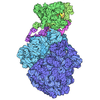
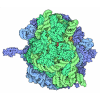
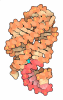
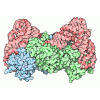
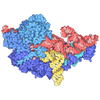
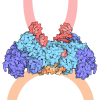
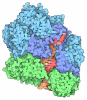
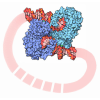
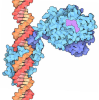
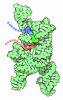
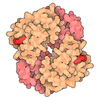
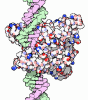
| Title | Effector complex from type IV-C CRISPR-Cas system | |||||||||
 Components Components |
| |||||||||
 Keywords Keywords | RNA BINDING PROTEIN / CRISPR-Cas / nuclease / RNA-guided / Cas10 / Cas7 | |||||||||
| Function / homology | DNA / DNA (> 10) / RNA / RNA (> 10) Function and homology information Function and homology information | |||||||||
| Biological species |   Pyrococcus abyssi (archaea) Pyrococcus abyssi (archaea) | |||||||||
| Method | ELECTRON MICROSCOPY / single particle reconstruction / cryo EM / Resolution: 3.21 Å | |||||||||
 Authors Authors | Pittman, C. / Xu, C. / Catchpole, R. / Garrett, S. / Fuchs, R. / Makarova, K. / Koonin, E. / Zhao, P. / Wells, L. / Graveley, B. ...Pittman, C. / Xu, C. / Catchpole, R. / Garrett, S. / Fuchs, R. / Makarova, K. / Koonin, E. / Zhao, P. / Wells, L. / Graveley, B. / Chu, X. / Ke, A. / Terns, M. | |||||||||
| Funding support |  United States, 1items United States, 1items
| |||||||||
 Citation Citation | Journal: Cell Rep / Year: 2026 Title: Type IV-C CRISPR-Cas effector complexes recognize double-stranded DNA and switch on collateral cleavage of ssDNA and RNA. Authors: Conor C Pittman / Chengtao Xu / Ryan J Catchpole / Sandra Garrett / Ryan Fuchs / Xiaomeng Chu / Kira S Makarova / Eugene V Koonin / Peng Zhao / Lance Wells / Brenton R Graveley / Ailong Ke / Michael P Terns / Abstract: Type IV-C CRISPR-Cas systems remain enigmatic compared to other class 1 systems. Here, we expand the type IV-C catalog, identifying two phylogenetically distinct clades primarily found in archaea (IV- ...Type IV-C CRISPR-Cas systems remain enigmatic compared to other class 1 systems. Here, we expand the type IV-C catalog, identifying two phylogenetically distinct clades primarily found in archaea (IV-C1) or bacteria (IV-C2), distinguishable by the Cas10IVc subunit architecture. We functionally and structurally characterize type IV-C1 systems from Thermococcus onnurineus (Ton) and Pyrococcus abyssi (Pab). Type IV-C complexes assemble with crRNAs derived from distinct CRISPR arrays and recognize a 5'-GGG-3' protospacer adjacent motif (PAM) to bind double-stranded DNA targets. Target recognition activates the HD domain of Cas10IVc, triggering metal-dependent collateral cleavage of single-stranded DNA and RNA. This behavior is explained by allosteric alignment of the HD active site, triggered by PAM-dependent R-loop formation, as revealed by cryo-EM. Together, our findings suggest that type IV-C systems provide immunity via non-specific cleavage of nucleic acids generated during mobile genetic element replication or transcription. | |||||||||
| History |
|
- Structure visualization
| Structure viewer | Molecule: MolmilJmol/JSmol |
|---|
- Downloads & links
-Download
| PDBx/mmCIF format | 11hd.cif.gz | 742.6 KB | Display | PDBx/mmCIF format |
|---|---|---|---|---|
| PDB format | pdb11hd.ent.gz | 601.7 KB | Display | PDB format |
| PDBx/mmJSON format | 11hd.json.gz | Tree view | PDBx/mmJSON format | |
| Others |  Other downloads Other downloads |
-Validation report
| Arichive directory | https://data.pdbj.org/pub/pdb/validation_reports/1h/11hdftp://data.pdbj.org/pub/pdb/validation_reports/1h/11hd | HTTPS FTP |
|---|
-Related structure data
| Related structure data |  75686MC  11fsC  11hcC M: map data used to model this data C: citing same article ( |
|---|---|
| Similar structure data |


-Links
 PDBj
PDBj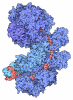
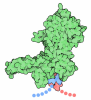
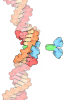
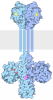

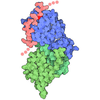
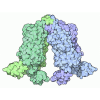
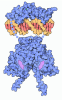
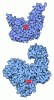
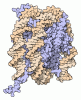
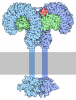
- Assembly
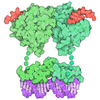
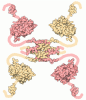
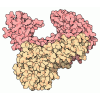
| Deposited unit | 
|
|---|---|
| 1 |
|
-Components
-Protein , 4 types, 15 molecules BEGCFHIDKLMNOJA
| #1: Protein | Mass: 36531.379 Da / Num. of mol.: 7 Source method: isolated from a genetically manipulated source Source: (gene. exp.) Pyrococcus abyssi (archaea) / Production host:   Escherichia coli (E. coli) Escherichia coli (E. coli)#2: Protein | | Mass: 35403.852 Da / Num. of mol.: 1 Source method: isolated from a genetically manipulated source Source: (gene. exp.) Pyrococcus abyssi (archaea) / Production host: Escherichia coli (E. coli)#3: Protein | Mass: 14065.316 Da / Num. of mol.: 6 Source method: isolated from a genetically manipulated source Source: (gene. exp.) Pyrococcus abyssi (archaea) / Production host: Escherichia coli (E. coli)#6: Protein | | Mass: 70278.211 Da / Num. of mol.: 1 Source method: isolated from a genetically manipulated source Source: (gene. exp.) Pyrococcus abyssi (archaea) / Production host: Escherichia coli (E. coli) |
|---|
-DNA chain / RNA chain , 2 types, 2 molecules PQ
| #4: DNA chain | Mass: 11444.326 Da / Num. of mol.: 1 / Source method: obtained synthetically / Source: (synth.) Pyrococcus abyssi (archaea) |
|---|---|
| #5: RNA chain | Mass: 15131.104 Da / Num. of mol.: 1 Source method: isolated from a genetically manipulated source Source: (gene. exp.) Pyrococcus abyssi (archaea) / Production host: Escherichia coli (E. coli) |
-Non-polymers , 2 types, 3 molecules 

| #7: Chemical | ChemComp-ZN /  Mass: 65.409 Da / Num. of mol.: 1 / Source method: obtained synthetically / Formula: Zn Mass: 65.409 Da / Num. of mol.: 1 / Source method: obtained synthetically / Formula: Zn |
|---|---|
| #8: Chemical |  Mass: 24.305 Da / Num. of mol.: 2 / Source method: obtained synthetically / Formula: Mg / Feature type: SUBJECT OF INVESTIGATION Mass: 24.305 Da / Num. of mol.: 2 / Source method: obtained synthetically / Formula: Mg / Feature type: SUBJECT OF INVESTIGATION |
-Details
| Has ligand of interest | Y |
|---|---|
| Has protein modification | Y |
-Experimental details
-Experiment
| Experiment | Method: ELECTRON MICROSCOPY |
|---|---|
| EM experiment | Aggregation state: PARTICLE / 3D reconstruction method: single particle reconstruction |
- Sample preparation
| Component | Name: Effector complex from type IV-C CRISPR-Cas system / Type: COMPLEX / Entity ID: #1-#6 / Source: MULTIPLE SOURCES |
|---|---|
| Molecular weight | Experimental value: NO |
| Source (natural) | Organism: Pyrococcus abyssi (archaea) |
| Source (recombinant) | Organism: Escherichia coli (E. coli) |
| Buffer solution | pH: 7.5 |
| Specimen | Embedding applied: NO / Shadowing applied: NO / Staining applied: NO / Vitrification applied: YES |
| Vitrification | Cryogen name: ETHANE |
- Electron microscopy imaging
| Experimental equipment |  Model: Titan Krios / Image courtesy: FEI Company |
|---|---|
| Microscopy | Model: TFS KRIOS |
| Electron gun | Electron source:  FIELD EMISSION GUN / Accelerating voltage: 300 kV / Illumination mode: FLOOD BEAM FIELD EMISSION GUN / Accelerating voltage: 300 kV / Illumination mode: FLOOD BEAM |
| Electron lens | Mode: BRIGHT FIELD / Nominal magnification: 81000 X / Nominal defocus max: 2000 nm / Nominal defocus min: 800 nm |
| Image recording | Electron dose: 50 e/Å2 / Film or detector model: GATAN K3 (6k x 4k) |
- Processing
| EM software |
| ||||||||||||||||||||||||
|---|---|---|---|---|---|---|---|---|---|---|---|---|---|---|---|---|---|---|---|---|---|---|---|---|---|
| CTF correction | Type: PHASE FLIPPING AND AMPLITUDE CORRECTION | ||||||||||||||||||||||||
| Particle selection | Num. of particles selected: 883889 | ||||||||||||||||||||||||
| 3D reconstruction | Resolution: 3.21 Å / Resolution method: FSC 0.143 CUT-OFF / Num. of particles: 38895 / Symmetry type: POINT | ||||||||||||||||||||||||
| Refinement | Highest resolution: 3.21 Å Stereochemistry target values: REAL-SPACE (WEIGHTED MAP SUM AT ATOM CENTERS) | ||||||||||||||||||||||||
| Refine LS restraints |
|
