 Movie
Movie Controller

[English] 日本語
 Yorodumi
- PDB-10ic: Rhesus rotavirus (consensus structure at 4.7 Angstrom resolution ... -
+ Open data

- Basic information
| Entry | Database: PDB / ID: 10ic | |||||||||||||||||||||||||||
|---|---|---|---|---|---|---|---|---|---|---|---|---|---|---|---|---|---|---|---|---|---|---|---|---|---|---|---|---|
| Title | Rhesus rotavirus (consensus structure at 4.7 Angstrom resolution from cryo-ET) | |||||||||||||||||||||||||||
 Components Components |
| |||||||||||||||||||||||||||
 Keywords Keywords | VIRUS / Rotavirus / non-enveloped virus / viral entry / tomography | |||||||||||||||||||||||||||
| Function / homology |  Function and homology information Function and homology informationviral intermediate capsid / host cell endoplasmic reticulum lumen / T=13 icosahedral viral capsid / T=2 icosahedral viral capsid / viral inner capsid / viral outer capsid / viral nucleocapsid / receptor-mediated virion attachment to host cell / host cell surface receptor binding / fusion of virus membrane with host plasma membrane ...viral intermediate capsid / host cell endoplasmic reticulum lumen / T=13 icosahedral viral capsid / T=2 icosahedral viral capsid / viral inner capsid / viral outer capsid / viral nucleocapsid / receptor-mediated virion attachment to host cell / host cell surface receptor binding / fusion of virus membrane with host plasma membrane / viral envelope / structural molecule activity / RNA binding / metal ion binding Similarity search - Function | |||||||||||||||||||||||||||
| Biological species |  Simian rotavirus A strain RRV Simian rotavirus A strain RRV | |||||||||||||||||||||||||||
| Method | ELECTRON MICROSCOPY / subtomogram averaging / cryo EM / Resolution: 4.7 Å | |||||||||||||||||||||||||||
 Authors Authors | de Sautu, M. / Leistner, C. / Kirchhausen, T. / Jenni, S. / Harrison, S.C. | |||||||||||||||||||||||||||
| Funding support |  United States, 3items United States, 3items
| |||||||||||||||||||||||||||
 Citation Citation | Journal: Science / Year: 2026 Title: Mechanism of membrane perforation in rotavirus cell entry. Authors: Marilina de Sautu / Conny Leistner / Tomas Kirchhausen / Simon Jenni / Stephen C Harrison / Abstract: Cell entry of nonenveloped animal viruses requires translocation of a macromolecular assembly across a cellular membrane. Double-stranded RNA viruses introduce into the target cell an inner capsid ...Cell entry of nonenveloped animal viruses requires translocation of a macromolecular assembly across a cellular membrane. Double-stranded RNA viruses introduce into the target cell an inner capsid particle that does not uncoat further. Instead, it extrudes capped viral mRNA by virtue of polymerase and capping activities within it. As described here, we used cryogenic electron tomography to visualize the full course of rhesus rotavirus entry, from cell attachment and virion uptake to release of the subviral particle. The cryo-tomograms and subtomogram averaging of classified subparticles link high-resolution structures of the virion and its components with time series from live-cell fluorescence microscopy. We outline the mechanism of each step in the entry process, including the membrane perforation step that transfers a subviral particle into the cytosol. #1: Journal: bioRxiv / Year: 2026 Title: Mechanism of membrane perforation in rotavirus cell entry. Authors: Marilina de Sautu / Conny Leistner / Tomas Kirchhausen / Simon Jenni / Stephen C Harrison / Abstract: Infectious cell entry by non-enveloped viruses requires delivery of the viral genome -- in many cases enclosed within a large, subviral particle -- across the membrane of an intracellular compartment. ...Infectious cell entry by non-enveloped viruses requires delivery of the viral genome -- in many cases enclosed within a large, subviral particle -- across the membrane of an intracellular compartment. Rotaviruses and other double-strand RNA (dsRNA) viruses introduce into their target cells an inner capsid particle, roughly 700 Å in diameter, that does not uncoat further but instead extrudes capped viral mRNA by virtue of RNA-dependent RNA polymerase and capping activities within it. The delivery agent is an outer protein layer of the virion. We describe here use of cryogenic electron tomography (cryo-ET) to visualize the full course of rhesus rotavirus (RRV) entry, from cell attachment and inward budding of the virion to arrival of the subviral particle in the cytosol. The cryo-tomograms and subtomogram averaging of classified subparticles have enabled us to link high-resolution structures of the virion and its components with time series from live-cell fluorescence microscopy and thus to outline the molecular mechanism of each step in the entry process, including the hitherto elusive membrane perforation step needed for transfer of the subviral particle into the cytosol. | |||||||||||||||||||||||||||
| History |
|
- Structure visualization
| Structure viewer | Molecule: MolmilJmol/JSmol |
|---|
- Downloads & links
-Download
| PDBx/mmCIF format | 10ic.cif.gz | 3.6 MB | Display | PDBx/mmCIF format |
|---|---|---|---|---|
| PDB format | pdb10ic.ent.gz | Display | PDB format | |
| PDBx/mmJSON format | 10ic.json.gz | Tree view | PDBx/mmJSON format | |
| Others |  Other downloads Other downloads |
-Validation report
| Arichive directory | https://data.pdbj.org/pub/pdb/validation_reports/0i/10icftp://data.pdbj.org/pub/pdb/validation_reports/0i/10ic | HTTPS FTP |
|---|
-Related structure data
| Related structure data |  75185MC  10idC M: map data used to model this data C: citing same article ( |
|---|---|
| Similar structure data |

-Links
 PDBj
PDBj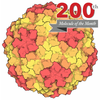
- Assembly
| Deposited unit | 
|
|---|---|
| 1 | x 60
|
| 2 |
|
| 3 | x 5
|
| 4 | x 6
|
| 5 | 
|
| Symmetry | Point symmetry: (Schoenflies symbol: I (icosahedral)) |
-Components
-Protein , 3 types, 28 molecules 0Y1ZPQRSTUVWXABCDEFGHIJKLMNO
| #1: Protein | Mass: 37136.531 Da / Num. of mol.: 13 Source method: isolated from a genetically manipulated source Source: (gene. exp.) Simian rotavirus A strain RRV / Cell line (production host): MA104 / Production host:  Chlorocebus aethiops (grivet monkey) / References: UniProt: P12476 Chlorocebus aethiops (grivet monkey) / References: UniProt: P12476#2: Protein | Mass: 103425.992 Da / Num. of mol.: 2 Source method: isolated from a genetically manipulated source Source: (gene. exp.) Simian rotavirus A strain RRV / Cell line (production host): MA104 / Production host: Chlorocebus aethiops (grivet monkey) / References: UniProt: B3F2X3#3: Protein | Mass: 44962.773 Da / Num. of mol.: 13 Source method: isolated from a genetically manipulated source Source: (gene. exp.) Simian rotavirus A strain RRV / Cell line (production host): MA104 / Production host: Chlorocebus aethiops (grivet monkey) / References: UniProt: B2BN53 |
|---|
-Sugars , 1 types, 13 molecules 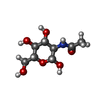
| #4: Sugar | ChemComp-NAG / 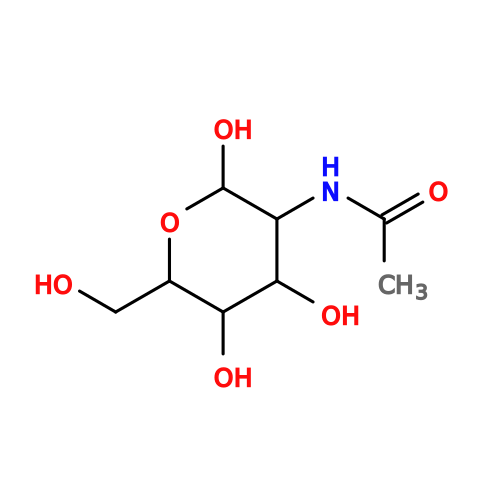 Type: D-saccharide, beta linking / Mass: 221.208 Da / Num. of mol.: 13 / Source method: obtained synthetically / Formula: C8H15NO6 / Feature type: SUBJECT OF INVESTIGATION Type: D-saccharide, beta linking / Mass: 221.208 Da / Num. of mol.: 13 / Source method: obtained synthetically / Formula: C8H15NO6 / Feature type: SUBJECT OF INVESTIGATION |
|---|
-Non-polymers , 3 types, 75 molecules 


| #5: Chemical | ChemComp-CA /  Mass: 40.078 Da / Num. of mol.: 52 / Source method: obtained synthetically / Formula: Ca / Feature type: SUBJECT OF INVESTIGATION Mass: 40.078 Da / Num. of mol.: 52 / Source method: obtained synthetically / Formula: Ca / Feature type: SUBJECT OF INVESTIGATION#6: Chemical | ChemComp-ZN /  Mass: 65.409 Da / Num. of mol.: 18 / Source method: obtained synthetically / Formula: Zn / Feature type: SUBJECT OF INVESTIGATION Mass: 65.409 Da / Num. of mol.: 18 / Source method: obtained synthetically / Formula: Zn / Feature type: SUBJECT OF INVESTIGATION#7: Chemical | ChemComp-CL /  Mass: 35.453 Da / Num. of mol.: 5 / Source method: obtained synthetically / Formula: Cl / Feature type: SUBJECT OF INVESTIGATION Mass: 35.453 Da / Num. of mol.: 5 / Source method: obtained synthetically / Formula: Cl / Feature type: SUBJECT OF INVESTIGATION |
|---|
-Details
| Has ligand of interest | Y |
|---|---|
| Has protein modification | Y |
-Experimental details
-Experiment
| Experiment | Method: ELECTRON MICROSCOPY |
|---|---|
| EM experiment | Aggregation state: CELL / 3D reconstruction method: subtomogram averaging |
- Sample preparation
| Component | Name: Simian rotavirus A strain RRV / Type: VIRUS / Entity ID: #1-#3 / Source: RECOMBINANT |
|---|---|
| Molecular weight | Experimental value: NO |
| Source (natural) | Organism: Simian rotavirus A strain RRV |
| Source (recombinant) | Organism: Chlorocebus aethiops (grivet monkey) / Cell: MA104 |
| Details of virus | Empty: NO / Enveloped: NO / Isolate: STRAIN / Type: VIRION |
| Buffer solution | pH: 7.3 |
| Specimen | Embedding applied: NO / Shadowing applied: NO / Staining applied: NO / Vitrification applied: YES |
| Vitrification | Cryogen name: ETHANE |
- Electron microscopy imaging
| Experimental equipment |  Model: Titan Krios / Image courtesy: FEI Company |
|---|---|
| Microscopy | Model: TFS KRIOS |
| Electron gun | Electron source:  FIELD EMISSION GUN / Accelerating voltage: 300 kV / Illumination mode: FLOOD BEAM FIELD EMISSION GUN / Accelerating voltage: 300 kV / Illumination mode: FLOOD BEAM |
| Electron lens | Mode: BRIGHT FIELD / Nominal defocus max: 5000 nm / Nominal defocus min: 3000 nm |
| Image recording | Electron dose: 3.8 e/Å2 / Avg electron dose per subtomogram: 156 e/Å2 / Film or detector model: FEI FALCON IV (4k x 4k) |
- Processing
| EM software |
| ||||||||||||
|---|---|---|---|---|---|---|---|---|---|---|---|---|---|
| CTF correction | Type: PHASE FLIPPING AND AMPLITUDE CORRECTION | ||||||||||||
| Symmetry | Point symmetry: I (icosahedral) | ||||||||||||
| 3D reconstruction | Resolution: 4.7 Å / Resolution method: FSC 0.143 CUT-OFF / Num. of particles: 8565 / Symmetry type: POINT | ||||||||||||
| EM volume selection | Num. of tomograms: 537 / Num. of volumes extracted: 8565 | ||||||||||||
| Atomic model building | Protocol: RIGID BODY FIT Details: PDB-ID 9C1G placed without refinement. Position given by I2 point group symmetry. |
