Movie
Movie Controller


+ Open data

- Basic information
| Entry |  | |||||||||
|---|---|---|---|---|---|---|---|---|---|---|
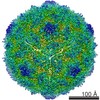
| Title | Yeast-expressed polio type 3 expanded virus-like particles | |||||||||
 Map data Map data | deepEMhancer-processed map | |||||||||
 Sample Sample |
| |||||||||
 Keywords Keywords | Poliovirus type 3 / virus-like particles / expanded state / VIRUS LIKE PARTICLE | |||||||||
| Function / homology |  Function and homology information Function and homology informationsymbiont genome entry into host cell via pore formation in plasma membrane / viral capsid / host cell cytoplasm / symbiont-mediated suppression of host gene expression / virion attachment to host cell / structural molecule activity Similarity search - Function | |||||||||
| Biological species |  Poliovirus 3 Poliovirus 3 | |||||||||
| Method | single particle reconstruction / cryo EM / Resolution: 2.76 Å | |||||||||
 Authors Authors | Hong Q / Cong Y | |||||||||
| Funding support |  China, 2 items China, 2 items
| |||||||||
 Citation Citation | Journal: Antiviral Res / Year: 2026 Title: High-yield production of immunogenic PV3 virus-like particle in yeast. Authors: Tian Chen / Qin Hong / Wenyu Han / Shuxia Wang / Cheng Lin / Jiaqi Yao / Chaoyang Lian / Qingwei Liu / Xiaoli Wang / Yanqiu Zhou / Yao Cong / Zhong Huang / Abstract: The identification of thermally stabilized mutants of all three poliovirus serotypes (PV1, PV2, and PV3) has enabled the development of virus-like particle (VLP)-based next-generation poliovirus ...The identification of thermally stabilized mutants of all three poliovirus serotypes (PV1, PV2, and PV3) has enabled the development of virus-like particle (VLP)-based next-generation poliovirus vaccines. PV3 stabilized mutant-derived VLPs (sVLPs) have been produced in several recombinant systems through co-expression of mutant P1 polyprotein with native or uncleavable viral protease 3CD, and have shown immunogenicity in animal models. However, their yields remain suboptimal, likely because of intrinsic 3CD toxicity and/or inefficient 3CD-mediated cleavage of P1 into capsid subunits VP0, VP3, and VP1, creating a bottleneck for cost-effective product development. In this study, we designed a protease-independent expression strategy based on simultaneous co-expression of VP0, VP3, and VP1 capsid subunit (VP0/VP3/VP1) and compared it with the conventional P1/3CD co-expression approach for production of PV3 sVLP and wildtype VLP (wtVLP) in Pichia pastoris. For each VLP type, the VP0/VP3/VP1 strategy in general enhances target protein expression and D-antigen formation compared with P1/3CD co-expression. The PV3 sVLP produced by the VP0/VP3/VP1 strategy possesses higher levels of D-antigen and significantly enhanced thermostability than the corresponding wtVLP. Moreover, structural and immunological analyses reveal that PV3 sVLP, but not wtVLP, adopts a native conformation and potently elicits neutralizing antibodies in a mouse model. These findings not only confirm yeast-produced PV3 sVLP as a promising vaccine candidate, but also establish a high-yield and scalable expression strategy amenable to further development and industrial-level production of sVLP-based next-generation polio vaccines. | |||||||||
| History |
|
- Structure visualization
| Supplemental images |
|---|

- Downloads & links
-EMDB archive
| Map data | emd_81997.map.gz | 374.8 MB | EMDB map data format | |
|---|---|---|---|---|
| Header (meta data) | emd-81997-v30.xmlemd-81997.xml | 19.9 KB 19.9 KB | Display Display | EMDB header |
| Images |  emd_81997.png emd_81997.png | 180.9 KB | ||
| Filedesc metadata | emd-81997.cif.gz | 6 KB | ||
| Others | emd_81997_additional_1.map.gzemd_81997_half_map_1.map.gzemd_81997_half_map_2.map.gz | 350.1 MB 351.4 MB 351.3 MB | ||
| Archive directory |  https://data.pdbj.org/pub/emdb/structures/EMD-81997ftp://data.pdbj.org/pub/emdb/structures/EMD-81997 https://data.pdbj.org/pub/emdb/structures/EMD-81997ftp://data.pdbj.org/pub/emdb/structures/EMD-81997 | HTTPS FTP |
-Related structure data
| Related structure data |  43muMC  43miC M: atomic model generated by this map C: citing same article ( |
|---|---|
| Similar structure data |

-Links
| EMDB pages | EMDB (EBI/PDBe) / EMDataResource |
|---|---|
| Related items in Molecule of the Month |
-Map
| File | Download / File: emd_81997.map.gz / Format: CCP4 / Size: 443.3 MB / Type: IMAGE STORED AS FLOATING POINT NUMBER (4 BYTES) | ||||||||||||||||||||||||||||||||||||
|---|---|---|---|---|---|---|---|---|---|---|---|---|---|---|---|---|---|---|---|---|---|---|---|---|---|---|---|---|---|---|---|---|---|---|---|---|---|
| Annotation | deepEMhancer-processed map | ||||||||||||||||||||||||||||||||||||
| Projections & slices | Image control
Images are generated by Spider. | ||||||||||||||||||||||||||||||||||||
| Voxel size | X=Y=Z: 1.093 Å | ||||||||||||||||||||||||||||||||||||
| Density |
| ||||||||||||||||||||||||||||||||||||
| Symmetry | Space group: 1 | ||||||||||||||||||||||||||||||||||||
| Details | EMDB XML:
|
 Z (Sec.)
 Y (Row.)
 X (Col.)


-Supplemental data
-Additional map: Density map from 3D refinement
| File | emd_81997_additional_1.map | ||||||||||||
|---|---|---|---|---|---|---|---|---|---|---|---|---|---|
| Annotation | Density map from 3D refinement | ||||||||||||
| Projections & Slices |
| ||||||||||||
| Density Histograms |


-Half map: #2
| File | emd_81997_half_map_1.map | ||||||||||||
|---|---|---|---|---|---|---|---|---|---|---|---|---|---|
| Projections & Slices |
| ||||||||||||
| Density Histograms |


-Half map: #1
| File | emd_81997_half_map_2.map | ||||||||||||
|---|---|---|---|---|---|---|---|---|---|---|---|---|---|
| Projections & Slices |
| ||||||||||||
| Density Histograms |


- Sample components
-Entire : Poliovirus 3
| Entire | Name: Poliovirus 3 |
|---|---|
| Components |
|
-Supramolecule #1: Poliovirus 3
| Supramolecule | Name: Poliovirus 3 / type: virus / ID: 1 / Parent: 0 / Macromolecule list: all Details: Yeast-expressed polio type 3 expanded virus-like particles NCBI-ID: 12086 / Sci species name: Poliovirus 3 / Virus type: VIRUS-LIKE PARTICLE / Virus isolate: STRAIN / Virus enveloped: No / Virus empty: Yes |
|---|
-Macromolecule #1: VP1
| Macromolecule | Name: VP1 / type: protein_or_peptide / ID: 1 / Number of copies: 1 / Enantiomer: LEVO |
|---|---|
| Source (natural) | Organism: Poliovirus 3 |
| Molecular weight | Theoretical: 33.509652 KDa |
| Recombinant expression | Organism:  Komagataella pastoris (fungus) Komagataella pastoris (fungus) |
| Sequence | String: IEDLITEVAQ GALTLSLPKQ QDSLPDTKAS GPAHSKEVPA LTAVETGATN PLVPSDTVQT RHVIQRRSRS ESTIESFFAR GACVAIIEV DNEEPTTRAQ KLFATWRITY KDTVQLRRKL EFFTYSRFDM EFTFVVTANF TNTNNGHALN QVYQIMYIPP G APTPKSWD ...String: IEDLITEVAQ GALTLSLPKQ QDSLPDTKAS GPAHSKEVPA LTAVETGATN PLVPSDTVQT RHVIQRRSRS ESTIESFFAR GACVAIIEV DNEEPTTRAQ KLFATWRITY KDTVQLRRKL EFFTYSRFDM EFTFVVTANF TNTNNGHALN QVYQIMYIPP G APTPKSWD DYTWQTSSNP SIFYTYGAAP ARISVPYVGL ANAYSHFYDG FAKVPLKTDA NDQIGDSLYS AMTVDDFGVL AI RVVNDHN PTKVTSKVRI YMKPKHVRVW CPRPPRAVPY YGPGVDYKDN LNPLSEKGLT TY UniProtKB: Genome polyprotein |
-Macromolecule #2: VP2
| Macromolecule | Name: VP2 / type: protein_or_peptide / ID: 2 / Number of copies: 1 / Enantiomer: LEVO |
|---|---|
| Source (natural) | Organism: Poliovirus 3 |
| Molecular weight | Theoretical: 30.15692 KDa |
| Recombinant expression | Organism: Komagataella pastoris (fungus) |
| Sequence | String: SPNVEACGYS DRVLQLTLGN STITTQEAAN SVVAYGRWPE FIRDDEANPV DQPTEPDVAT CRFYTLDTVM WGKESKGWWW KLPDALRDM GLFGQNMYYH YLGRSGYTVH VQCNASKFHQ GALGVFAIPE YCLAGDSDKQ RYTSYANANP GEKGGKFYSQ F NRDTAVTS ...String: SPNVEACGYS DRVLQLTLGN STITTQEAAN SVVAYGRWPE FIRDDEANPV DQPTEPDVAT CRFYTLDTVM WGKESKGWWW KLPDALRDM GLFGQNMYYH YLGRSGYTVH VQCNASKFHQ GALGVFAIPE YCLAGDSDKQ RYTSYANANP GEKGGKFYSQ F NRDTAVTS PKREFCPVDY LLGCGVLLGN AFVYPHQIIN LRTNNSATIV LPYVNALAID SMVKHNNWGI AILPLSPLDF AQ DSSVEIP ITVTIAPMCS EFNGLRNVTA PKFQ UniProtKB: Genome polyprotein |
-Macromolecule #3: VP3
| Macromolecule | Name: VP3 / type: protein_or_peptide / ID: 3 / Number of copies: 1 / Enantiomer: LEVO |
|---|---|
| Source (natural) | Organism: Poliovirus 3 |
| Molecular weight | Theoretical: 26.256057 KDa |
| Recombinant expression | Organism: Komagataella pastoris (fungus) |
| Sequence | String: GLPVLNTPGS NQYLTSDNHQ SPCAIPEFDV TPPIDIPGEV KNMMELAEID TMIPLNLENT KRNTMDMYRV TLSDSADLSQ PILCLSLSP ASDPRLSHTM LGEVLNYYTH WAGSLKFTFL FCGSMMATGK ILVAYAPPGA QPPTSRKEAM LGTHVIWDLG L QSSCTMVV ...String: GLPVLNTPGS NQYLTSDNHQ SPCAIPEFDV TPPIDIPGEV KNMMELAEID TMIPLNLENT KRNTMDMYRV TLSDSADLSQ PILCLSLSP ASDPRLSHTM LGEVLNYYTH WAGSLKFTFL FCGSMMATGK ILVAYAPPGA QPPTSRKEAM LGTHVIWDLG L QSSCTMVV PWISNVTYRQ TTQDSFTEGG YISMFYQTRI VVPLSTPKSM SMLGFVSACN DFSVRLLRDT THISQSALPQ UniProtKB: Genome polyprotein |
-Experimental details
-Structure determination
| Method | cryo EM |
|---|---|
 Processing Processing | single particle reconstruction |
| Aggregation state | particle |
-Sample preparation
| Buffer | pH: 7.5 |
|---|---|
| Vitrification | Cryogen name: ETHANE |
- Electron microscopy
| Microscope | TFS KRIOS |
|---|---|
| Image recording | Film or detector model: GATAN K3 (6k x 4k) / Average electron dose: 50.0 e/Å2 |
| Electron beam | Acceleration voltage: 300 kV / Electron source:  FIELD EMISSION GUN FIELD EMISSION GUN |
| Electron optics | Illumination mode: FLOOD BEAM / Imaging mode: BRIGHT FIELD / Nominal defocus max: 2.5 µm / Nominal defocus min: 0.8 µm |
| Experimental equipment |  Model: Titan Krios / Image courtesy: FEI Company |