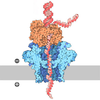
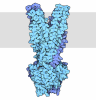
Journal: Nat Commun / Year: 2026 Title: Architecture of the Wza-Wzc complex that mediates colanic acid translocation across the cell envelope in Gram-negative bacteria. Authors: Jiao Liu / Yanlong Han / Guanxue Huang / Manfeng Zhang / Junlei Du / Haizhen Zhou / Dahua Chen / Yihua Huang / Abstract: The Wzx/Wzy-dependent pathway is a highly conserved mechanism for bacterial polysaccharide biosynthesis. This pathway is exemplified by the assembly and export of colanic acid mediated by the Wza-Wzc ...The Wzx/Wzy-dependent pathway is a highly conserved mechanism for bacterial polysaccharide biosynthesis. This pathway is exemplified by the assembly and export of colanic acid mediated by the Wza-Wzc complex. While recent structural investigations have yielded valuable insights into the molecular basis of colanic acid biosynthesis, the overall architecture of the Wza-Wzc complex and the regulatory mechanism of colanic acid export remain incompletely understood. Here, we report cryo-electron microscopy (cryo-EM) structures of the Wza-Wzc complex from E. coli K12 in two functionally states: the autophosphorylated wild-type (Wza-Wzc) state and the non-phosphorylated (Wza-Wzc) state. Both structures reveal that Wza and Wzc assemble into a continuous channel spanning the entire bacterial cell envelope, indicating that phosphorylation of Wzc does not disassemble the intact export channel. Relative to Wza-Wzc, the octameric periplasmic domain of Wzc in Wza-Wzc undergoes a significant conformational rearrangement. This rearrangement reduces constriction region's diameter and confers a negatively charged property to the interior of the Wzc octamer, which is proposed to inhibit colanic acid export. Collectively, these structural findings confirm that the Wza-Wzc complex forms a colanic acid export channel throughout Wzc's phosphorylation-dephosphorylation cycle, advancing our mechanistic understanding of the Wzx/Wzy-dependent polysaccharide biosynthesis pathway in Gram-negative bacteria.
In the structure databanks used in Yorodumi, some data are registered as the other names, "COVID-19 virus" and "2019-nCoV". Here are the details of the virus and the list of structure data.
Jan 31, 2019. EMDB accession codes are about to change! (news from PDBe EMDB page)
EMDB accession codes are about to change! (news from PDBe EMDB page)
The allocation of 4 digits for EMDB accession codes will soon come to an end. Whilst these codes will remain in use, new EMDB accession codes will include an additional digit and will expand incrementally as the available range of codes is exhausted. The current 4-digit format prefixed with “EMD-” (i.e. EMD-XXXX) will advance to a 5-digit format (i.e. EMD-XXXXX), and so on. It is currently estimated that the 4-digit codes will be depleted around Spring 2019, at which point the 5-digit format will come into force.
The EM Navigator/Yorodumi systems omit the EMD- prefix.
Related info.:Q: What is EMD? / ID/Accession-code notation in Yorodumi/EM Navigator
Yorodumi is a browser for structure data from EMDB, PDB, SASBDB, etc.
This page is also the successor to EM Navigator detail page, and also detail information page/front-end page for Omokage search.
The word "yorodu" (or yorozu) is an old Japanese word meaning "ten thousand". "mi" (miru) is to see.
Related info.:EMDB / PDB / SASBDB / Comparison of 3 databanks / Yorodumi Search / Aug 31, 2016. New EM Navigator & Yorodumi / Yorodumi Papers / Jmol/JSmol / Function and homology information / Changes in new EM Navigator and Yorodumi
 Movie
Movie Controller


 Open data
 Basic information
 Map data
 Sample
 Keywords
 Function and homology information
 Escherichia coli K-12 (bacteria)
 Authors
 China, 1 items
  Citation
 Structure visualization
 Downloads & links
 emd_80645.png
 http://ftp.pdbj.org/pub/emdb/structures/EMD-80645


 Z (Sec.)
 Y (Row.)
 X (Col.)


 Sample components
 Processing
 Electron microscopy
 FIELD EMISSION GUN