[English] 日本語
Yorodumi
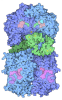
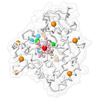
- EMDB-80251: Structure of mouse iNOS in the output state -

+
Open data


ID or keywords:

Loading...

-
Basic information

Entry
Database: EMDB / ID: EMD-80251
TitleStructure of mouse iNOS in the output state
Map data
Sample
  • Complex: mouse iNOS in the output state with all cofactors and substrates.
    • Protein or peptide: Nitric oxide synthase, inducible
    • Protein or peptide: Calmodulin-2
  • Ligand: 5,6,7,8-TETRAHYDROBIOPTERIN
  • Ligand: PROTOPORPHYRIN IX CONTAINING FE
  • Ligand: ZINC ION
  • Ligand: ARGININE
  • Ligand: FLAVIN MONONUCLEOTIDE
  • Ligand: FLAVIN-ADENINE DINUCLEOTIDE
  • Ligand: NADPH DIHYDRO-NICOTINAMIDE-ADENINE-DINUCLEOTIDE PHOSPHATE
  • Ligand: CALCIUM ION
KeywordsiNOS / reductase domain / oxygenase domain / output state / OXIDOREDUCTASE
Function / homology
Function and homology information


: / : / : / Nitric oxide stimulates guanylate cyclase / ROS and RNS production in phagocytes / G protein-coupled receptor signaling pathway coupled to cGMP nucleotide second messenger / : / : / : / : ...: / : / : / Nitric oxide stimulates guanylate cyclase / ROS and RNS production in phagocytes / G protein-coupled receptor signaling pathway coupled to cGMP nucleotide second messenger / : / : / : / : / : / Peroxisomal protein import / cAMP-dependent protein kinase regulator activity / prostaglandin secretion / type 3 metabotropic glutamate receptor binding / tetrahydrobiopterin binding / arginine binding / superoxide metabolic process / peptidyl-cysteine S-nitrosylation / blood vessel remodeling / response to corticosterone / regulation of cytokine production involved in inflammatory response / regulation of synaptic vesicle exocytosis / negative regulation of ryanodine-sensitive calcium-release channel activity / Fc-gamma receptor signaling pathway involved in phagocytosis / regulation of synaptic vesicle endocytosis / cellular response to cytokine stimulus / cortical cytoskeleton / regulation of insulin secretion / nitric-oxide synthase binding / response to tumor necrosis factor / adenylate cyclase binding / nitric-oxide synthase (NADPH) / protein phosphatase activator activity / nitric-oxide synthase activity / response to bacterium / detection of calcium ion / regulation of cardiac muscle contraction / L-arginine catabolic process / negative regulation of blood pressure / phosphatidylinositol 3-kinase binding / activation of adenylate cyclase activity / response to amphetamine / positive regulation of nitric-oxide synthase activity / nitric oxide biosynthetic process / catalytic complex / calcium channel inhibitor activity / regulation of heart rate / regulation of release of sequestered calcium ion into cytosol by sarcoplasmic reticulum / titin binding / response to hormone / voltage-gated potassium channel complex / nitric oxide-cGMP-mediated signaling / calcium channel complex / nitric-oxide synthase regulator activity / adenylate cyclase activator activity / positive regulation of interleukin-8 production / cellular response to xenobiotic stimulus / regulation of cytokinesis / calcium-mediated signaling / spindle microtubule / sarcomere / regulation of blood pressure / G2/M transition of mitotic cell cycle / negative regulation of protein catabolic process / circadian rhythm / cellular response to type II interferon / Hsp90 protein binding / positive regulation of interleukin-6 production / beta-catenin binding / disordered domain specific binding / mitochondrial membrane / calcium-dependent protein binding / synaptic vesicle membrane / NADP binding / FMN binding / flavin adenine dinucleotide binding / myelin sheath / peroxisome / response to lipopolysaccharide / actin binding / spindle pole / cellular response to lipopolysaccharide / regulation of cell population proliferation / growth cone / calmodulin binding / response to hypoxia / defense response to bacterium / inflammatory response / transmembrane transporter binding / neuron projection / intracellular signal transduction / positive regulation of apoptotic process / cadherin binding / protein domain specific binding / negative regulation of gene expression / centrosome / heme binding / calcium ion binding / protein kinase binding
Similarity search - Function
Calmodulin / Nitric-oxide synthase, eukaryote / Nitric oxide synthase, N-terminal / Nitric oxide synthase, N-terminal domain superfamily / Nitric oxide synthase, domain 2 superfamily / Nitric oxide synthase, domain 1 superfamily / Nitric oxide synthase, domain 3 superfamily / : / Nitric oxide synthase, oxygenase domain / Nitric oxide synthase (NOS) signature. ...Calmodulin / Nitric-oxide synthase, eukaryote / Nitric oxide synthase, N-terminal / Nitric oxide synthase, N-terminal domain superfamily / Nitric oxide synthase, domain 2 superfamily / Nitric oxide synthase, domain 1 superfamily / Nitric oxide synthase, domain 3 superfamily / : / Nitric oxide synthase, oxygenase domain / Nitric oxide synthase (NOS) signature. / Sulfite reductase [NADPH] flavoprotein alpha-component-like, FAD-binding / NADPH-cytochrome p450 reductase, FAD-binding, alpha-helical domain superfamily / FAD binding domain / Flavodoxin-like / Flavoprotein pyridine nucleotide cytochrome reductase / Flavodoxin / Flavodoxin-like domain profile. / Flavodoxin/nitric oxide synthase / Oxidoreductase FAD/NAD(P)-binding / Oxidoreductase NAD-binding domain / FAD-binding domain, ferredoxin reductase-type / Ferredoxin-NADP reductase (FNR), nucleotide-binding domain / Ferredoxin reductase-type FAD binding domain profile. / Riboflavin synthase-like beta-barrel / Flavoprotein-like superfamily / EF-hand domain pair / EF-hand, calcium binding motif / EF-Hand 1, calcium-binding site / EF-hand calcium-binding domain. / EF-hand calcium-binding domain profile. / EF-hand domain / EF-hand domain pair
Similarity search - Domain/homology
Calmodulin-2 / Nitric oxide synthase, inducible
Similarity search - Component
Biological speciesMus musculus (house mouse)
Methodsingle particle reconstruction / cryo EM / Resolution: 3.4 Å
AuthorsChen L / Shi Y / Liu X
Funding support China, 2 items
OrganizationGrant numberCountry
Ministry of Science and Technology (MoST, China)2022YFA1303000 China
National Natural Science Foundation of China (NSFC)32225027 China
CitationJournal: To Be Published
Title: Structural Mechanism of Electron Shuttling in Inducible Nitric Oxide Synthase
Authors: Shi Y / Chen L / Liu X
History
DepositionApr 11, 2026-
Header (metadata) releaseNov 25, 2026-
Map releaseNov 25, 2026-
UpdateNov 25, 2026-
Current statusNov 25, 2026Processing site: PDBc / Status: Released

-
Structure visualization

Supplemental images

Downloads & links

-
Map

FileDownload / File: emd_80251.map.gz / Format: CCP4 / Size: 103 MB / Type: IMAGE STORED AS FLOATING POINT NUMBER (4 BYTES)
Projections & slices

Image control

Size
Brightness
Contrast
Others
AxesZ (Sec.)Y (Row.)X (Col.)
0.83 Å/pix.
x 300 pix.
= 250.2 Å
0.83 Å/pix.
x 300 pix.
= 250.2 Å
0.83 Å/pix.
x 300 pix.
= 250.2 Å

Surface

Projections

Slices (1/3)

Slices (1/2)

Slices (2/3)

Images are generated by Spider.

Voxel sizeX=Y=Z: 0.834 Å
Density
Contour LevelBy AUTHOR: 0.3
Minimum - Maximum-0.6082008 - 2.0921297
Average (Standard dev.)0.014199048 (±0.05473228)
SymmetrySpace group: 1
Details

EMDB XML:

Map geometry
Axis orderXYZ
Origin000
Dimensions300300300
Spacing300300300
CellA=B=C: 250.2 Å
α=β=γ: 90.0 °

-
Supplemental data

-
Sample components

+
Entire : mouse iNOS in the output state with all cofactors and substrates.

EntireName: mouse iNOS in the output state with all cofactors and substrates.
Components
  • Complex: mouse iNOS in the output state with all cofactors and substrates.
    • Protein or peptide: Nitric oxide synthase, inducible
    • Protein or peptide: Calmodulin-2
  • Ligand: 5,6,7,8-TETRAHYDROBIOPTERIN
  • Ligand: PROTOPORPHYRIN IX CONTAINING FE
  • Ligand: ZINC ION
  • Ligand: ARGININE
  • Ligand: FLAVIN MONONUCLEOTIDE
  • Ligand: FLAVIN-ADENINE DINUCLEOTIDE
  • Ligand: NADPH DIHYDRO-NICOTINAMIDE-ADENINE-DINUCLEOTIDE PHOSPHATE
  • Ligand: CALCIUM ION

+
Supramolecule #1: mouse iNOS in the output state with all cofactors and substrates.

SupramoleculeName: mouse iNOS in the output state with all cofactors and substrates.
type: complex / ID: 1 / Parent: 0 / Macromolecule list: #1-#2
Source (natural)Organism: Mus musculus (house mouse)

+
Macromolecule #1: Nitric oxide synthase, inducible

MacromoleculeName: Nitric oxide synthase, inducible / type: protein_or_peptide / ID: 1 / Number of copies: 2 / Enantiomer: LEVO / EC number: nitric-oxide synthase (NADPH)
Source (natural)Organism: Mus musculus (house mouse)
Molecular weightTheoretical: 131.713734 KDa
Recombinant expressionOrganism: Homo sapiens (human)
SequenceString: MACPWKFLFK VKSYQSDLKE EKDINNNVKK TPCAVLSPTI QDDPKSHQNG SPQLLTGTAQ NVPESLDKLH VTSTRPQYVR IKNWGSGEI LHDTLHHKAT SDFTCKSKSC LGSIMNPKSL TRGPRDKPTP LEELLPHAIE FINQYYGSFK EAKIEEHLAR L EAVTKEIE ...String:
MACPWKFLFK VKSYQSDLKE EKDINNNVKK TPCAVLSPTI QDDPKSHQNG SPQLLTGTAQ NVPESLDKLH VTSTRPQYVR IKNWGSGEI LHDTLHHKAT SDFTCKSKSC LGSIMNPKSL TRGPRDKPTP LEELLPHAIE FINQYYGSFK EAKIEEHLAR L EAVTKEIE TTGTYQLTLD ELIFATKMAW RNAPRCIGRI QWSNLQVFDA RNCSTAQEMF QHICRHILYA TNNGNIRSAI TV FPQRSDG KHDFRLWNSQ LIRYAGYQMP DGTIRGDAAT LEFTQLCIDL GWKPRYGRFD VLPLVLQADG QDPEVFEIPP DLV LEVTME HPKYEWFQEL GLKWYALPAV ANMLLEVGGL EFPACPFNGW YMGTEIGVRD FCDTQRYNIL EEVGRRMGLE THTL ASLWK DRAVTEINVA VLHSFQKQNV TIMDHHTASE SFMKHMQNEY RARGGCPADW IWLVPPVSGS ITPVFHQEML NYVLS PFYY YQIEPWKTHI WQNEKLRPRR REIRFRVLVK VVFFASMLMR KVMASRVRAT VLFATETGKS EALARDLATL FSYAFN TKV VCMDQYKAST LEEEQLLLVV TSTFGNGDCP SNGQTLKKSL FMLRELNHTF RYAVFGLGSS MYPQFCAFAH DIDQKLS HL GASQLAPTGE GDELSGQEDA FRSWAVQTFR AACETFDVRS KHHIQIPKRF TSNATWEPQQ YRLIQSPEPL DLNRALSS I HAKNVFTMRL KSQQNLQSEK SSRTTLLVQL TFEGSRGPSY LPGEHLGIFP GNQTALVQGI LERVVDCPTP HQTVCLEVL DESGSYWVKD KRLPPCSLSQ ALTYFLDITT PPTQLQLHKL ARFATDETDR QRLEALCQPS EYNDWKFSNN PTFLEVLEEF PSLHVPAAF LLSQLPILKP RYYSISSSQD HTPSEVHLTV AVVTYRTRDG QGPLHHGVCS TWIRNLKPQD PVPCFVRSVS G FQLPEDPS QPCILIGPGT GIAPFRSFWQ QRLHDSQHKG LKGGRMSLVF GCRHPEEDHL YQEEMQEMVR KRVLFQVHTG YS RLPGKPK VYVQDILQKQ LANEVLSVLH GEQGHLYICG DVRMARDVAT TLKKLVATKL NLSEEQVEDY FFQLKSQKRY HED IFGAVF SYGAKKGSAL EEPKATRLLE LEVLFQ

UniProtKB: Nitric oxide synthase, inducible

+
Macromolecule #2: Calmodulin-2

MacromoleculeName: Calmodulin-2 / type: protein_or_peptide / ID: 2 / Number of copies: 1 / Enantiomer: LEVO
Source (natural)Organism: Mus musculus (house mouse)
Molecular weightTheoretical: 17.397107 KDa
Recombinant expressionOrganism: Homo sapiens (human)
SequenceString:
GPGGEFMADQ LTEEQIAEFK EAFSLFDKDG DGTITTKELG TVMRSLGQNP TEAELQDMIN EVDADGNGTI DFPEFLTMMA RKMKDTDSE EEIREAFRVF DKDGNGYISA AELRHVMTNL GEKLTDEEVD EMIREADIDG DGQVNYEEFV QMMTAK

UniProtKB: Calmodulin-2

+
Macromolecule #3: 5,6,7,8-TETRAHYDROBIOPTERIN
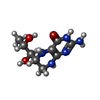
MacromoleculeName: 5,6,7,8-TETRAHYDROBIOPTERIN / type: ligand / ID: 3 / Number of copies: 2 / Formula: H4B
Molecular weightTheoretical: 241.247 Da
Chemical component information

ChemComp-H4B:
5,6,7,8-TETRAHYDROBIOPTERIN / neurotransmitter*YM

+
Macromolecule #4: PROTOPORPHYRIN IX CONTAINING FE
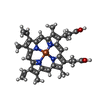
MacromoleculeName: PROTOPORPHYRIN IX CONTAINING FE / type: ligand / ID: 4 / Number of copies: 2 / Formula: HEM
Molecular weightTheoretical: 616.487 Da
Chemical component information

ChemComp-HEM:
PROTOPORPHYRIN IX CONTAINING FE

+
Macromolecule #5: ZINC ION

MacromoleculeName: ZINC ION / type: ligand / ID: 5 / Number of copies: 1 / Formula: ZN
Molecular weightTheoretical: 65.409 Da

+
Macromolecule #6: ARGININE

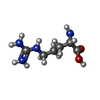
MacromoleculeName: ARGININE / type: ligand / ID: 6 / Number of copies: 2 / Formula: ARG
Molecular weightTheoretical: 175.209 Da
Chemical component information

ChemComp-ARG:
ARGININE

+
Macromolecule #7: FLAVIN MONONUCLEOTIDE
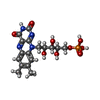
MacromoleculeName: FLAVIN MONONUCLEOTIDE / type: ligand / ID: 7 / Number of copies: 1 / Formula: FMN
Molecular weightTheoretical: 456.344 Da
Chemical component information

ChemComp-FMN:
FLAVIN MONONUCLEOTIDE

+
Macromolecule #8: FLAVIN-ADENINE DINUCLEOTIDE
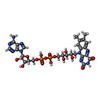
MacromoleculeName: FLAVIN-ADENINE DINUCLEOTIDE / type: ligand / ID: 8 / Number of copies: 1 / Formula: FAD
Molecular weightTheoretical: 785.55 Da
Chemical component information

ChemComp-FAD:
FLAVIN-ADENINE DINUCLEOTIDE / FAD*YM

+
Macromolecule #9: NADPH DIHYDRO-NICOTINAMIDE-ADENINE-DINUCLEOTIDE PHOSPHATE
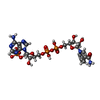
MacromoleculeName: NADPH DIHYDRO-NICOTINAMIDE-ADENINE-DINUCLEOTIDE PHOSPHATE
type: ligand / ID: 9 / Number of copies: 1 / Formula: NDP
Molecular weightTheoretical: 745.421 Da
Chemical component information

ChemComp-NDP:
NADPH DIHYDRO-NICOTINAMIDE-ADENINE-DINUCLEOTIDE PHOSPHATE

+
Macromolecule #10: CALCIUM ION

MacromoleculeName: CALCIUM ION / type: ligand / ID: 10 / Number of copies: 4 / Formula: CA
Molecular weightTheoretical: 40.078 Da

-
Experimental details

-
Structure determination

Methodcryo EM
Processingsingle particle reconstruction
Aggregation stateparticle

-
Sample preparation

BufferpH: 7.5
VitrificationCryogen name: ETHANE

-
Electron microscopy

MicroscopeTFS KRIOS
Image recordingFilm or detector model: GATAN K3 (6k x 4k) / Average electron dose: 50.0 e/Å2
Electron beamAcceleration voltage: 300 kV / Electron source: FIELD EMISSION GUN
Electron opticsIllumination mode: FLOOD BEAM / Imaging mode: BRIGHT FIELD / Nominal defocus max: 1.8 µm / Nominal defocus min: 1.5 µm
Experimental equipment
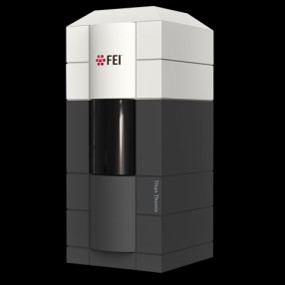
Model: Titan Krios / Image courtesy: FEI Company

+
Image processing

CTF correctionType: NONE
Startup modelType of model: OTHER
Final reconstructionResolution.type: BY AUTHOR / Resolution: 3.4 Å / Resolution method: FSC 0.143 CUT-OFF / Software - Name: cryoSPARC / Number images used: 36477
Initial angle assignmentType: MAXIMUM LIKELIHOOD
Final angle assignmentType: MAXIMUM LIKELIHOOD

+
About Yorodumi

-
News

-
Feb 9, 2022. New format data for meta-information of EMDB entries

New format data for meta-information of EMDB entries

  • Version 3 of the EMDB header file is now the official format.
  • The previous official version 1.9 will be removed from the archive.

Related info.:EMDB header

External links:wwPDB to switch to version 3 of the EMDB data model

-
Aug 12, 2020. Covid-19 info

Covid-19 info

URL: https://pdbj.org/emnavi/covid19.php

New page: Covid-19 featured information page in EM Navigator.

Related info.:Covid-19 info / Mar 5, 2020. Novel coronavirus structure data

+
Mar 5, 2020. Novel coronavirus structure data

Novel coronavirus structure data

Related info.:Yorodumi Speices / Aug 12, 2020. Covid-19 info

External links:COVID-19 featured content - PDBj / Molecule of the Month (242):Coronavirus Proteases

+
Jan 31, 2019. EMDB accession codes are about to change! (news from PDBe EMDB page)

EMDB accession codes are about to change! (news from PDBe EMDB page)

  • The allocation of 4 digits for EMDB accession codes will soon come to an end. Whilst these codes will remain in use, new EMDB accession codes will include an additional digit and will expand incrementally as the available range of codes is exhausted. The current 4-digit format prefixed with “EMD-” (i.e. EMD-XXXX) will advance to a 5-digit format (i.e. EMD-XXXXX), and so on. It is currently estimated that the 4-digit codes will be depleted around Spring 2019, at which point the 5-digit format will come into force.
  • The EM Navigator/Yorodumi systems omit the EMD- prefix.

Related info.:Q: What is EMD? / ID/Accession-code notation in Yorodumi/EM Navigator

External links:EMDB Accession Codes are Changing Soon! / Contact to PDBj

+
Jul 12, 2017. Major update of PDB

Major update of PDB

  • wwPDB released updated PDB data conforming to the new PDBx/mmCIF dictionary.
  • This is a major update changing the version number from 4 to 5, and with Remediation, in which all the entries are updated.
  • In this update, many items about electron microscopy experimental information are reorganized (e.g. em_software).
  • Now, EM Navigator and Yorodumi are based on the updated data.

External links:wwPDB Remediation / Enriched Model Files Conforming to OneDep Data Standards Now Available in the PDB FTP Archive

-
Yorodumi

Thousand views of thousand structures

  • Yorodumi is a browser for structure data from EMDB, PDB, SASBDB, etc.
  • This page is also the successor to EM Navigator detail page, and also detail information page/front-end page for Omokage search.
  • The word "yorodu" (or yorozu) is an old Japanese word meaning "ten thousand". "mi" (miru) is to see.

Related info.:EMDB / PDB / SASBDB / Comparison of 3 databanks / Yorodumi Search / Aug 31, 2016. New EM Navigator & Yorodumi / Yorodumi Papers / Jmol/JSmol / Function and homology information / Changes in new EM Navigator and Yorodumi

Read more