[English] 日本語
Yorodumi
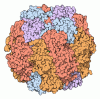
- EMDB-80105: Cryo-EM structure of native Rubisco from Nitrosospira multiformis -

+
Open data


ID or keywords:

Loading...

-
Basic information

Entry
Database: EMDB / ID: EMD-80105
TitleCryo-EM structure of native Rubisco from Nitrosospira multiformis
Map data
Sample
  • Complex: Ribulose bisphosphate carboxylase
    • Protein or peptide: Ribulose bisphosphate carboxylase large chain
    • Protein or peptide: Ribulose bisphosphate carboxylase small subunit
  • Ligand: ZINC ION
  • Ligand: water
Keywordsrubisco / carbon fixation / nitrifying bacterium / autotrophy / cryo-EM / LYASE
Function / homology
Function and homology information


ribulose-bisphosphate carboxylase / ribulose-bisphosphate carboxylase activity / reductive pentose-phosphate cycle / monooxygenase activity / magnesium ion binding
Similarity search - Function
Ribulose bisphosphate carboxylase, small subunit / Ribulose bisphosphate carboxylase small subunit, domain / Ribulose bisphosphate carboxylase, small subunit superfamily / Ribulose bisphosphate carboxylase, small chain / Ribulose bisphosphate carboxylase, small chain / Ribulose bisphosphate carboxylase large subunit, type I / Ribulose bisphosphate carboxylase, large chain, active site / Ribulose bisphosphate carboxylase large chain active site. / Ribulose bisphosphate carboxylase, large subunit, ferrodoxin-like N-terminal / Ribulose bisphosphate carboxylase large chain, N-terminal domain ...Ribulose bisphosphate carboxylase, small subunit / Ribulose bisphosphate carboxylase small subunit, domain / Ribulose bisphosphate carboxylase, small subunit superfamily / Ribulose bisphosphate carboxylase, small chain / Ribulose bisphosphate carboxylase, small chain / Ribulose bisphosphate carboxylase large subunit, type I / Ribulose bisphosphate carboxylase, large chain, active site / Ribulose bisphosphate carboxylase large chain active site. / Ribulose bisphosphate carboxylase, large subunit, ferrodoxin-like N-terminal / Ribulose bisphosphate carboxylase large chain, N-terminal domain / Ribulose bisphosphate carboxylase, large subunit, C-terminal / RuBisCO / Ribulose bisphosphate carboxylase, large subunit, C-terminal domain superfamily / RuBisCO large subunit, N-terminal domain superfamily / Ribulose bisphosphate carboxylase large chain, catalytic domain
Similarity search - Domain/homology
Ribulose bisphosphate carboxylase large chain / Ribulose bisphosphate carboxylase small subunit
Similarity search - Component
Biological speciesNitrosospira multiformis ATCC 25196 (bacteria)
Methodsingle particle reconstruction / cryo EM / Resolution: 2.26 Å
AuthorsTanaka Y / Nishigaya Y
Funding support1 items
OrganizationGrant numberCountry
Not funded
CitationJournal: Biochem Biophys Res Commun / Year: 2026
Title: Cryo-EM structure of RubisCO from Nitrosospira multiformis.
Authors: Yoshiki Tanaka / Yuki Nishigaya /
Abstract: Nitrosospira multiformis is a soil ammonia-oxidizing bacterium (AOB) that fixes CO via RubisCO using energy derived from ammonia oxidation. Despite its ecological and agricultural relevance, the ...Nitrosospira multiformis is a soil ammonia-oxidizing bacterium (AOB) that fixes CO via RubisCO using energy derived from ammonia oxidation. Despite its ecological and agricultural relevance, the structure of N. multiformis RubisCO (NmRubisCO) remained unknown. Here, we report the cryo-EM structure of NmRubisCO at 2.26 Å resolution, determined through single-particle analysis of protein copurified with the membrane fraction following cell lysis and ultracentrifugation without column chromatography. Analysis revealed an LS hexadecameric Form IC (red-like) RubisCO with a six-residue insertion in the βB-βC loop (BC loop) of the large-subunit N-terminal domain that forms a solvent-exposed, well-ordered protrusion. The active site lacks carbamylation at K206 and Mg binding, representing an inactive state. A putative metal ion coordinated by H296, H298, and H331, tentatively assigned as Zn based on coordination geometry and distances, was identified near the catalytic center; this His-coordinated metal site has not been described in other RubisCO structures. Loop 6 adopts a closed-like conformation in the absence of substrate, a configuration consistent with a potential requirement for activase-mediated remodeling. The C-terminal extension of the small subunit forms interdimer β-sheet interactions that stabilize the holoenzyme. These structural features provide a framework for understanding Form IC RubisCO in carboxysome-less soil AOB.
History
DepositionApr 3, 2026-
Header (metadata) releaseMay 27, 2026-
Map releaseMay 27, 2026-
UpdateMay 27, 2026-
Current statusMay 27, 2026Processing site: PDBj / Status: Released

-
Structure visualization

Supplemental images

Downloads & links

-
Map

FileDownload / File: emd_80105.map.gz / Format: CCP4 / Size: 15 MB / Type: IMAGE STORED AS FLOATING POINT NUMBER (4 BYTES)
Projections & slices

Image control

Size
Brightness
Contrast
Others
AxesZ (Sec.)Y (Row.)X (Col.)
0.88 Å/pix.
x 158 pix.
= 138.787 Å
0.88 Å/pix.
x 158 pix.
= 138.787 Å
0.88 Å/pix.
x 158 pix.
= 138.787 Å

Surface

Projections

Slices (1/3)

Slices (1/2)

Slices (2/3)

Images are generated by Spider.

Voxel sizeX=Y=Z: 0.8784 Å
Density
Contour LevelBy AUTHOR: 0.022
Minimum - Maximum-0.08580261 - 0.14313145
Average (Standard dev.)0.0016558919 (±0.014603507)
SymmetrySpace group: 1
Details

EMDB XML:

Map geometry
Axis orderXYZ
Origin000
Dimensions158158158
Spacing158158158
CellA=B=C: 138.7872 Å
α=β=γ: 90.0 °

-
Supplemental data

-
Mask #1

Fileemd_80105_msk_1.map
Projections & Slices
AxesZYX

Projections

Slices (1/2)
Density Histograms

-
Half map: #2

Fileemd_80105_half_map_1.map
Projections & Slices
AxesZYX

Projections

Slices (1/2)
Density Histograms

-
Half map: #1

Fileemd_80105_half_map_2.map
Projections & Slices
AxesZYX

Projections

Slices (1/2)
Density Histograms

-
Sample components

-
Entire : Ribulose bisphosphate carboxylase

EntireName: Ribulose bisphosphate carboxylase
Components
  • Complex: Ribulose bisphosphate carboxylase
    • Protein or peptide: Ribulose bisphosphate carboxylase large chain
    • Protein or peptide: Ribulose bisphosphate carboxylase small subunit
  • Ligand: ZINC ION
  • Ligand: water

-
Supramolecule #1: Ribulose bisphosphate carboxylase

SupramoleculeName: Ribulose bisphosphate carboxylase / type: complex / ID: 1 / Parent: 0 / Macromolecule list: #1-#2
Source (natural)Organism: Nitrosospira multiformis ATCC 25196 (bacteria)
Molecular weightTheoretical: 560 KDa

-
Macromolecule #1: Ribulose bisphosphate carboxylase large chain

MacromoleculeName: Ribulose bisphosphate carboxylase large chain / type: protein_or_peptide / ID: 1 / Number of copies: 8 / Enantiomer: LEVO / EC number: ribulose-bisphosphate carboxylase
Source (natural)Organism: Nitrosospira multiformis ATCC 25196 (bacteria)
Molecular weightTheoretical: 54.379926 KDa
SequenceString: MSEAITGAER YKSGVIPYKK MGYWEPDYVP KDTDIIAMFR ITPQAGVEPE EAAAAVAGES STATWTVVWT DRLTACELYR AKAFRTDPV PNTGEGTKTE QQYFAYIAYD LDLFEPGSIA NLTASIIGNV FGFKAVKALR LEDMRIPVAY LKTFQGPATG I IVERERLD ...String:
MSEAITGAER YKSGVIPYKK MGYWEPDYVP KDTDIIAMFR ITPQAGVEPE EAAAAVAGES STATWTVVWT DRLTACELYR AKAFRTDPV PNTGEGTKTE QQYFAYIAYD LDLFEPGSIA NLTASIIGNV FGFKAVKALR LEDMRIPVAY LKTFQGPATG I IVERERLD KFGRPLLGAT TKPKLGLSGR NYGRVVYEGL KGGLDFMKDD ENINSQPFMH WRDRFLYCME AVNKASAATG EV KGHYLNV TAGTMEEMYE RAEFAKSLGS VIIMIDLVIG YTAIQSMAKW ARKNDMILHL HRAGNSTYSR QKNHGMNFRV ICK WMRMAG VDHIHAGTVV GKLEGDPLMI KGFYDTLRDR HTPVSLEHGL FFEQDWASLN KVMPVASGGI HAGQMHQLLD YLGE DVILQ FGGGTIGHPQ GIQAGAVANR VALEAMIMAR NEGRDYVKEG PQILEEAAKW CTPLKLALDT WKDITFNYES TDTAD FVPS ETASV

UniProtKB: Ribulose bisphosphate carboxylase large chain

-
Macromolecule #2: Ribulose bisphosphate carboxylase small subunit

MacromoleculeName: Ribulose bisphosphate carboxylase small subunit / type: protein_or_peptide / ID: 2 / Number of copies: 8 / Enantiomer: LEVO
Source (natural)Organism: Nitrosospira multiformis ATCC 25196 (bacteria)
Molecular weightTheoretical: 16.805855 KDa
SequenceString:
MMTNFQNRLT QGQFSFLPPL TDKQISAQIK YALKNNWAIG IEYTDDPHPR NTYWEMFGNP MFDLKDPAGI LQEINDCRKT YPNHYIRVT AFDSSRGVES PAMSYIVNRP KNEPGFGLVR QEVDGRQIRY TVHSYATEKP EAERY

UniProtKB: Ribulose bisphosphate carboxylase small subunit

-
Macromolecule #3: ZINC ION

MacromoleculeName: ZINC ION / type: ligand / ID: 3 / Number of copies: 8 / Formula: ZN
Molecular weightTheoretical: 65.409 Da

-
Macromolecule #4: water

MacromoleculeName: water / type: ligand / ID: 4 / Number of copies: 433 / Formula: HOH
Molecular weightTheoretical: 18.015 Da
Chemical component information

ChemComp-HOH:
WATER

-
Experimental details

-
Structure determination

Methodcryo EM
Processingsingle particle reconstruction
Aggregation stateparticle

-
Sample preparation

Concentration3 mg/mL
BufferpH: 7.5
Component:
ConcentrationFormulaName
250.0 mMNaClsodium chloride
25.0 mMC8H18N2O6S2PIPES
GridModel: Quantifoil R1.2/1.3 / Material: COPPER / Mesh: 300 / Support film - Material: CARBON / Support film - topology: HOLEY / Support film - Film thickness: 0.2 / Pretreatment - Type: GLOW DISCHARGE / Pretreatment - Time: 90 sec. / Pretreatment - Atmosphere: AIR / Pretreatment - Pressure: 0.05 kPa
VitrificationCryogen name: ETHANE / Chamber humidity: 100 % / Chamber temperature: 277 K / Instrument: FEI VITROBOT MARK IV
DetailsTotal protein concentration of the membrane suspension

-
Electron microscopy

MicroscopeJEOL CRYO ARM 300
Specialist opticsPhase plate: VOLTA PHASE PLATE / Energy filter - Name: In-column Omega Filter
Image recordingFilm or detector model: GATAN K3 BIOQUANTUM (6k x 4k) / Number real images: 10080 / Average exposure time: 1.5 sec. / Average electron dose: 50.0 e/Å2
Electron beamAcceleration voltage: 300 kV / Electron source: FIELD EMISSION GUN
Electron opticsC2 aperture diameter: 70.0 µm / Calibrated defocus max: 2.5 µm / Calibrated defocus min: 0.5 µm / Illumination mode: FLOOD BEAM / Imaging mode: BRIGHT FIELD / Cs: 2.7 mm / Nominal defocus max: 1.8 µm / Nominal defocus min: 0.6 µm / Nominal magnification: 57000
Sample stageSpecimen holder model: JEOL / Cooling holder cryogen: NITROGEN

+
Image processing

Particle selectionNumber selected: 1577431
Details: Perform 2D sorting on the particles collected via LoG picking, train Topaz on the useful ones, and then perform Topaz picking
CTF correctionSoftware - Name: CTFFIND (ver. 4.1.14) / Type: PHASE FLIPPING AND AMPLITUDE CORRECTION
Startup modelType of model: INSILICO MODEL
In silico model: Initial model was generated by RELION ab initio reconstruction using stochastic gradient descent (SGD) algorithm, without any external reference.
Final reconstructionNumber classes used: 2 / Applied symmetry - Point group: D4 (2x4 fold dihedral) / Algorithm: BACK PROJECTION / Resolution.type: BY AUTHOR / Resolution: 2.26 Å / Resolution method: FSC 0.143 CUT-OFF / Software - Name: RELION (ver. 5.0.1) / Number images used: 64288
Initial angle assignmentType: MAXIMUM LIKELIHOOD / Software - Name: RELION (ver. 5.0.1)
Final angle assignmentType: MAXIMUM LIKELIHOOD / Software - Name: RELION (ver. 5.0.1)
Final 3D classificationNumber classes: 3 / Software - Name: RELION (ver. 5.0.1)
FSC plot (resolution estimation)

-
Atomic model buiding 1

Initial modelPDB ID:

Chain - Source name: PDB / Chain - Initial model type: experimental model
RefinementSpace: REAL / Protocol: RIGID BODY FIT
Output model

PDB-25hn:
Cryo-EM structure of native Rubisco from Nitrosospira multiformis

+
About Yorodumi

-
News

-
Feb 9, 2022. New format data for meta-information of EMDB entries

New format data for meta-information of EMDB entries

  • Version 3 of the EMDB header file is now the official format.
  • The previous official version 1.9 will be removed from the archive.

Related info.:EMDB header

External links:wwPDB to switch to version 3 of the EMDB data model

-
Aug 12, 2020. Covid-19 info

Covid-19 info

URL: https://pdbj.org/emnavi/covid19.php

New page: Covid-19 featured information page in EM Navigator.

Related info.:Covid-19 info / Mar 5, 2020. Novel coronavirus structure data

+
Mar 5, 2020. Novel coronavirus structure data

Novel coronavirus structure data

Related info.:Yorodumi Speices / Aug 12, 2020. Covid-19 info

External links:COVID-19 featured content - PDBj / Molecule of the Month (242):Coronavirus Proteases

+
Jan 31, 2019. EMDB accession codes are about to change! (news from PDBe EMDB page)

EMDB accession codes are about to change! (news from PDBe EMDB page)

  • The allocation of 4 digits for EMDB accession codes will soon come to an end. Whilst these codes will remain in use, new EMDB accession codes will include an additional digit and will expand incrementally as the available range of codes is exhausted. The current 4-digit format prefixed with “EMD-” (i.e. EMD-XXXX) will advance to a 5-digit format (i.e. EMD-XXXXX), and so on. It is currently estimated that the 4-digit codes will be depleted around Spring 2019, at which point the 5-digit format will come into force.
  • The EM Navigator/Yorodumi systems omit the EMD- prefix.

Related info.:Q: What is EMD? / ID/Accession-code notation in Yorodumi/EM Navigator

External links:EMDB Accession Codes are Changing Soon! / Contact to PDBj

+
Jul 12, 2017. Major update of PDB

Major update of PDB

  • wwPDB released updated PDB data conforming to the new PDBx/mmCIF dictionary.
  • This is a major update changing the version number from 4 to 5, and with Remediation, in which all the entries are updated.
  • In this update, many items about electron microscopy experimental information are reorganized (e.g. em_software).
  • Now, EM Navigator and Yorodumi are based on the updated data.

External links:wwPDB Remediation / Enriched Model Files Conforming to OneDep Data Standards Now Available in the PDB FTP Archive

-
Yorodumi

Thousand views of thousand structures

  • Yorodumi is a browser for structure data from EMDB, PDB, SASBDB, etc.
  • This page is also the successor to EM Navigator detail page, and also detail information page/front-end page for Omokage search.
  • The word "yorodu" (or yorozu) is an old Japanese word meaning "ten thousand". "mi" (miru) is to see.

Related info.:EMDB / PDB / SASBDB / Comparison of 3 databanks / Yorodumi Search / Aug 31, 2016. New EM Navigator & Yorodumi / Yorodumi Papers / Jmol/JSmol / Function and homology information / Changes in new EM Navigator and Yorodumi

Read more