National Institutes of Health/National Institute of General Medical Sciences (NIH/NIGMS)
United States
National Science Foundation (NSF, United States)
United States
Citation
Journal: bioRxiv / Year: 2026 Title: EZH2 Serine 21 Phosphorylation Restrains Compact-State PRC2 Activation and H3K27me3 Propagation. Authors: Andrew Q Rashoff / Mark Matyas / Elizabeth G Porter / Ryen Hazzard / Benjamin A Garcia / Vignesh Kasinath / Peter W Lewis Abstract: Polycomb Repressive Complex 2 (PRC2) propagates H3K27me3 through EED-dependent allosteric activation, yet how cells modulate the magnitude of this positive-feedback response remains poorly understood. ...Polycomb Repressive Complex 2 (PRC2) propagates H3K27me3 through EED-dependent allosteric activation, yet how cells modulate the magnitude of this positive-feedback response remains poorly understood. Here, we identify phosphorylation of EZH2 serine 21 as a post-translational mechanism that attenuates PRC2 allosteric responsiveness. Prior structural studies have established that activator-bound PRC2 adopts both compact and extended active conformations. Using cryo-EM classification of wild-type and phospho-null EZH2 S21A PRC2 complexes, we find that the phospho-null EZH2 S21A substitution changes the distribution of particles across these pre-existing states, shifting PRC2 from a predominantly extended conformation to one enriched for the compact, allosterically activated conformation. Consistent with this structural transition, EZH2 S21A increases basal PRC2 activity, lowers the EC for H3K27me3-dependent stimulation, and accelerates H3K27me3 accumulation on peptide and nucleosome substrates. Disruption of the EED-EZH2 interface suppresses the S21A gain-of-activity phenotype, indicating that S21 phosphorylation constrains PRC2 by limiting productive EED-EZH2 allosteric coupling. In mesenchymal progenitor cells, loss of this phosphorylation-dependent restraint broadens H3K27me3 domains, reduces canonical PRC1 enrichment at high-occupancy Polycomb target loci, misregulates lineage-associated transcriptional programs, and impairs differentiation. These findings identify EZH2 S21 phosphorylation as a molecular rheostat that limits compact-state PRC2 activation, constrains H3K27me3 spreading, and preserves Polycomb-dependent developmental competence.
In the structure databanks used in Yorodumi, some data are registered as the other names, "COVID-19 virus" and "2019-nCoV". Here are the details of the virus and the list of structure data.
Jan 31, 2019. EMDB accession codes are about to change! (news from PDBe EMDB page)
EMDB accession codes are about to change! (news from PDBe EMDB page)
The allocation of 4 digits for EMDB accession codes will soon come to an end. Whilst these codes will remain in use, new EMDB accession codes will include an additional digit and will expand incrementally as the available range of codes is exhausted. The current 4-digit format prefixed with “EMD-” (i.e. EMD-XXXX) will advance to a 5-digit format (i.e. EMD-XXXXX), and so on. It is currently estimated that the 4-digit codes will be depleted around Spring 2019, at which point the 5-digit format will come into force.
The EM Navigator/Yorodumi systems omit the EMD- prefix.
Related info.:Q: What is EMD? / ID/Accession-code notation in Yorodumi/EM Navigator
Yorodumi is a browser for structure data from EMDB, PDB, SASBDB, etc.
This page is also the successor to EM Navigator detail page, and also detail information page/front-end page for Omokage search.
The word "yorodu" (or yorozu) is an old Japanese word meaning "ten thousand". "mi" (miru) is to see.
Related info.:EMDB / PDB / SASBDB / Comparison of 3 databanks / Yorodumi Search / Aug 31, 2016. New EM Navigator & Yorodumi / Yorodumi Papers / Jmol/JSmol / Function and homology information / Changes in new EM Navigator and Yorodumi
 Movie
Movie Controller


 Open data
 Basic information
 Map data
 Sample
 Keywords
 Homo sapiens (human)
 Authors
 United States, 2 items
  Citation
 Structure visualization
 Downloads & links
 EMDB map data format
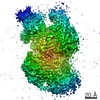
 emd_76902.png
 https://data.pdbj.org/pub/emdb/structures/EMD-76902


 Z (Sec.)
 Y (Row.)
 X (Col.)


 Sample components
 Processing
 Electron microscopy
 FIELD EMISSION GUN