Journal: IUCrJ / Year: 2026 Title: Evaluating the Volta phase plate for improved tomogram alignment in cryo-electron tomography. Authors: Joshua Hutchings / Daniel Ji / Shawn Zheng / Elizabeth A Montabana / Utz H Ermel / Ariana Peck / Jonathan Schwartz / Rahel Woldeyes / Mohammadreza Paraan / Mallak Ali / Norbert S Hill / ...Authors: Joshua Hutchings / Daniel Ji / Shawn Zheng / Elizabeth A Montabana / Utz H Ermel / Ariana Peck / Jonathan Schwartz / Rahel Woldeyes / Mohammadreza Paraan / Mallak Ali / Norbert S Hill / Hannah Siems / Daniel Serwas / Anchi Cheng / Dari Kimanius / David A Agard / Clinton S Potter / Bridget Carragher / Yue Yu / Abstract: The Volta phase plate (VPP) can enhance low-frequency phase contrast in cryo-electron microscopy (cryo-EM) and cryo-electron tomography (cryo-ET), but its impact on tomogram alignment has not been ...The Volta phase plate (VPP) can enhance low-frequency phase contrast in cryo-electron microscopy (cryo-EM) and cryo-electron tomography (cryo-ET), but its impact on tomogram alignment has not been systematically assessed. Using sub-2 Å single-particle analysis (SPA) and analytical contrast transfer function (CTF) modeling, we show that despite high-frequency information loss and moderate signal damping, the VPP enhances signal in low-frequency bands that are crucial for tilt-series alignment. We show that VPP tomograms exhibit increased contrast and remain higher in contrast post denoising, for thick and crowded specimens. Quantitative comparison of tomograms acquired with and without the VPP shows improved tilt-axis orientation measurements and a higher fraction of tomograms amenable to local tilt-series alignment. Although acquisition with the VPP yields lower subtomogram averaging (STA) resolution, these results show that the primary benefits of the VPP for cryo-ET are contrast enhancement and improved tilt-series alignment robustness, which are crucial for studying cellular ultrastructure and protein organization in crowded environments, where STA at moderate resolutions remains valuable.
In the structure databanks used in Yorodumi, some data are registered as the other names, "COVID-19 virus" and "2019-nCoV". Here are the details of the virus and the list of structure data.
Jan 31, 2019. EMDB accession codes are about to change! (news from PDBe EMDB page)
EMDB accession codes are about to change! (news from PDBe EMDB page)
The allocation of 4 digits for EMDB accession codes will soon come to an end. Whilst these codes will remain in use, new EMDB accession codes will include an additional digit and will expand incrementally as the available range of codes is exhausted. The current 4-digit format prefixed with “EMD-” (i.e. EMD-XXXX) will advance to a 5-digit format (i.e. EMD-XXXXX), and so on. It is currently estimated that the 4-digit codes will be depleted around Spring 2019, at which point the 5-digit format will come into force.
The EM Navigator/Yorodumi systems omit the EMD- prefix.
Related info.:Q: What is EMD? / ID/Accession-code notation in Yorodumi/EM Navigator
Yorodumi is a browser for structure data from EMDB, PDB, SASBDB, etc.
This page is also the successor to EM Navigator detail page, and also detail information page/front-end page for Omokage search.
The word "yorodu" (or yorozu) is an old Japanese word meaning "ten thousand". "mi" (miru) is to see.
Related info.:EMDB / PDB / SASBDB / Comparison of 3 databanks / Yorodumi Search / Aug 31, 2016. New EM Navigator & Yorodumi / Yorodumi Papers / Jmol/JSmol / Function and homology information / Changes in new EM Navigator and Yorodumi
 Movie
Movie Controller

 Yorodumi
 Open data
 Basic information
 Map data
 Sample
 Keywords
 Mycoplasma mycoides (bacteria)
 Authors
 United States, 1 items
  Citation
 Structure visualization
 Downloads & links
 EMDB map data format
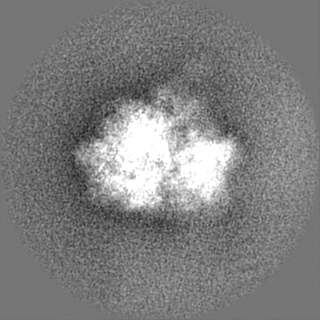
 emd_75899.png
 https://data.pdbj.org/pub/emdb/structures/EMD-75899


 Z (Sec.)
 Y (Row.)
 X (Col.)




 Sample components
 Processing
 Electron microscopy
 FIELD EMISSION GUN

