National Institutes of Health/National Institute Of Allergy and Infectious Diseases (NIH/NIAID)
R56AI150474-06A1
United States
National Institutes of Health/National Institute Of Allergy and Infectious Diseases (NIH/NIAID)
NIH R01AI186663
United States
Citation
Journal: bioRxiv / Year: 2025 Title: Cryo-ET Reveals Distinct Gag Lattice Architectures in Virus-like Particles and Immature HIV-1. Authors: Benjamin Preece / Wiley Peppel / Haley Durden / Rodrigo Gallegos / Gabriel Clinger / Nicole Bohn / Antje Huwendiek-Poser / Gillian Ysassi / Allyson Roman / Giovanna Garcia / Tasheena Cly / ...Authors: Benjamin Preece / Wiley Peppel / Haley Durden / Rodrigo Gallegos / Gabriel Clinger / Nicole Bohn / Antje Huwendiek-Poser / Gillian Ysassi / Allyson Roman / Giovanna Garcia / Tasheena Cly / David Belnap / Saveez Saffarian Abstract: HIV-1 is released from infected cells as immature virions whose membranes are supported by a Gag lattice. During maturation, this lattice is cleaved by the viral protease to release capsid proteins ...HIV-1 is released from infected cells as immature virions whose membranes are supported by a Gag lattice. During maturation, this lattice is cleaved by the viral protease to release capsid proteins that assemble into the mature core. The architecture of the Gag lattice is central to this process, and the Gag lattice is targeted by maturation inhibitors that block cleavage. Using cryo-electron tomography, we compared Gag-only virus-like particles (VLPs) with immature HIV-1 virions and found that VLPs assemble denser and more complete lattices, exhibiting a strong correlation between lattice curvature and Gag copy number. In contrast, immature virions incorporate fewer Gag molecules and display weaker coupling between curvature and Gag stoichiometry. These findings show that while Gag alone can form the canonical immature lattice, additional viral components fine-tune lattice organization and curvature, potentially regulating protease accessibility, virion release, and the onset of HIV-1 maturation.
Applied symmetry - Point group: C6 (6 fold cyclic) / Resolution.type: BY AUTHOR / Resolution: 6.3 Å / Resolution method: FSC 0.143 CUT-OFF / Software - Name: Dynamo (ver. 1.1.532) / Number subtomograms used: 29860
Extraction
Number tomograms: 12 / Number images used: 15400 / Software - Name: Dynamo (ver. 1.1.532)
CTF correction
Software - Name: IMOD (ver. 4) Software - details: Used for CTF Correction and tomographic reconstruction Type: PHASE FLIPPING AND AMPLITUDE CORRECTION
Final angle assignment
Type: OTHER
FSC plot (resolution estimation)
+
About Yorodumi
-
News
-
Feb 9, 2022. New format data for meta-information of EMDB entries
New format data for meta-information of EMDB entries
Version 3 of the EMDB header file is now the official format.
The previous official version 1.9 will be removed from the archive.
In the structure databanks used in Yorodumi, some data are registered as the other names, "COVID-19 virus" and "2019-nCoV". Here are the details of the virus and the list of structure data.
Jan 31, 2019. EMDB accession codes are about to change! (news from PDBe EMDB page)
EMDB accession codes are about to change! (news from PDBe EMDB page)
The allocation of 4 digits for EMDB accession codes will soon come to an end. Whilst these codes will remain in use, new EMDB accession codes will include an additional digit and will expand incrementally as the available range of codes is exhausted. The current 4-digit format prefixed with “EMD-” (i.e. EMD-XXXX) will advance to a 5-digit format (i.e. EMD-XXXXX), and so on. It is currently estimated that the 4-digit codes will be depleted around Spring 2019, at which point the 5-digit format will come into force.
The EM Navigator/Yorodumi systems omit the EMD- prefix.
Related info.:Q: What is EMD? / ID/Accession-code notation in Yorodumi/EM Navigator
Yorodumi is a browser for structure data from EMDB, PDB, SASBDB, etc.
This page is also the successor to EM Navigator detail page, and also detail information page/front-end page for Omokage search.
The word "yorodu" (or yorozu) is an old Japanese word meaning "ten thousand". "mi" (miru) is to see.
Related info.:EMDB / PDB / SASBDB / Comparison of 3 databanks / Yorodumi Search / Aug 31, 2016. New EM Navigator & Yorodumi / Yorodumi Papers / Jmol/JSmol / Function and homology information / Changes in new EM Navigator and Yorodumi
 Movie
Movie Controller


 Open data
 Basic information
 Map data
 Sample
 Keywords
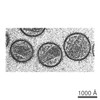 Human immunodeficiency virus 1
 Authors
 United States, 2 items
  Citation
 Structure visualization
 Downloads & links
 EMDB map data format
 emd_75662.png
 https://data.pdbj.org/pub/emdb/structures/EMD-75662
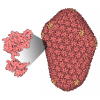
 Z (Sec.)
 Y (Row.)
 X (Col.)


 Sample components
 Processing
 Electron microscopy
 FIELD EMISSION GUN

