columnar/cuboidal epithelial cell development / regulation of phosphate transport / Regulation of commissural axon pathfinding by SLIT and ROBO / regulation of TOR signaling / commissural neuron axon guidance / fertilization / regulation of ERK1 and ERK2 cascade / transmembrane receptor protein tyrosine kinase activity / cell surface receptor protein tyrosine kinase signaling pathway / protein kinase C binding ...columnar/cuboidal epithelial cell development / regulation of phosphate transport / Regulation of commissural axon pathfinding by SLIT and ROBO / regulation of TOR signaling / commissural neuron axon guidance / fertilization / regulation of ERK1 and ERK2 cascade / transmembrane receptor protein tyrosine kinase activity / cell surface receptor protein tyrosine kinase signaling pathway / protein kinase C binding / regulation of cell growth / neuron cellular homeostasis / receptor protein-tyrosine kinase / heparin binding / protein tyrosine kinase activity / protein phosphatase binding / spermatogenesis / gene expression / protein phosphorylation / cell differentiation / signaling receptor complex / negative regulation of gene expression / calcium ion binding / perinuclear region of cytoplasm / cell surface / signal transduction / : / extracellular region / ATP binding / identical protein binding / plasma membrane / cytoplasm 類似検索 - 分子機能
: / EGF domain / EGF domain / : / Thrombospondin N-terminal -like domains. / Laminin G domain / von Willebrand factor (vWF) type C domain / von Willebrand factor type C domain / VWFC domain signature. / VWFC domain profile. ...: / EGF domain / EGF domain / : / Thrombospondin N-terminal -like domains. / Laminin G domain / von Willebrand factor (vWF) type C domain / von Willebrand factor type C domain / VWFC domain signature. / VWFC domain profile. / Laminin G domain / Laminin G domain / von Willebrand factor (vWF) type C domain / VWFC domain / LDLR class B repeat / Low-density lipoprotein-receptor YWTD domain / : / Calcium-binding EGF domain / Six-bladed beta-propeller, TolB-like / EGF-type aspartate/asparagine hydroxylation site / EGF-like calcium-binding, conserved site / Calcium-binding EGF-like domain signature. / Aspartic acid and asparagine hydroxylation site. / EGF-like calcium-binding domain / Calcium-binding EGF-like domain / Epidermal growth factor-like domain. / Fibronectin type III domain / EGF-like domain profile. / Growth factor receptor cysteine-rich domain superfamily / EGF-like domain signature 1. / EGF-like domain signature 2. / : / EGF-like domain / Fibronectin type 3 domain / Fibronectin type-III domain profile. / Fibronectin type III / Fibronectin type III superfamily / Tyrosine-protein kinase, catalytic domain / Tyrosine kinase, catalytic domain / Tyrosine protein kinases specific active-site signature. / Tyrosine-protein kinase, active site / Concanavalin A-like lectin/glucanase domain superfamily / Protein tyrosine and serine/threonine kinase / Serine-threonine/tyrosine-protein kinase, catalytic domain / Protein kinase, ATP binding site / Protein kinases ATP-binding region signature. / Immunoglobulin-like fold / Protein kinase domain profile. / Protein kinase domain / Protein kinase-like domain superfamily 類似検索 - ドメイン・相同性
Proto-oncogene tyrosine-protein kinase ROS / Protein kinase C-binding protein NELL2 類似検索 - 構成要素
National Institutes of Health/National Cancer Institute (NIH/NCI)
米国
引用
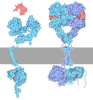
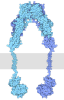
ジャーナル: Nat Commun / 年: 2026 タイトル: Clustering and a conformational switch drive activation of the mammalian receptor tyrosine kinase ROS1. 著者: Hengyi Li / Jianan Zhang / Tongqing Li / Yueyue Wang / Claudio R Alarcón / Daryl E Klein / 要旨: Receptor tyrosine kinases (RTKs) are key regulators of cellular signaling and are often co-opted in cancer. ROS1 is an orphan RTK aberrantly expressed in multiple tumors, yet no approved biologic ...Receptor tyrosine kinases (RTKs) are key regulators of cellular signaling and are often co-opted in cancer. ROS1 is an orphan RTK aberrantly expressed in multiple tumors, yet no approved biologic therapies target it, and its activation mechanism remains unknown. Here, we present Cryo-EM structures of mammalian ROS1 in ligand-free and NELL2-bound states, revealing how trimeric NELL2 induces both receptor clustering and a conformational switch that relieves receptor autoinhibition - both mechanisms are required for ROS1 activation. These structures, along with biochemical characterization, reflect a striking evolutionary divergence in regulatory logic compared to the invertebrate ortholog Sevenless (dROS1), highlighting how conserved RTKs can adopt fundamentally different activation strategies. Guided by these structural insights, we develop monoclonal antibodies that either block ligand binding or trap ROS1 in an inactive conformation. These agents potently suppress ROS1 signaling, representing distinct mechanistic classes of biologics that directly target ROS1 activity. Our findings elucidate a distinct mode of RTK regulation and establish a therapeutic framework for cancers driven by ROS1.
 ムービー
ムービー コントローラー


 データを開く
 基本情報
基本情報
 マップデータ
 試料
試料 キーワード
キーワード 機能・相同性情報
 Mus musculus (ハツカネズミ)
 データ登録者
 米国, 1件
  引用
引用 構造の表示
構造の表示
 ダウンロードとリンク
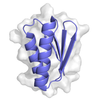
 emd_75142.png
 http://ftp.pdbj.org/pub/emdb/structures/EMD-75142



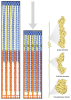
 Z (Sec.)
 Y (Row.)
 X (Col.)


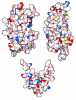
 試料の構成要素
 解析
解析 電子顕微鏡法
 FIELD EMISSION GUN

