 Movie
Movie Controller

[English] 日本語
 Yorodumi
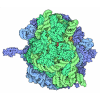
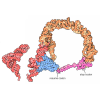
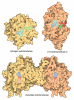
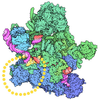
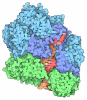
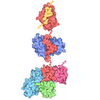
- EMDB-75038: Cryo-EM structure of CRBN-DDB1 in complex with HBS1L and TNG961 -
+ Open data

- Basic information
| Entry |  | |||||||||
|---|---|---|---|---|---|---|---|---|---|---|
| Title | Cryo-EM structure of CRBN-DDB1 in complex with HBS1L and TNG961 | |||||||||
 Map data Map data | final postprocess map | |||||||||
 Sample Sample |
| |||||||||
 Keywords Keywords | FOCAD / ribosome / PELO / ubiquitin / CYTOSOLIC PROTEIN | |||||||||
| Function / homology |  Function and homology information Function and homology informationDom34-Hbs1 complex / nuclear-transcribed mRNA catabolic process, no-go decay / mRNA decay by 3' to 5' exoribonuclease / negative regulation of monoatomic ion transmembrane transport / positive regulation by virus of viral protein levels in host cell / ribosome disassembly / spindle assembly involved in female meiosis / epigenetic programming in the zygotic pronuclei / UV-damage excision repair / biological process involved in interaction with symbiont ...Dom34-Hbs1 complex / nuclear-transcribed mRNA catabolic process, no-go decay / mRNA decay by 3' to 5' exoribonuclease / negative regulation of monoatomic ion transmembrane transport / positive regulation by virus of viral protein levels in host cell / ribosome disassembly / spindle assembly involved in female meiosis / epigenetic programming in the zygotic pronuclei / UV-damage excision repair / biological process involved in interaction with symbiont / regulation of mitotic cytokinesis / regulation of mitotic cell cycle phase transition / regulation of miRNA-mediated gene silencing / regulation of natural killer cell activation / WD40-repeat domain binding / regulation of cell cycle phase transition / locomotory exploration behavior / Cul4-RING E3 ubiquitin ligase complex / regulation of stem cell population maintenance / Cul4A-RING E3 ubiquitin ligase complex / Cul4B-RING E3 ubiquitin ligase complex / ubiquitin ligase complex scaffold activity / negative regulation of adipose tissue development / regulation of cellular response to stress / PELO:HBS1L and ABCE1 dissociate a ribosome on a non-stop mRNA / limb development / viral release from host cell / cullin family protein binding / positive regulation of Wnt signaling pathway / negative regulation of protein-containing complex assembly / regulation of DNA-templated DNA replication initiation / positive regulation of viral genome replication / positive regulation of gluconeogenesis / regulation of embryonic development / replication fork processing / rhythmic process / rescue of stalled cytosolic ribosome / proteasomal protein catabolic process / epigenetic regulation of gene expression / positive regulation of protein-containing complex assembly / nucleotide-excision repair / regulation of autophagy / Recognition of DNA damage by PCNA-containing replication complex / regulation of circadian rhythm / DNA Damage Recognition in GG-NER / cell population proliferation / Dual Incision in GG-NER / Transcription-Coupled Nucleotide Excision Repair (TC-NER) / Formation of TC-NER Pre-Incision Complex / Formation of Incision Complex in GG-NER / cellular response to UV / Dual incision in TC-NER / positive regulation of protein catabolic process / cytosolic ribosome / Gap-filling DNA repair synthesis and ligation in TC-NER / regulation of cell population proliferation / site of double-strand break / Neddylation / spermatogenesis / ubiquitin-dependent protein catabolic process / Potential therapeutics for SARS / damaged DNA binding / proteasome-mediated ubiquitin-dependent protein catabolic process / Hydrolases; Acting on acid anhydrides; Acting on GTP to facilitate cellular and subcellular movement / regulation of apoptotic process / transmembrane transporter binding / chromosome, telomeric region / protein-macromolecule adaptor activity / protein ubiquitination / translation / DNA repair / GTPase activity / DNA damage response / nucleolus / GTP binding / protein-containing complex binding / perinuclear region of cytoplasm / signal transduction / : / protein-containing complex / DNA binding / extracellular exosome / nucleoplasm / metal ion binding / membrane / nucleus / cytosol / cytoplasm Similarity search - Function | |||||||||
| Biological species |  Homo sapiens (human) Homo sapiens (human) | |||||||||
| Method | single particle reconstruction / cryo EM / Resolution: 2.9 Å | |||||||||
 Authors Authors | Whittington DA | |||||||||
| Funding support | 1 items
| |||||||||
 Citation Citation | Journal: Cancer Discov / Year: 2026 Title: TNG961 Is a Selective Oral HBS1L Molecular Glue Degrader for the Treatment of FOCAD-Deleted Cancers. Authors: Hilary E Nicholson / Douglas A Whittington / Frank J Bruzzese / Katherine Lazarides / Lauren Catherine M Martires / Matthew R Tonini / Helena N Jenkins / Minjie Zhang / Preksha Shahagadkar / ...Authors: Hilary E Nicholson / Douglas A Whittington / Frank J Bruzzese / Katherine Lazarides / Lauren Catherine M Martires / Matthew R Tonini / Helena N Jenkins / Minjie Zhang / Preksha Shahagadkar / Charlotte B Pratt / Kimberly J Briggs / Patrick McCarren / Alice W Tsai / Madhavi Bandi / Chengyin Min / Alan Huang / Hongxiang Zhang / Samuel R Meier / Binzhang Shen / Yi Yu / Colin Liang / Yong Liu / Teng Teng / John Zhang / Adam Crystal / William D Mallender / Xinyuan Edward Wu / John P Maxwell / Jannik N Andersen /  Abstract: When tumor suppressor genes are lost through chromosomal deletion, the deletion of adjacent genes can generate therapeutic vulnerabilities. MTAP is frequently co-deleted with the chr9p21 tumor ...When tumor suppressor genes are lost through chromosomal deletion, the deletion of adjacent genes can generate therapeutic vulnerabilities. MTAP is frequently co-deleted with the chr9p21 tumor suppressor gene CDKN2A, creating a synthetic lethal dependency on protein arginine methyltransferase 5 (PRMT5). Telomeric to MTAP lies focadhesin (FOCAD), whose loss induces dependency on the HBS1-like translational GTPase (HBS1L)-protein pelota homolog (PELO) ribosome rescue complex for translational maintenance. FOCAD is deleted in ∼1 out of 3 MTAP-deleted cancers. We screened an immunomodulatory imide drug (IMiD)-focused diversity library and identified a weak hit that bound cereblon (CRBN), promoted HBS1L-CRBN-compound complex formation, and induced E3-ligase-dependent HBS1L ubiquitination and degradation. Guided by cryo-EM structures and proteome selectivity, we developed TNG961, a potent, selective HBS1L degrader that disrupts the HBS1L-PELO complex, inducing translational arrest, unfolded protein response activation, and growth inhibition in FOCAD-negative models. Oral administration of TNG961 regresses FOCAD-negative xenografts, including PRMT5 inhibitor-refractory models, establishing HBS1L degradation as a strategy to exploit FOCAD loss and supporting the clinical evaluation of TNG961 as a first-in-class precision oncology therapeutic. SIGNIFICANCE: FOCAD deletion, frequently co-occurring with MTAP/CDKN2A loss, creates a synthetic lethal dependency on the HBS1L-PELO ribosome rescue complex. TNG961, a first-in-class molecular glue ...SIGNIFICANCE: FOCAD deletion, frequently co-occurring with MTAP/CDKN2A loss, creates a synthetic lethal dependency on the HBS1L-PELO ribosome rescue complex. TNG961, a first-in-class molecular glue degrader of HBS1L, enforces translational arrest and drives tumor regressions in FOCAD-negative models, including PRMT5 inhibitor-refractory tumors, establishing a novel precision oncology strategy for chromosome 9p21 co-deletion contexts. | |||||||||
| History |
|
- Structure visualization
| Supplemental images |
|---|

- Downloads & links
-EMDB archive
| Map data | emd_75038.map.gz | 166.4 MB | EMDB map data format | |
|---|---|---|---|---|
| Header (meta data) | emd-75038-v30.xmlemd-75038.xml | 28.5 KB 28.5 KB | Display Display | EMDB header |
| Images |  emd_75038.png emd_75038.png | 133.7 KB | ||
| Masks | emd_75038_msk_1.map | 178 MB | Mask map | |
| Filedesc metadata | emd-75038.cif.gz | 8.5 KB | ||
| Others | emd_75038_half_map_1.map.gzemd_75038_half_map_2.map.gz | 139.5 MB 139.5 MB | ||
| Archive directory |  https://data.pdbj.org/pub/emdb/structures/EMD-75038ftp://data.pdbj.org/pub/emdb/structures/EMD-75038 https://data.pdbj.org/pub/emdb/structures/EMD-75038ftp://data.pdbj.org/pub/emdb/structures/EMD-75038 | HTTPS FTP |
-Related structure data
| Related structure data |  10ayMC  11mrC M: atomic model generated by this map C: citing same article ( |
|---|---|
| Similar structure data |

-Links
| EMDB pages | EMDB (EBI/PDBe) / EMDataResource |
|---|---|
| Related items in Molecule of the Month |

-Map
| File | Download / File: emd_75038.map.gz / Format: CCP4 / Size: 178 MB / Type: IMAGE STORED AS FLOATING POINT NUMBER (4 BYTES) | ||||||||||||||||||||||||||||||||||||
|---|---|---|---|---|---|---|---|---|---|---|---|---|---|---|---|---|---|---|---|---|---|---|---|---|---|---|---|---|---|---|---|---|---|---|---|---|---|
| Annotation | final postprocess map | ||||||||||||||||||||||||||||||||||||
| Projections & slices | Image control
Images are generated by Spider. | ||||||||||||||||||||||||||||||||||||
| Voxel size | X=Y=Z: 0.932 Å | ||||||||||||||||||||||||||||||||||||
| Density |
| ||||||||||||||||||||||||||||||||||||
| Symmetry | Space group: 1 | ||||||||||||||||||||||||||||||||||||
| Details | EMDB XML:
|
 Z (Sec.)
 Y (Row.)
 X (Col.)


-Supplemental data
-Mask #1
| File | emd_75038_msk_1.map | ||||||||||||
|---|---|---|---|---|---|---|---|---|---|---|---|---|---|
| Projections & Slices |
| ||||||||||||
| Density Histograms |


-Half map: Half map 1
| File | emd_75038_half_map_1.map | ||||||||||||
|---|---|---|---|---|---|---|---|---|---|---|---|---|---|
| Annotation | Half map 1 | ||||||||||||
| Projections & Slices |
| ||||||||||||
| Density Histograms |


-Half map: Half map 2
| File | emd_75038_half_map_2.map | ||||||||||||
|---|---|---|---|---|---|---|---|---|---|---|---|---|---|
| Annotation | Half map 2 | ||||||||||||
| Projections & Slices |
| ||||||||||||
| Density Histograms |


- Sample components
-Entire : Ternary complex of HBS1L, cereblon, and DDB1 with TNG961
| Entire | Name: Ternary complex of HBS1L, cereblon, and DDB1 with TNG961 |
|---|---|
| Components |
|
-Supramolecule #1: Ternary complex of HBS1L, cereblon, and DDB1 with TNG961
| Supramolecule | Name: Ternary complex of HBS1L, cereblon, and DDB1 with TNG961 type: complex / ID: 1 / Parent: 0 / Macromolecule list: #1-#3 |
|---|---|
| Source (natural) | Organism: Homo sapiens (human) |
| Molecular weight | Theoretical: 393 KDa |
-Macromolecule #1: HBS1-like protein
| Macromolecule | Name: HBS1-like protein / type: protein_or_peptide / ID: 1 / Number of copies: 2 / Enantiomer: LEVO EC number: Hydrolases; Acting on acid anhydrides; Acting on GTP to facilitate cellular and subcellular movement |
|---|---|
| Source (natural) | Organism: Homo sapiens (human) |
| Molecular weight | Theoretical: 22.94701 KDa |
| Recombinant expression | Organism:  Trichoplusia ni (cabbage looper) Trichoplusia ni (cabbage looper) |
| Sequence | String: GKPPQRSIDK PFRLCVSDVF KDQGSGFCIT GKIEAGYIQT GDRLLAMPPN ETCTVKGITL HDEPVDWAAA GDHVSLTLVG MDIIKINVG CIFCGPKVPI KACTRFRARI LIFNIEIPIT KGFPVLLHYQ TVSEPAVIKR LISVLNKSTG EVTKKKPKFL T KGQNALVE ...String: GKPPQRSIDK PFRLCVSDVF KDQGSGFCIT GKIEAGYIQT GDRLLAMPPN ETCTVKGITL HDEPVDWAAA GDHVSLTLVG MDIIKINVG CIFCGPKVPI KACTRFRARI LIFNIEIPIT KGFPVLLHYQ TVSEPAVIKR LISVLNKSTG EVTKKKPKFL T KGQNALVE LQTQRPIALE LYKDFKELGR FMLRYGGSTI AAGVVTEIKE UniProtKB: HBS1-like protein |
-Macromolecule #2: Protein cereblon
| Macromolecule | Name: Protein cereblon / type: protein_or_peptide / ID: 2 / Number of copies: 2 / Enantiomer: LEVO |
|---|---|
| Source (natural) | Organism: Homo sapiens (human) |
| Molecular weight | Theoretical: 46.378293 KDa |
| Recombinant expression | Organism:  Spodoptera frugiperda (fall armyworm) Spodoptera frugiperda (fall armyworm) |
| Sequence | String: GEAKKPNIIN FDTSLPTSHT YLGADMEEFH GRTLHDDDSC QVIPVLPQVM MILIPGQTLP LQLFHPQEVS MVRNLIQKDR TFAVLAYSN VQEREAQFGT TAEIYAYREE QDFGIEIVKV KAIGRQRFKV LELRTQSDGI QQAKVQILPE CVLPSTMSAV Q LESLNKCQ ...String: GEAKKPNIIN FDTSLPTSHT YLGADMEEFH GRTLHDDDSC QVIPVLPQVM MILIPGQTLP LQLFHPQEVS MVRNLIQKDR TFAVLAYSN VQEREAQFGT TAEIYAYREE QDFGIEIVKV KAIGRQRFKV LELRTQSDGI QQAKVQILPE CVLPSTMSAV Q LESLNKCQ IFPSKPVSRE DQCSYKWWQK YQKRKFHCAN LTSWPRWLYS LYDAETLMDR IKKQLREWDE NLKDDSLPSN PI DFSYRVA ACLPIDDVLR IQLLKIGSAI QRLRCELDIM NKCTSLCCKQ CQETEITTKN EIFSLSLCGP MAAYVNPHGY VHE TLTVYK ACNLNLIGRP STEHSWFPGY AWTVAQCKIC ASHIGWKFTA TKKDMSPQKF WGLTRSALLP TIPDTEDEIS PDKV ILCL UniProtKB: Protein cereblon |
-Macromolecule #3: DNA damage-binding protein 1
| Macromolecule | Name: DNA damage-binding protein 1 / type: protein_or_peptide / ID: 3 / Number of copies: 2 / Enantiomer: LEVO |
|---|---|
| Source (natural) | Organism: Homo sapiens (human) |
| Molecular weight | Theoretical: 127.097469 KDa |
| Recombinant expression | Organism: Spodoptera frugiperda (fall armyworm) |
| Sequence | String: MSYNYVVTAQ KPTAVNGCVT GHFTSAEDLN LLIAKNTRLE IYVVTAEGLR PVKEVGMYGK IAVMELFRPK GESKDLLFIL TAKYNACIL EYKQSGESID IITRAHGNVQ DRIGRPSETG IIGIIDPECR MIGLRLYDGL FKVIPLDRDN KELKAFNIRL E ELHVIDVK ...String: MSYNYVVTAQ KPTAVNGCVT GHFTSAEDLN LLIAKNTRLE IYVVTAEGLR PVKEVGMYGK IAVMELFRPK GESKDLLFIL TAKYNACIL EYKQSGESID IITRAHGNVQ DRIGRPSETG IIGIIDPECR MIGLRLYDGL FKVIPLDRDN KELKAFNIRL E ELHVIDVK FLYGCQAPTI CFVYQDPQGR HVKTYEVSLR EKEFNKGPWK QENVEAEASM VIAVPEPFGG AIIIGQESIT YH NGDKYLA IAPPIIKQST IVCHNRVDPN GSRYLLGDME GRLFMLLLEK EEQMDGTVTL KDLRVELLGE TSIAECLTYL DNG VVFVGS RLGDSQLVKL NVDSNEQGSY VVAMETFTNL GPIVDMCVVD LERQGQGQLV TCSGAFKEGS LRIIRNGIGI HEHA SIDLP GIKGLWPLRS DPNRETDDTL VLSFVGQTRV LMLNGEEVEE TELMGFVDDQ QTFFCGNVAH QQLIQITSAS VRLVS QEPK ALVSEWKEPQ AKNISVASCN SSQVVVAVGR ALYYLQIHPQ ELRQISHTEM EHEVACLDIT PLGDSNGLSP LCAIGL WTD ISARILKLPS FELLHKEMLG GEIIPRSILM TTFESSHYLL CALGDGALFY FGLNIETGLL SDRKKVTLGT QPTVLRT FR SLSTTNVFAC SDRPTVIYSS NHKLVFSNVN LKEVNYMCPL NSDGYPDSLA LANNSTLTIG TIDEIQKLHI RTVPLYES P RKICYQEVSQ CFGVLSSRIE VQDTSGGTTA LRPSASTQAL SSSVSSSKLF SSSTAPHETS FGEEVEVHNL LIIDQHTFE VLHAHQFLQN EYALSLVSCK LGKDPNTYFI VGTAMVYPEE AEPKQGRIVV FQYSDGKLQT VAEKEVKGAV YSMVEFNGKL LASINSTVR LYEWTTEKEL RTECNHYNNI MALYLKTKGD FILVGDLMRS VLLLAYKPME GNFEEIARDF NPNWMSAVEI L DDDNFLGA ENAFNLFVCQ KDSAATTDEE RQHLQEVGLF HLGEFVNVFC HGSLVMQNLG ETSTPTQGSV LFGTVNGMIG LV TSLSESW YNLLLDMQNR LNKVIKSVGK IEHSFWRSFH TERKTEPATG FIDGDLIESF LDISRPKMQE VVANLQYDDG SGM KREATA DDLIKVVEEL TRIH UniProtKB: DNA damage-binding protein 1 |
-Macromolecule #4: N-{6-[(3R)-2,6-dioxopiperidin-3-yl]naphthalen-1-yl}-N'-{2-[6-(tri...
| Macromolecule | Name: N-{6-[(3R)-2,6-dioxopiperidin-3-yl]naphthalen-1-yl}-N'-{2-[6-(trifluoromethyl)-1-benzothiophen-2-yl]propan-2-yl}urea type: ligand / ID: 4 / Number of copies: 2 / Formula: A1C4S |
|---|---|
| Molecular weight | Theoretical: 539.569 Da |
-Macromolecule #5: ZINC ION
| Macromolecule | Name: ZINC ION / type: ligand / ID: 5 / Number of copies: 2 / Formula: ZN |
|---|---|
| Molecular weight | Theoretical: 65.409 Da |
-Experimental details
-Structure determination
| Method | cryo EM |
|---|---|
 Processing Processing | single particle reconstruction |
| Aggregation state | particle |
-Sample preparation
| Concentration | 8 mg/mL |
|---|---|
| Buffer | pH: 7.5 Details: 0.1 M HEPES (pH 7.5), 0.24 M sodium chloride, 3 mM TCEP, 0.2 % n-octylglucoside |
| Grid | Model: UltrAuFoil R1.2/1.3 / Material: GOLD / Mesh: 300 / Pretreatment - Type: GLOW DISCHARGE |
| Vitrification | Cryogen name: ETHANE / Chamber humidity: 100 % / Chamber temperature: 281 K / Instrument: FEI VITROBOT MARK IV |
| Details | sample kept at 4 degrees Celsius |
- Electron microscopy
| Microscope | TFS KRIOS |
|---|---|
| Specialist optics | Energy filter - Name: TFS Selectris X / Energy filter - Slit width: 20 eV |
| Image recording | Film or detector model: TFS FALCON 4i (4k x 4k) / Number real images: 9532 / Average electron dose: 48.0 e/Å2 |
| Electron beam | Acceleration voltage: 300 kV / Electron source:  FIELD EMISSION GUN FIELD EMISSION GUN |
| Electron optics | Illumination mode: FLOOD BEAM / Imaging mode: BRIGHT FIELD / Nominal defocus max: 2.2 µm / Nominal defocus min: 1.0 µm / Nominal magnification: 130000 |
| Experimental equipment |  Model: Titan Krios / Image courtesy: FEI Company |
+Image processing
-Atomic model buiding 1
| Initial model |
| ||||||||||||
|---|---|---|---|---|---|---|---|---|---|---|---|---|---|
| Details | rigid body placement of proteins followed by real space refinement | ||||||||||||
| Refinement | Space: REAL / Protocol: RIGID BODY FIT / Target criteria: cross-correlation coefficient | ||||||||||||
| Output model | PDB-10ay: |

