National Institutes of Health/National Institute Of Allergy and Infectious Diseases (NIH/NIAID)
AI143673
United States
Citation
Journal: Sci Transl Med / Year: 2026 Title: Design of a neutralizing and protective pan-encephalitic alphavirus receptor decoy protein. Authors: Sathvik Palakurty / Saravanan Raju / Alan Sariol / Ngan Wagoner / Theron C Gilliland / William B Klimstra / Michael S Diamond / Abstract: Venezuelan (VEEV), eastern (EEEV), and western (WEEV) equine encephalitis viruses are alphaviruses from different serocomplexes that cause neurological disease in humans. Given their antigenic ...Venezuelan (VEEV), eastern (EEEV), and western (WEEV) equine encephalitis viruses are alphaviruses from different serocomplexes that cause neurological disease in humans. Given their antigenic distance, it has been challenging to isolate cross-reactive antibodies that neutralize infection by multiple medically relevant encephalitic alphaviruses. Recently, distinct entry receptors were identified for these encephalitic alphaviruses: LDLRAD3 for VEEV, VLDLR for EEEV and some strains of WEEV, and PCDH10 for WEEV. Here, using structure-guided mutagenesis, we generated a soluble chimeric protein derived from the LA1 domain of LDLRAD3 and the LA2 domain of VLDLR, termed LDLRAD3-vLA1-VLDLR-LA2, which neutralized infection by VEEV, EEEV, and some WEEV strains in cell culture and protected mice from infection. Structural analysis of this engineered decoy revealed binding to distinct sites on each virus, which corresponded to those engaged by their endogenous entry receptors. We extended the neutralizing and protective capacity to contemporary WEEV strains by adding a single extracellular cadherin domain from sparrow PCDH10 through a stabilized symmetric bispecific decoy scaffold. Our designed receptor decoy serves as a possible countermeasure against multiple encephalitic alphaviruses, and this design platform could be harnessed to develop therapeutic agents against viruses from other families.
In the structure databanks used in Yorodumi, some data are registered as the other names, "COVID-19 virus" and "2019-nCoV". Here are the details of the virus and the list of structure data.
Jan 31, 2019. EMDB accession codes are about to change! (news from PDBe EMDB page)
EMDB accession codes are about to change! (news from PDBe EMDB page)
The allocation of 4 digits for EMDB accession codes will soon come to an end. Whilst these codes will remain in use, new EMDB accession codes will include an additional digit and will expand incrementally as the available range of codes is exhausted. The current 4-digit format prefixed with “EMD-” (i.e. EMD-XXXX) will advance to a 5-digit format (i.e. EMD-XXXXX), and so on. It is currently estimated that the 4-digit codes will be depleted around Spring 2019, at which point the 5-digit format will come into force.
The EM Navigator/Yorodumi systems omit the EMD- prefix.
Related info.:Q: What is EMD? / ID/Accession-code notation in Yorodumi/EM Navigator
Yorodumi is a browser for structure data from EMDB, PDB, SASBDB, etc.
This page is also the successor to EM Navigator detail page, and also detail information page/front-end page for Omokage search.
The word "yorodu" (or yorozu) is an old Japanese word meaning "ten thousand". "mi" (miru) is to see.
Related info.:EMDB / PDB / SASBDB / Comparison of 3 databanks / Yorodumi Search / Aug 31, 2016. New EM Navigator & Yorodumi / Yorodumi Papers / Jmol/JSmol / Function and homology information / Changes in new EM Navigator and Yorodumi
 Movie
Movie Controller


 Open data
 Basic information
 Map data
 Sample
 Keywords
 Homo sapiens (human) /
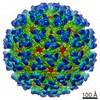 Eastern equine encephalitis virus
 Authors
 United States, 1 items
  Citation
 Structure visualization
 Downloads & links
 EMDB map data format
 emd_74158.png
 https://data.pdbj.org/pub/emdb/structures/EMD-74158
 Z (Sec.)
 Y (Row.)
 X (Col.)


 Sample components
 Processing
 Electron microscopy
 FIELD EMISSION GUN

