- EMDB-73803: Cryo-EM structure of human Wntless in complex with Wnt5a at 1:1 s... -
+
Open data
ID or keywords:
Loading...
-
Basic information
Entry
Database: EMDB / ID: EMD-73803
Title
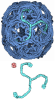
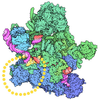
Cryo-EM structure of human Wntless in complex with Wnt5a at 1:1 stoichiometry
Map data
structure of human Wntless in complex with Wnt5a at 1:1 stoichiometry
Sample
Complex: human Wntless in complex with Wnt5a at 1:1 stoichiometry
Protein or peptide: Protein Wnt-5a
Protein or peptide: Protein wntless homolog
Ligand: PALMITOLEIC ACID
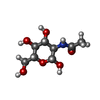
Ligand: 2-acetamido-2-deoxy-beta-D-glucopyranose
Ligand: 1,2-DIOLEOYL-SN-GLYCERO-3-PHOSPHOCHOLINE
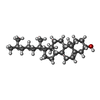
Ligand: CHOLESTEROL
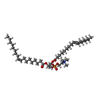
Ligand: 1-O-OCTADECYL-SN-GLYCERO-3-PHOSPHOCHOLINE
Keywords
Wnt transporter / Wnt5a / Wnt signaling / MEMBRANE PROTEIN
Function / homology
Function and homology information
optic cup formation involved in camera-type eye development / receptor tyrosine kinase-like orphan receptor binding / chemoattraction of serotonergic neuron axon / positive regulation of timing of anagen / negative regulation of cell proliferation in midbrain / primary heart field specification / chemorepulsion of dopaminergic neuron axon / postsynapse assembly / olfactory bulb interneuron development / positive regulation of protein kinase C activity ...optic cup formation involved in camera-type eye development / receptor tyrosine kinase-like orphan receptor binding / chemoattraction of serotonergic neuron axon / positive regulation of timing of anagen / negative regulation of cell proliferation in midbrain / primary heart field specification / chemorepulsion of dopaminergic neuron axon / postsynapse assembly / olfactory bulb interneuron development / positive regulation of protein kinase C activity / chemoattractant activity involved in axon guidance / melanocyte proliferation / negative regulation of mesenchymal cell proliferation / negative regulation of melanin biosynthetic process / Wnt signaling pathway, calcium modulating pathway / regulation of postsynaptic cytosolic calcium ion concentration / Wnt protein secretion / cementum mineralization / negative regulation of synapse assembly / macrophage derived foam cell differentiation / atrial septum development / positive regulation of Wnt protein secretion / secondary heart field specification / positive regulation of non-canonical Wnt signaling pathway / Negative regulation of TCF-dependent signaling by WNT ligand antagonists / WNT5A-dependent internalization of FZD2, FZD5 and ROR2 / WNT ligand biogenesis and trafficking / excitatory synapse assembly / anterior/posterior axis specification, embryo / embryonic skeletal system development / WNT5A-dependent internalization of FZD4 / positive regulation of macrophage cytokine production / face development / anterior/posterior axis specification / secondary palate development / exocrine pancreas development / positive regulation of neuron projection arborization / presynapse assembly / hindbrain development / positive regulation of T cell chemotaxis / genitalia development / ventricular septum development / non-canonical Wnt signaling pathway / Wnt-protein binding / WNT5:FZD7-mediated leishmania damping / lens development in camera-type eye / positive regulation of cytokine production involved in immune response / hematopoietic stem cell proliferation / positive regulation of response to cytokine stimulus / midbrain dopaminergic neuron differentiation / cartilage development / positive regulation of macrophage activation / mesoderm formation / positive regulation of ossification / positive regulation of type I interferon-mediated signaling pathway / PCP/CE pathway / Class B/2 (Secretin family receptors) / frizzled binding / regulation of postsynapse organization / inhibitory synapse assembly / Wnt signaling pathway, planar cell polarity pathway / regulation of canonical NF-kappaB signal transduction / negative regulation of fat cell differentiation / midbrain development / positive regulation of Rac protein signal transduction / positive regulation of protein localization to synapse / cell fate commitment / regulation of synapse organization / canonical Wnt signaling pathway / keratinocyte differentiation / epithelial to mesenchymal transition / cellular response to transforming growth factor beta stimulus / positive regulation of Wnt signaling pathway / postsynaptic modulation of chemical synaptic transmission / cellular response to retinoic acid / positive regulation of chemokine production / positive regulation of endothelial cell proliferation / endomembrane system / male gonad development / cellular response to calcium ion / positive regulation of apoptotic signaling pathway / positive regulation of endothelial cell migration / Wnt signaling pathway / axon guidance / positive regulation of fibroblast proliferation / cytokine activity / wound healing / positive regulation of interleukin-8 production / positive regulation of interleukin-1 beta production / positive regulation of neuron projection development / TCF dependent signaling in response to WNT / trans-Golgi network / clathrin-coated endocytic vesicle membrane / negative regulation of canonical Wnt signaling pathway / intracellular protein transport / Asymmetric localization of PCP proteins / cellular response to type II interferon / positive regulation of type II interferon production / phospholipid binding / positive regulation of interleukin-6 production Similarity search - Function
Protein wntless / : / : / Wntless-like, transmembrane domain / Wntless, GOLD domain / Wnt protein, conserved site / Wnt-1 family signature. / Wnt / Wnt, C-terminal domain / wnt family / found in Wnt-1 Similarity search - Domain/homology
National Institutes of Health/National Institute of General Medical Sciences (NIH/NIGMS)
R01GM150878
United States
Citation
Journal: Nat Commun / Year: 2026 Title: Conformational cycling of the Wntless transporter drives trafficking and secretion of Wnt morphogens. Authors: Yunhui Ge / Taciani de Almeida Magalhaes / Hongjiang Wu / Dick J H van den Boomen / Thu Uyen Nguyen / Tongyi Dou / Gaya P Yadav / Sukyeong Lee / Zhao Wang / Andrew Lemoff / Xuemei Luo / ...Authors: Yunhui Ge / Taciani de Almeida Magalhaes / Hongjiang Wu / Dick J H van den Boomen / Thu Uyen Nguyen / Tongyi Dou / Gaya P Yadav / Sukyeong Lee / Zhao Wang / Andrew Lemoff / Xuemei Luo / Sumitha S Menon / Min Zhang / Jin Wang / Zhicheng Jin / Jiansen Jiang / Adrian Salic / Pengxiang Huang / Abstract: Wnt proteins are lipid-modified morphogens fundamental in development and disease. During Wnt biogenesis, the G-protein-coupled receptor (GPCR)-like transporter Wntless (WLS) escorts lipidated Wnts ...Wnt proteins are lipid-modified morphogens fundamental in development and disease. During Wnt biogenesis, the G-protein-coupled receptor (GPCR)-like transporter Wntless (WLS) escorts lipidated Wnts from the endoplasmic reticulum to the plasma membrane, then transfers them to extracellular carriers, forming active and soluble morphogen-carrier complexes. To dissect the mechanisms involved, we solve cryo-EM structures of Wnt-bound WLS and unliganded WLS, and perform structure-guided functional experiments. Wnts engage WLS via three conserved hairpins, which are all required for Wnt trafficking to the cell surface and carrier-mediated secretion. Wnt release from cells is driven by dramatic conformational changes in the WLS transmembrane domain, reminiscent of GPCR activation, together with WLS extracellular rearrangements. Unexpectedly, we find that Wnt5a bound to WLS forms dimers, with implications for Wnt signaling. These findings define the mechanism of WLS conformational cycling that governs the intracellular transport and extracellular release of Wnt morphogens, essential steps in the Wnt pathway.
In the structure databanks used in Yorodumi, some data are registered as the other names, "COVID-19 virus" and "2019-nCoV". Here are the details of the virus and the list of structure data.
Jan 31, 2019. EMDB accession codes are about to change! (news from PDBe EMDB page)
EMDB accession codes are about to change! (news from PDBe EMDB page)
The allocation of 4 digits for EMDB accession codes will soon come to an end. Whilst these codes will remain in use, new EMDB accession codes will include an additional digit and will expand incrementally as the available range of codes is exhausted. The current 4-digit format prefixed with “EMD-” (i.e. EMD-XXXX) will advance to a 5-digit format (i.e. EMD-XXXXX), and so on. It is currently estimated that the 4-digit codes will be depleted around Spring 2019, at which point the 5-digit format will come into force.
The EM Navigator/Yorodumi systems omit the EMD- prefix.
Related info.:Q: What is EMD? / ID/Accession-code notation in Yorodumi/EM Navigator
Yorodumi is a browser for structure data from EMDB, PDB, SASBDB, etc.
This page is also the successor to EM Navigator detail page, and also detail information page/front-end page for Omokage search.
The word "yorodu" (or yorozu) is an old Japanese word meaning "ten thousand". "mi" (miru) is to see.
Related info.:EMDB / PDB / SASBDB / Comparison of 3 databanks / Yorodumi Search / Aug 31, 2016. New EM Navigator & Yorodumi / Yorodumi Papers / Jmol/JSmol / Function and homology information / Changes in new EM Navigator and Yorodumi
 Movie
Movie Controller

 Yorodumi
 Open data
 Basic information
 Map data
 Sample
 Keywords
 Function and homology information
 Homo sapiens (human)
 Authors
 United States, 1 items
  Citation
 Structure visualization
 Downloads & links
 emd_73803.png
 https://data.pdbj.org/pub/emdb/structures/EMD-73803





 Z (Sec.)
 Y (Row.)
 X (Col.)


 Sample components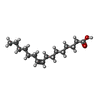

 Processing
 Electron microscopy
 FIELD EMISSION GUN

