National Institutes of Health/National Institute of General Medical Sciences (NIH/NIGMS)
United States
Citation
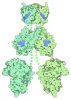
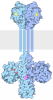
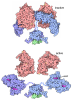
Journal: Commun Chem / Year: 2026 Title: A bacteriophytochrome Pr/Pfr heterodimer studied through single-particle time-resolved cryo-electron microscopy. Authors: Prabin Karki / William C Budell / Rohit Kannachel / David Menendez / Carolina Hernandez / Joshua H Mendez / Shemiran Kanou / Manjeet Singh / Chavdar Slavov / Peter Schwander / Tek Narsingh ...Authors: Prabin Karki / William C Budell / Rohit Kannachel / David Menendez / Carolina Hernandez / Joshua H Mendez / Shemiran Kanou / Manjeet Singh / Chavdar Slavov / Peter Schwander / Tek Narsingh Malla / Emina A Stojković / Marius Schmidt / Abstract: Phytochromes are dimeric photoreceptors found in bacteria, fungi, and plants that reversibly interconvert between a red-absorbing Pr state and a far-red-absorbing Pfr state. In bacteria, phytochromes ...Phytochromes are dimeric photoreceptors found in bacteria, fungi, and plants that reversibly interconvert between a red-absorbing Pr state and a far-red-absorbing Pfr state. In bacteria, phytochromes (BphPs) regulate diverse responses through a two-component signaling pathway comprising a C-terminal histidine kinase (HK) and a response regulator. A previous cryo-EM study of the wild-type BphP from Stigmatella aurantiaca (SaBphP2) revealed a stable Pr/Pfr heterodimer in which the two protomers adopt distinct Pr and Pfr conformations. Here, using the Spotiton technique, we captured the same heterodimer by illuminating SaBphP2 particles on the cryo-EM grid and vitrifying them 10 ms later. Comparison with the Pr/Pr homodimer reveals a 180° rotation of the HK domain, driven by an unwinding of the coiled-coil helices that connect the photosensory core to the enzymatic domain. The large-scale reorientations provide mechanistic insight into light-triggered signal transduction mediated by bacterial phytochromes.
In the structure databanks used in Yorodumi, some data are registered as the other names, "COVID-19 virus" and "2019-nCoV". Here are the details of the virus and the list of structure data.
Jan 31, 2019. EMDB accession codes are about to change! (news from PDBe EMDB page)
EMDB accession codes are about to change! (news from PDBe EMDB page)
The allocation of 4 digits for EMDB accession codes will soon come to an end. Whilst these codes will remain in use, new EMDB accession codes will include an additional digit and will expand incrementally as the available range of codes is exhausted. The current 4-digit format prefixed with “EMD-” (i.e. EMD-XXXX) will advance to a 5-digit format (i.e. EMD-XXXXX), and so on. It is currently estimated that the 4-digit codes will be depleted around Spring 2019, at which point the 5-digit format will come into force.
The EM Navigator/Yorodumi systems omit the EMD- prefix.
Related info.:Q: What is EMD? / ID/Accession-code notation in Yorodumi/EM Navigator
Yorodumi is a browser for structure data from EMDB, PDB, SASBDB, etc.
This page is also the successor to EM Navigator detail page, and also detail information page/front-end page for Omokage search.
The word "yorodu" (or yorozu) is an old Japanese word meaning "ten thousand". "mi" (miru) is to see.
Related info.:EMDB / PDB / SASBDB / Comparison of 3 databanks / Yorodumi Search / Aug 31, 2016. New EM Navigator & Yorodumi / Yorodumi Papers / Jmol/JSmol / Function and homology information / Changes in new EM Navigator and Yorodumi
 Movie
Movie Controller

 Yorodumi
 Open data
 Basic information
 Map data
 Sample
 Keywords
 Function and homology information
 Stigmatella aurantiaca (bacteria)
 Authors
 United States, 3 items
  Citation
 Structure visualization
 Downloads & links
 emd_73612.png
 http://ftp.pdbj.org/pub/emdb/structures/EMD-73612


 Z (Sec.)
 Y (Row.)
 X (Col.)


 Sample components
 Escherichia coli (E. coli)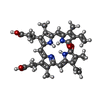
 Processing
 Electron microscopy
 FIELD EMISSION GUN

