 Movie
Movie Controller

[English] 日本語
 Yorodumi
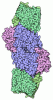
- EMDB-73407: Negative stained A. vinelandii NifEN/NifH ADPxAIF4- stabilized complex -
+ Open data

- Basic information
| Entry |  | ||||||||||||
|---|---|---|---|---|---|---|---|---|---|---|---|---|---|
| Title | Negative stained A. vinelandii NifEN/NifH ADPxAIF4- stabilized complex | ||||||||||||
 Map data Map data | |||||||||||||
 Sample Sample |
| ||||||||||||
 Keywords Keywords | Nitrogenase / Complex / Metal cluster / OXIDOREDUCTASE | ||||||||||||
| Function / homology |  Function and homology information Function and homology informationnitrogenase / nitrogenase activity / protein-containing complex assembly / ATP binding Similarity search - Function | ||||||||||||
| Biological species |  Azotobacter vinelandii DJ (bacteria) Azotobacter vinelandii DJ (bacteria) | ||||||||||||
| Method | single particle reconstruction / negative staining / Resolution: 14.8 Å | ||||||||||||
 Authors Authors | Neumann B / Brandon K / Hu Y / Ribbe MW / Gonen S | ||||||||||||
| Funding support |  United States, 3 items United States, 3 items
| ||||||||||||
 Citation Citation | Journal: Nat Catal / Year: 2026 Title: Structural insights into metallocluster trafficking in the nitrogenase assembly scaffold NifEN. Authors: Bryan Neumann / Kristal A Brandon / Robert Quechol / Diana S Suder / Chi Chung Lee / Yimo Yang / Kamil Górecki / Jared A Wiig / Yilin Hu / Shane Gonen / Markus W Ribbe / Abstract: Nitrogenase catalyses small-molecule activation, and has great relevance to agronomy, environment and energy. Understanding the assembly of the complex nitrogenase cofactor is a decades-long goal in ...Nitrogenase catalyses small-molecule activation, and has great relevance to agronomy, environment and energy. Understanding the assembly of the complex nitrogenase cofactor is a decades-long goal in the field, and structural insights into this process remain scarce. Here we report a cryogenic electron microscopy (cryo-EM) study of heterologously expressed NifEN, a key player converting the precursor (L-cluster) to a mature cofactor (M-cluster). Structural analyses of apo- and holo-NifEN demonstrate major conformational changes triggered by L-cluster incorporation. Further examinations of NifEN structures with inwardly and outwardly bound L-clusters, coupled with supporting mutational studies, AlphaFold 3 predictions and negative-stain EM analyses of NifEN complexed with upstream (NifB) and downstream (NifH) assembly partners, reveal a tunnel linking NifEN with NifB and NifH, with NifEN serving as a dynamic hub that coordinates L-cluster reception, maturation and delivery via conformation-gated metallocluster trafficking. | ||||||||||||
| History |
|
- Structure visualization
| Supplemental images |
|---|

- Downloads & links
-EMDB archive
| Map data | emd_73407.map.gz | 60.6 MB | EMDB map data format | |
|---|---|---|---|---|
| Header (meta data) | emd-73407-v30.xmlemd-73407.xml | 18.7 KB 18.7 KB | Display Display | EMDB header |
| Images |  emd_73407.png emd_73407.png | 45.8 KB | ||
| Masks | emd_73407_msk_1.map | 125 MB | Mask map | |
| Filedesc metadata | emd-73407.cif.gz | 5.9 KB | ||
| Others | emd_73407_half_map_1.map.gzemd_73407_half_map_2.map.gz | 115.7 MB 115.7 MB | ||
| Archive directory |  https://data.pdbj.org/pub/emdb/structures/EMD-73407ftp://data.pdbj.org/pub/emdb/structures/EMD-73407 https://data.pdbj.org/pub/emdb/structures/EMD-73407ftp://data.pdbj.org/pub/emdb/structures/EMD-73407 | HTTPS FTP |
-Related structure data


-Links
| EMDB pages | EMDB (EBI/PDBe) / EMDataResource |
|---|---|
| Related items in Molecule of the Month |
-Map
| File | Download / File: emd_73407.map.gz / Format: CCP4 / Size: 125 MB / Type: IMAGE STORED AS FLOATING POINT NUMBER (4 BYTES) | ||||||||||||||||||||||||||||||||||||
|---|---|---|---|---|---|---|---|---|---|---|---|---|---|---|---|---|---|---|---|---|---|---|---|---|---|---|---|---|---|---|---|---|---|---|---|---|---|
| Projections & slices | Image control
Images are generated by Spider. | ||||||||||||||||||||||||||||||||||||
| Voxel size | X=Y=Z: 1.14678 Å | ||||||||||||||||||||||||||||||||||||
| Density |
| ||||||||||||||||||||||||||||||||||||
| Symmetry | Space group: 1 | ||||||||||||||||||||||||||||||||||||
| Details | EMDB XML:
|
 Z (Sec.)
 Y (Row.)
 X (Col.)


-Supplemental data
-Mask #1
| File | emd_73407_msk_1.map | ||||||||||||
|---|---|---|---|---|---|---|---|---|---|---|---|---|---|
| Projections & Slices |
| ||||||||||||
| Density Histograms |


-Half map: #1
| File | emd_73407_half_map_1.map | ||||||||||||
|---|---|---|---|---|---|---|---|---|---|---|---|---|---|
| Projections & Slices |
| ||||||||||||
| Density Histograms |


-Half map: #2
| File | emd_73407_half_map_2.map | ||||||||||||
|---|---|---|---|---|---|---|---|---|---|---|---|---|---|
| Projections & Slices |
| ||||||||||||
| Density Histograms |


- Sample components
-Entire : NifEN/NifH ADPxAIF4- stabilized complex
| Entire | Name: NifEN/NifH ADPxAIF4- stabilized complex |
|---|---|
| Components |
|
-Supramolecule #1: NifEN/NifH ADPxAIF4- stabilized complex
| Supramolecule | Name: NifEN/NifH ADPxAIF4- stabilized complex / type: complex / ID: 1 / Parent: 0 / Macromolecule list: all |
|---|---|
| Source (natural) | Organism: Azotobacter vinelandii DJ (bacteria) |
| Molecular weight | Theoretical: 330 KDa |
-Macromolecule #1: Nitrogenase iron-molybdenum cofactor biosynthesis protein NifE
| Macromolecule | Name: Nitrogenase iron-molybdenum cofactor biosynthesis protein NifE type: protein_or_peptide / ID: 1 / Enantiomer: LEVO |
|---|---|
| Source (natural) | Organism: Azotobacter vinelandii DJ (bacteria) |
| Sequence | String: MKAKDIAELL DEPACSHNKK EKSGCAKPKP GATDGGCSFD GAQIALLPVA DVAHIVHGPI ACAGSSWDN RGTRSSGPDL YRIGMTTDLT ENDVIMGRAE KRLFHAIRQA VESYSPPAVF V YNTCVPAL IGDDVDAVCK AAAERFGTPV IPVDSAGFYG TKNLGNRIAG ...String: MKAKDIAELL DEPACSHNKK EKSGCAKPKP GATDGGCSFD GAQIALLPVA DVAHIVHGPI ACAGSSWDN RGTRSSGPDL YRIGMTTDLT ENDVIMGRAE KRLFHAIRQA VESYSPPAVF V YNTCVPAL IGDDVDAVCK AAAERFGTPV IPVDSAGFYG TKNLGNRIAG EAMLKYVIGT RE PDPLPVG SERPGIRVHD VNLIGEYNIA GEFWHVLPLL DELGLRVLCT LAGDARYREV QTM HRAEVN MMVCSKAMLN VARKLQETYG TPWFEGSFYG ITDTSQALRD FARLLDDPDL TART EALIA REEAKVRAAL EPWRARLEGK RVLLYTGGVK SWSVVSALQD LGMKVVATGT KKSTE EDKA RIRELMGDDV KMLDEGNARV LLKTVDEYQA DILIAGGRNM YTALKGRVPF LDINQE REF GYAGYDGMLE LVRQLCITLE CPVWEAVRRP APWDIPASQD AAPSAPARSA NA UniProtKB: Nitrogenase iron-molybdenum cofactor biosynthesis protein NifE |
-Macromolecule #2: Nitrogenase iron-molybdenum cofactor biosynthesis protein NifN
| Macromolecule | Name: Nitrogenase iron-molybdenum cofactor biosynthesis protein NifN type: protein_or_peptide / ID: 2 / Enantiomer: LEVO |
|---|---|
| Source (natural) | Organism: Azotobacter vinelandii DJ (bacteria) |
| Sequence | String: MAEIINRNKA LAVSPLKASQ TMGAALAILG LARSMPLFHG SQGCTAFAKV FFVRHFREPV PLQTTAMDQ VSSVMGADEN VVEALKTICE RQNPSVIGLL TTGLSETQGC DLHTALHEFR T QYEEYKDV PIVPVNTPDF SGCFESGFAA AVKAIVETLV PERRDQVGKR ...String: MAEIINRNKA LAVSPLKASQ TMGAALAILG LARSMPLFHG SQGCTAFAKV FFVRHFREPV PLQTTAMDQ VSSVMGADEN VVEALKTICE RQNPSVIGLL TTGLSETQGC DLHTALHEFR T QYEEYKDV PIVPVNTPDF SGCFESGFAA AVKAIVETLV PERRDQVGKR PRQVNVLCSA NL TPGDLEY IAESIESFGL RPLLIPDLSG SLDGHLDENR FNALTTGGLS VAELATAGQS VAT LVVGQS LAGAADALAE RTGVPDRRFG MLYGLDAVDA WLMALAEISG NPVPDRYKRQ RAQL QDAML DTHFMLSSAR TAIAADPDLL LGFDALLRSM GAHTVAAVVP ARAAALVDSP LPSVR VGDL EDLEHAARAG QAQLVIGNSH ALASARRLGV PLLRAGFPQY DLLGGFQRCW SGYRGS SQV LFDLANLLVE HHQGIQPYHS IYAQKPATEQ PQWRH UniProtKB: Nitrogenase iron-molybdenum cofactor biosynthesis protein NifN |
-Macromolecule #3: Nitrogenase iron protein
| Macromolecule | Name: Nitrogenase iron protein / type: protein_or_peptide / ID: 3 / Enantiomer: LEVO |
|---|---|
| Source (natural) | Organism: Azotobacter vinelandii DJ (bacteria) |
| Sequence | String: MAMRQCAIYG KGGIGKSTTT QNLVAALAEM GKKVMIVGCD PKADSTRLIL HSKAQNTIME MAAEAGTVE DLELEDVLKA GYGGVKCVES GGPEPGVGCA GRGVITAINF LEEEGAYEDD L DFVFYDVL GDVVCGGFAM PIRENKAQEI YIVCSGEMMA MYAANNISKG ...String: MAMRQCAIYG KGGIGKSTTT QNLVAALAEM GKKVMIVGCD PKADSTRLIL HSKAQNTIME MAAEAGTVE DLELEDVLKA GYGGVKCVES GGPEPGVGCA GRGVITAINF LEEEGAYEDD L DFVFYDVL GDVVCGGFAM PIRENKAQEI YIVCSGEMMA MYAANNISKG IVKYANSGSV RL GGLICNS RNTDREDELI IALANKLGTQ MIHFVPRDNV VQRAEIRRMT VIEYDPKAKQ ADE YRALAR KVVDNKLLVI PNPITMDELE ELLMEFGIME VEDESIVGKT AEEV UniProtKB: Nitrogenase iron protein |
-Experimental details
-Structure determination
| Method | negative staining |
|---|---|
 Processing Processing | single particle reconstruction |
| Aggregation state | particle |
-Sample preparation
| Concentration | 0.1 mg/mL |
|---|---|
| Buffer | pH: 8 |
| Staining | Type: NEGATIVE / Material: uranyl formate |
| Grid | Model: EMS Formvar Carbon / Material: COPPER / Mesh: 400 / Pretreatment - Type: GLOW DISCHARGE / Pretreatment - Time: 45 sec. / Pretreatment - Atmosphere: AIR |
- Electron microscopy
| Microscope | JEOL 2100F |
|---|---|
| Image recording | Film or detector model: OTHER / Average electron dose: 1.0 e/Å2 |
| Electron beam | Acceleration voltage: 200 kV / Electron source:  FIELD EMISSION GUN FIELD EMISSION GUN |
| Electron optics | Illumination mode: FLOOD BEAM / Imaging mode: BRIGHT FIELD / Nominal defocus max: 1.5 µm / Nominal defocus min: 1.0 µm |
