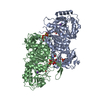
Journal: ACS Cent Sci / Year: 2026 Title: An Antifungal with a Novel Mechanism of Action Discovered via Resistance Gene-Guided Genome Mining. Authors: Bruno Perlatti / Sandeep Vellanki / Yalong Zhang / Yi-Ming Chiang / Yingxia Hu / Mengdi Yuan / Kyle Dunbar / Abigail Fine / Michelle F Grau / Sheena Li / Timothy O'Donnell / Rajani Shenoy / ...Authors: Bruno Perlatti / Sandeep Vellanki / Yalong Zhang / Yi-Ming Chiang / Yingxia Hu / Mengdi Yuan / Kyle Dunbar / Abigail Fine / Michelle F Grau / Sheena Li / Timothy O'Donnell / Rajani Shenoy / Hongtao Li / Hui Shi / Xia Xu / Zeyu Chen / Tara Arvedson / Yi Tang / Robert A Cramer / Victor Cee / Colin J B Harvey / Abstract: Invasive fungal infections claim over two million lives annually, a problem exacerbated by rising resistance to current antifungal treatments and an increasing population of immunocompromised ...Invasive fungal infections claim over two million lives annually, a problem exacerbated by rising resistance to current antifungal treatments and an increasing population of immunocompromised individuals. Despite this, antifungal drug development has stagnated, with few novel agents and fewer novel targets explored in recent decades. Here, we validate acetolactate synthase (ALS), an enzyme critical for branched-chain amino acid biosynthesis and absent in humans, as a promising target for new therapeutics. Using resistance gene-guided genome mining, we discovered a biosynthetic gene cluster in encoding HB-35018 (1), a novel spiro-cis-decalin tetramic acid that potently inhibits ALS. Biochemical and antifungal assays demonstrate that surpasses existing ALS inhibitors in efficacy against and other pathogenic fungi. Structural studies via cryo-electron microscopy reveal a unique covalent binding interaction between compound and ALS, distinct from known inhibitors, and finally, we demonstrate that ALS is essential for virulence in a mouse model of invasive aspergillosis. These findings position ALS as a promising target for antifungal development and demonstrate the potential of resistance gene-guided genome mining for antifungal discovery.
In the structure databanks used in Yorodumi, some data are registered as the other names, "COVID-19 virus" and "2019-nCoV". Here are the details of the virus and the list of structure data.
Jan 31, 2019. EMDB accession codes are about to change! (news from PDBe EMDB page)
EMDB accession codes are about to change! (news from PDBe EMDB page)
The allocation of 4 digits for EMDB accession codes will soon come to an end. Whilst these codes will remain in use, new EMDB accession codes will include an additional digit and will expand incrementally as the available range of codes is exhausted. The current 4-digit format prefixed with “EMD-” (i.e. EMD-XXXX) will advance to a 5-digit format (i.e. EMD-XXXXX), and so on. It is currently estimated that the 4-digit codes will be depleted around Spring 2019, at which point the 5-digit format will come into force.
The EM Navigator/Yorodumi systems omit the EMD- prefix.
Related info.:Q: What is EMD? / ID/Accession-code notation in Yorodumi/EM Navigator
Yorodumi is a browser for structure data from EMDB, PDB, SASBDB, etc.
This page is also the successor to EM Navigator detail page, and also detail information page/front-end page for Omokage search.
The word "yorodu" (or yorozu) is an old Japanese word meaning "ten thousand". "mi" (miru) is to see.
Related info.:EMDB / PDB / SASBDB / Comparison of 3 databanks / Yorodumi Search / Aug 31, 2016. New EM Navigator & Yorodumi / Yorodumi Papers / Jmol/JSmol / Function and homology information / Changes in new EM Navigator and Yorodumi
 Movie
Movie Controller

 Yorodumi
 Open data
 Basic information
 Map data
 Sample
 Keywords
 Function and homology information
 Aspergillus fumigatus (mold)
 Authors
 Citation

 Structure visualization
 Downloads & links
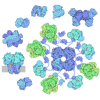
 emd_73040.png
 https://data.pdbj.org/pub/emdb/structures/EMD-73040


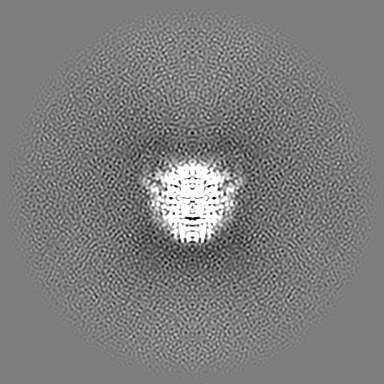
 Z (Sec.)
 Y (Row.)
 X (Col.)




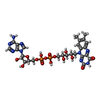
 Sample components
 Escherichia coli (E. coli)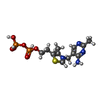
 Processing
 Electron microscopy
 FIELD EMISSION GUN