National Institutes of Health/National Heart, Lung, and Blood Institute (NIH/NHLBI)
R01HL153219
United States
National Institutes of Health/National Institute of Neurological Disorders and Stroke (NIH/NINDS)
R01NS112363
United States
National Institutes of Health/National Institute of Neurological Disorders and Stroke (NIH/NINDS)
R01NS111031
United States
National Institutes of Health/National Institute of Neurological Disorders and Stroke (NIH/NINDS)
R01NS129804
United States
Citation
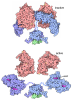
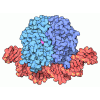
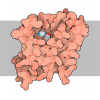
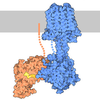
Journal: Cell / Year: 2026 Title: Dynamic dimer-of-dimers architecture defines Mg transport in human CNNM4. Authors: Zhiyong Bai / X Edward Zhou / Wei Lü / Juan Du / Abstract: Mg is essential for all living organisms, yet its transport across mammalian membranes remains poorly understood. Here, we present cryoelectron microscopy (cryo-EM) structures of a full-length ...Mg is essential for all living organisms, yet its transport across mammalian membranes remains poorly understood. Here, we present cryoelectron microscopy (cryo-EM) structures of a full-length mammalian Mg transporter on the plasma membrane, human CNNM4, in outward-facing and occluded states, revealing an unexpected tetrameric assembly organized as a dimer of asymmetric dimers-distinct from the symmetric dimers in prokaryotic homologs and long assumed for eukaryotic CNNMs. We show that Mg/ATP binding stabilizes the dynamic intracellular domains and promotes tetramerization, while an acidic patch binds additional Mg, potentially acting as a sensor to couple cytoplasmic Mg levels to transport activity. Within the transmembrane domain, a key glutamate flips upon Na binding and destabilizes the Mg-binding site in the outward-facing state, thereby promoting Mg/Na exchange. Together, these findings establish a mechanistic framework for CNNM transport and regulation that diverges from prokaryotic models and links CNNM function to human physiology and disease.
In the structure databanks used in Yorodumi, some data are registered as the other names, "COVID-19 virus" and "2019-nCoV". Here are the details of the virus and the list of structure data.
Jan 31, 2019. EMDB accession codes are about to change! (news from PDBe EMDB page)
EMDB accession codes are about to change! (news from PDBe EMDB page)
The allocation of 4 digits for EMDB accession codes will soon come to an end. Whilst these codes will remain in use, new EMDB accession codes will include an additional digit and will expand incrementally as the available range of codes is exhausted. The current 4-digit format prefixed with “EMD-” (i.e. EMD-XXXX) will advance to a 5-digit format (i.e. EMD-XXXXX), and so on. It is currently estimated that the 4-digit codes will be depleted around Spring 2019, at which point the 5-digit format will come into force.
The EM Navigator/Yorodumi systems omit the EMD- prefix.
Related info.:Q: What is EMD? / ID/Accession-code notation in Yorodumi/EM Navigator
Yorodumi is a browser for structure data from EMDB, PDB, SASBDB, etc.
This page is also the successor to EM Navigator detail page, and also detail information page/front-end page for Omokage search.
The word "yorodu" (or yorozu) is an old Japanese word meaning "ten thousand". "mi" (miru) is to see.
Related info.:EMDB / PDB / SASBDB / Comparison of 3 databanks / Yorodumi Search / Aug 31, 2016. New EM Navigator & Yorodumi / Yorodumi Papers / Jmol/JSmol / Function and homology information / Changes in new EM Navigator and Yorodumi
 Movie
Movie Controller

 Yorodumi
 Open data
 Basic information
 Map data
 Sample
 Keywords
 Function and homology information
 Homo sapiens (human)
 Authors
 United States, 4 items
  Citation
 Structure visualization
 Downloads & links
 emd_72697.png
 https://data.pdbj.org/pub/emdb/structures/EMD-72697


 Z (Sec.)
 Y (Row.)
 X (Col.)


 Sample components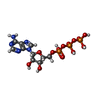
 Processing
 Electron microscopy
 FIELD EMISSION GUN
